
2009_CourseGuide_高级装配
- 格式:ppt
- 大小:619.00 KB
- 文档页数:21

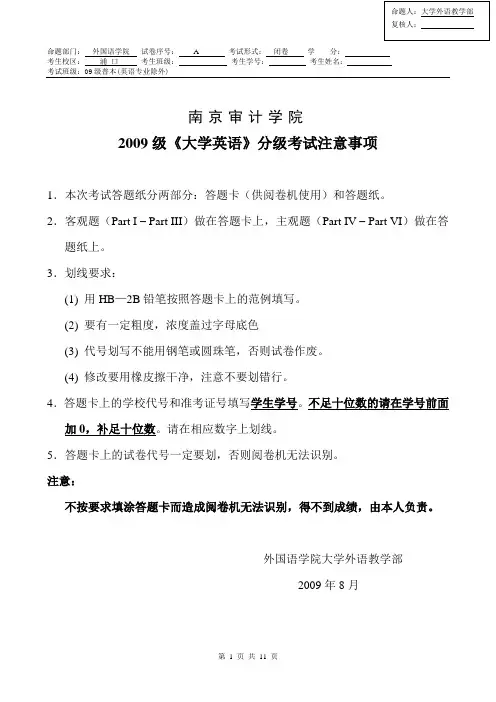
命题部门:外国语学院试卷序号: A 考试形式:闭卷学分:考生校区:浦口考生班级:考生学号:考生姓名:考试班级:09级普本(英语专业除外)南京审计学院2009级《大学英语》分级考试注意事项1.本次考试答题纸分两部分:答题卡(供阅卷机使用)和答题纸。
2.客观题(Part I – Part III)做在答题卡上,主观题(Part IV – Part VI)做在答题纸上。
3.划线要求:(1) 用HB—2B铅笔按照答题卡上的范例填写。
(2) 要有一定粗度,浓度盖过字母底色(3) 代号划写不能用钢笔或圆珠笔,否则试卷作废。
(4) 修改要用橡皮擦干净,注意不要划错行。
4.答题卡上的学校代号和准考证号填写学生学号。
不足十位数的请在学号前面加0,补足十位数。
请在相应数字上划线。
5.答题卡上的试卷代号一定要划,否则阅卷机无法识别。
注意:不按要求填涂答题卡而造成阅卷机无法识别,得不到成绩,由本人负责。
外国语学院大学外语教学部2009年8月2009级《大学英语》分级考试试卷Part I. Reading Comprehension (40%)Directions:Read the following passages and choose the best answer to each of the questions or incomplete statements following the passage. You must read the four choicesmarked A, B, C and D, and decide which is the best answer. Then mark thecorresponding letter on the Answer Sheet with a single line through the center.(2’×20)Passage 1Questions 1 to 5 are based on the following passage.It has been a widespread belief that the American family is dying. But a new study reveals that the American family is stronger than ever. This study affords surprising evidence of the persistence of American commitments to family life.The American family is changing, not dying. It is becoming smaller, men and women are becoming more equal, and the divorce rate is higher. But despite the high divorce rate, marriage has never been more popular. The majority of divorced people remarry, but only 2% marry more than twice. Most marriages last a long time, and a large proportion of divorces are from teenage marriages. Depending on the specific situation, there’s often good reason for teenage marriages to break up.There is no evidence that children receive less attention from mothers who work outside the home than from mothers working inside the home. So far the amount of educational or development time hasn’t varied very much, whether or not the mother works outside the home. In fact, working mothers try to make up for it by setting aside time only for their children.The study shows that television is by far the most significant new childcare arrangement of this century. The most important activity for children up to age 14 is watching television.School is the second most time-consuming activity for children. They spend an average of about 19 hours a week in school. A larger proportion of children go to school earlier than ever before, and they stay in school longer. Another big change is that the proportion of very young children in daycare centers (日托站) has almost doubled in recent years. Compared with these two dramatic changes in child activity, the changes caused by mothers working outside the home appear very small.1 The main idea of this article is that _______.A. the American family is dyingB. young people today don’t want to get marriedC. the American family is changing, but it is stronger than everD. education has resulted in dramatic changes in the American family2 Which of the following statements is NOT true?A. Marriage is more popular than before.B. Many divorced people remarry.C. The majority of marriages last long.D. Working mothers devote less time to their children.3 The author of this article believes that ________.A. the American family is here to stayB. children should not watch so much televisionC. mothers should not work when their children are smallD. teenage marriages should be encouraged4 What is the most significant new childcare arrangement of this century?A. The daycare center.B. Television.C. The school.D. Development time.5 According to the writer, which two major factors have led to the belief that the Americanfamily is dying?A. The divorce rate is high and working mothers neglect their children.B. The divorce rate is high and children care more about television than anything else.C. Divorces are increasing and many teenage marriages break up.D. Children stay in school longer and mothers have little time to take care of them. Passage 2Questions 6 to 10 are based on the following passage.What you give your relatives, friends, husband, or wife can help you know yourself better. Also, what they give you can tell you something about their personality. Most gift-giving (and getting) shows nothing more than the spirit of love and friendship. But it is possible to form some associations between the kinds of things bought and the people who buy them. Here is a guide to who gives you wha t --- and why.The clothes you wear tell something about your personality. They tell the world not only how you want to be seen but how you see yourself as well. When someone gives you something to wear that agrees with your self-image, they’re saying, “I agree with you. I like you the way you are.” Such a gift should be taken as a form of compliment. On the other hand, a gift of clothing that does not match your personality could be an insult to your character.Making something by hand has become the exception in many countries toda y-so much so that giving a homemade gift is sometimes considered unusual. If you receive a homemade gift, you’re lucky. It may not be made perfectly, but it will show a certain quality of love. People who give homemade gifts may be said to be very generous. They are given time and emotion, two important characteristics of being creative.A person who thinks of food when thinking of a gift is good example of what human warmth means. Whether you give a box of chocolates, a bag of oranges, or a ball of cheese, all carry the same message of comfort and support.People who give books as gifts either like reading or would like everyone to think they do. If you happen to receive a large, heavy book, this giver may be much more interested in the way things appear than in the way they actually are. Of course, reading is a way of feeling the emotions of another person and of learning new things. Giving a book can be a way of sharing a feeling or a newly learned meaning. The giver is probably trying to say to you what the book said to him.6 The first paragraph is written to tell readers that ________.A. the gifts you give can help you understand yourself betterB. the gifts you receive are helpful for you to know the personality of those who give themC. gifts can show friendship and loveD. there is a certain relationship between the kinds of gifts and the people who give them7 A person who likes the self-image of another person will give the latter ________.A. clothesB. a homemade giftC. a gift that agrees with the personality of the receiverD. a gift that matches the character of the giver8 Which of the following statements is NOT true according to the passage?A. What you wear can tell something about your personality.B. Homemade gifts are not welcomed in some countries.C. People who give books as gifts either like reading or would like everyone to think they do.D. Reading books given to you as gifts can be a way of sharing a feeling with the giver.9 If you give a large, heavy book as a gift, it may show that _________.A. you are knowledgeableB. the receiver is interested in readingC. you dislike readingD. you are more interested in the appearance of the book than in its contents10 People who want to show their love towards others often give _______.A. homemade giftsB. delicious foodC. expensive clothesD. interesting booksPassage 3Questions 11 to 15 are based on the following passage.My love of nature goes right back to my childhood, to the times when I stayed on my grandparent’s farm in Suffolk. I think it was my grandmother who encouraged me more than anyone: she taught me the names of wildflowers and got me interested in looking at the countryside, so it seemed obvious to go on to do zoology at university.I did n’t get my first camera until after I’d graduated, when I was due to go diving in Norway and needed a method of recording the sea creatures I would find there. My father didn’t know anything about photography, but he bought me an Exacta, which was really quite a good camera for the time, and I went off to take my first pictures of sea starfish. I became keen very quickly, and I learnt how to develop and print.I’ve tried from the beginning to produce pictures which are always biologically correct. There ar e people who will alter things deliberately: you don’t pick up sea creatures from the middle of the shore and take them down to attractive pools at the bottom of the shore without knowing you’re doing it.There can be a lot of ignorance in people’s behavior towards wild animals and it’s a problem that more and more people are going to wild places: while some animals may get used to cars, they won’t get used to people suddenly rushing up to them. The sheer pressure of people, coupled with the fact that there are increasingly few places where no one else has photographed, means that over the years, life has become much more difficult for the professional wildlife photographers.Nevertheless, wildlife photographers play a very important part in educating people about what is out there and what needs conserving. Although photography can be an enjoyable pastime, as it is to many people, it is also something that plays a very important part in educating young and old alike.11 The author decided to go to university and study zoology because _______________.A. she wanted to improve her life in the countrysideB. she was persuaded to do so by her grandmotherC. she was keen on the natural worldD. she wanted to stop moving around all the time12 How is the author different from some of the other wildlife photographers she meets?A. She tries to make her photographs as attractive as possible.B. She takes photographs which record accurate natural conditions.C. She likes to photograph plants as well as wildlife.D. She knows the best places to find wildlife.13 The author now finds it more difficult to photograph wild animals because ______________.A. there are fewer of themB. they have become more nervous of peopleC. it is harder to find suitable placesD. they have become frightened of cars14 According to the author, wildlife photography is important because it can make people realizethat ___________________.A. photography is an enjoyable hobbyB. we learn little about wildlife at schoolC. it is worthwhile visiting the countrysideD. it is important to look after wild animals15 Which of the following describes the author?A. Proud.B. Sensitive.C. Aggressive.D. Disappointed.Passage 4Questions 16 to 20 are based on the following passage.If you have been joining in chat room conversations, or trading e-mail with net pals, you have become one of the millions who write in a special, short form of English.Throughout the world, every night children and their elders are “talking”onlin e-many ofthem are talking at the same time.It is fast: trying talking to six people at once. It is convenient: three or four words per exchange. It takes cleverness, concentration and quick fingers.And it requires very simple language. There’s neither time nor space for explanations. Why waste precious key-strokes telling six friends you have to leave for a moment to take care of your little brother when BRB(= be right back) will do?Want to enter a conversation? Just type PMFJI (= pardon me for jumping in).Interested in whom you’re talking to? Type A/S/L, the common request to know your pal’s age, sex and location. You may get 15/M/NY as a reply from your pal.If something makes you laugh, say you’re OTF (= on the floor), or LOL (= laughing out loud), or join the two into ROTFL (= rolling on the floor laughing).And when it’s time to get back to work or go to bed, you type GTG (= got to go) or TTYL (= talk to you later).People want to write as fast as possible, and they want to get their ideas across as quickly as they can. Capital letters are left in the dust, except when expressing feelings, as it takes more time to hold down the “shift” key and use capitals. Punctuation is going, too.16 When people are online, they talk by_____.A. using body language.B. drawing some strange picturesC. making phone callsD. making use of an especially short form of English17 Internet makes many people in the world ______.A. talk at the same timeB. discover their friends and relativesC. pick out good things to buyD. find out about some problems in society18 The underlined sentence “There’s neither time nor space for explanation”(L.1, para. 4)means that _____.A. people should use words properlyB. people should know what time it is when they are talkingC. people online have to express themselves in a simple wayD. people should communicate in a funny way19 If you get 19/M/HK as an answer to your A/S/L, it means ______.A. the person who is talking to you is 19 from Hong Kong and he is highB. you are talking to a boy 19 years old and he lives in Hong KongC. you are talking to 19 boys from Hong Kong at the same timeD. the boy from Hong Kong has been online for 19 minutes20 Which of the following is a way to save online time?A. People seldom use capital letters or punctuation marks.B. Many people draw pictures.C. People only use the mouse instead of the keyboard.D. People never use the “shift” key.Part II. Vocabulary and Structure (15%)Directions:There are 30 incomplete sentences in this part. For each sentence there are four choices marked A, B, C and D. Choose the ONE that best completes the sentence.Then mark the corresponding letter on the Answer Sheet with a single linethrough the center. (0.5’×30)21 My sponsor ______ me __________ money when I lost my job.A. worked … out by C. kept… out withB. helped … out with D. carried… out for22 ______ you have finished your work, you may go and have a rest now.A. Now that C. As wellB. In case D. Due to23 He grabbed me ______ and pulled me onto the bus.A. by an arm C. on the armB. by the arm D. with the arm24 Scarcely ___________ now without some sort of incident involving the old lady.A. a day passes C. does a day passB. passes a day D. has a day passed25 Finally, the thief handed everything _______ he had stolen to the police.A. which C. whateverB. what D. that26 The passengers were robbed ________ all their money.A. of C. fromB. off D. away27 You should not _______ the peace of others by speaking so loudly.A. prohibit C. disturbB. collapse D. ban28 He found a number of men already ________.A. worked C. to workB. work D. working29 Where did you _____ the magazine I was reading?A. lay C. remainB. lie D. let30 ________ danger man is often much wiser than usual.A. In a time of C. In the time ofB. In the times of D. In time of31 ______ these books to the library, as they will soon be overdue.A. Bring C. FetchB. Take D. Leave32 What you say is, in a ______, true; but I should express it differently.A. sense C. meaningB. concept D. significance33 The matter _____ you were arguing about last night had been settled.A. when C. thatB. for which D. what34 He climbed up into the tree and picked all the fruit ______ reach.A. within C. beyondB. off D. inside35 Paul doesn’t have to be made ________. He always works hard.A. study C. studiedB. to study D. studying36 There isn’t any difference between the two. I really don’t know _________.A. where to choose C. to choose whatB. which to choose D. to choose which37 It doesn’t matter if you are born in a duck-yard ____ you come from a swan’s egg.A. as well C. as ifB. although D. since38 The house suddenly collapsed while it _______ down.A. pulled C. was being pulledB. had been pulled D. was pulled39 According to ______ they have told me, they should return in about three weeks.A. that C. whatB. any D. which40 Although the town had been ______ several times, little damage was done.A. attacked C. harmedB. injured D. struck41 When the little boy walked near the edge of the pond, his mother became very ______.A. eager C. anxiousB. keen D. frightening42 He used examples to _______ his argument.A. strengthen C. fixB. increase D. underline43 He ________ the whole list but still did not find his friend’s name.A. went by C. went intoB. went on D. went over44 There is always a _____ between what we say and what we do.A. crack C. gapB. room D. space45 In chemical factories, employees sometimes receive ______ pay for doing dangerouswork.A. add C. expensiveB. extra D. rich46 His parents died when he was young so he was ______ by his aunt.A. bred C. grown upB. fed up D. brought up47 The poor driver was still _____ when we pulled him out from under his car.A. live C. aliveB. lively D. living48 I’ve thrown away my old trousers. I’ll have to buy _______.A. some new pair C. a new pairB. a new one D. some new ones49 You ________ in person – a letter would have been enough.A. needn’t have come C. must not have comeB. shouldn’t have come D. can not have come50 I can’t keep ________ the teacher who speaks so fast.A. up C. withB. up with D. on withPart III. Cloze (10%)Directions:There are 20 blanks in the passage. For each blank there are four choices marked A, B, C and D. You should choose the one that best fits into the passage.Then mark the corresponding letter on the Answer Sheet with a single line through the center. (0.5’×20)Many teachers believe that the responsibilities for learning lie with the student. 51 a long reading assignment is given, instructors expect that students to be familiar with 52 in the reading even if they do not discuss it in class or take an examination.The 53 student is considered to be 54 who is motivated to learn for the sake of 55, not the one only interested in getting high grades. Sometimes homework is returned 56 brief written comments but without a grade. Even if a grade is not given, the student is 57 for learning the material assigned.When research is 58, the professor expects the student to take it actively and to complete it with 59 guidance. It is the 60 responsibility to find books, magazines, and articles in the library. Professors do not have the time to explain 61 a university library works; they expect students, 62 graduate students, to be able to exhaust the reference 63 in the library. Professors will help students who need it, but 64 that their students not be 65 dependent on them.In the United States, professors have many other duties 66 teaching, such as administrative or research work. 67, the time that a professor can spend with a student outside of class is 68. If a student has problems with classroom work, the student should either 69 a professor during office hours 70 make an appointment. 51 A. If C. BecauseB. Although D Before52 A. suggestion C. abstractB. context D. information53 A. poor C. averageB. ideal D. disappointed54 A. such C. anyB. one D. some55 A. fun C. learningB. work D. prize56 A. by C. forB. in D with57 A. criticized C. responsibleB. innocent D. dismissed58 A. collected C. assignedB. distributed D. finished59 A. maximum C. possibleB. minimum D. practical60 A. student’s C. assistant’sB. professor’s D. librarian’s61 A. when C. whyB. what D how62 A. particularly C. obviouslyB. essentially D. rarely63 A. selections C. sourcesB. collections D. origins64 A. hate C. likeB. dislike D. prefer65 A. too C. muchB. such D. more66 A. but C. withB. except D besides67 A. However C. FurthermoreB. Therefore D. Nevertheless68 A. plentiful C. irregularB. limited D. flexible69 A. greet C. approachB. annoy D. attach70 A. or C. toB. and D. butPart IV. Word-building (10%)Directions: Complete each of the following sentences with an appropriate form of the word in brackets. Write your answers on the Answer Sheet 2. (1’×10)71. My aunt almost fainted when she was told that what she bought at a very high price was not the________ drawing, but just a copy of it. (origin)72. The football players were trying to make an ______ on the national coach. (impress)73. Moreover, the threat of social violence increased the _______ of the government’s leaders.(anxious)74. I am ________ grateful to my master for all his help. (sincere)75. A _______ person thinks before speaking and considers the feelings of others. (think)76. This book is quite ______ anything I have ever read before. (like)77. My personal ________ with his family is deep. (involve)78. Speech and writing are man’s most important methods of ______. (communicate)79. I admire her because she is a ___ dancer. (talent)80. The ____ of Christie’s books shows no sign of going away. (popular)Part V. Translation(10%)Directions: Complete the sentences by translating into English the Chinese given in the brackets. Please write your translation on the Answer Sheet 2. (2’×5)81. ______________________________(就这个东西本身的质量和价格而言), it is deserving ofour purchase.82. Several cars crashed into each other on the highway________________________ (由于浓雾).83. _________________________(让我吃惊的是), the husband slapped his wife in front of us.84. National Day is _________________________(即将到来), we should tidy our dorm inadvance.85. He came to the meeting _____ (不顾天热).Part VI Writing (15%)Directions: For this part, you are allowed 30 minutes to write a short essay on the topic: Make Our Cities Greener.You should write at least 120 words following theoutline given bellow. Write your composition on the Answer Sheet 2. (15’)Your composition should be based on the following outlines:1. 我国城市绿化的现状2. 绿化的好处(如:清洁空气,美化城市,改善气候……等等)3. 怎样才能实现绿化第11 页共11 页。

Our school vision inspires both staff and students in our efforts to achieve student excellence, staff excellence and school excellence.Like the flame burning strongly in our crest, we will ignite, inspire and illuminate the lives of the charges under our care during their journey with us at Commonwealth by providing them a safe and nurturing environment for learning.MissionOur school mission centres on the primary function of the school – maximising the potential of each child and ensuring that he/she is equipped with the right skills & values to contribute effectively to society in future.ValuesThese are the values we want to nurture in our students during their time at Commonwealth. It is our hope that they will leave the school not only enriched with more knowledge and skills, but with their characters and attitudes growing in WEALTH as well.MottoCommonwealth Secondary School (abbreviation: CSS) is a government, autonomous and coeducational secondaryschool in Singapore. Founded in 1964, Commonwealth Secondary School offers secondary school education from secondary one to four/five which leads to the GCE 'O' Level and GCE 'N' Level certificates, and admits students (express stream) with PSLE score ranging from 240 and above annually.HistoryThe new campus at West Coast RoadCommonwealth Secondary School began as Tanglin Integrated Vocational Secondary School in 1964 and became an academic institution named Tanglin Secondary in 1969.In 1972, the name was changed again to Commonwealth Secondary School since it was situated near Commonwealth Drive. The school relocated to Jurong East in 1989 and functioned as a neighbourhood school in the Hong Kah constituency for seven years before movingto Jurong East Street 24 of the Yuhua Constituency at the end of 1995. The school moved to its new campus on West Coast Road in Nov 2006. The official opening ceremony of the new campus was held on July 11, 2008.[1]Commonwealth Secondary has been an autonomous school since 1995, a status given to the school because of its academic success and achievement in co-curricular programmes. Commonwealth Secondary is also a Higher Chinese Centre since 1995, catering to students who have the passion to pursue Higher Chinese Language(HCL) in the West District. On the academic front, in addition to being a Higher Chinese Centre, Commonwealth has also been offering Higher Malay and Higher Tamil to its pupils since 2006. From 2006, a humanities subject, Economics, was offered to Secondary 3 students. Dance and Drama has been Commonwealth's niche areas since 2000. The Walk in Art Gallery has been open since the school itself opened in 1993. In 2004, Commonwealth received its 1st Ministry of Education's Sustained Achievement Award for both uniformed groups and the performing arts.In 2007, CSS received the Singapore Quality Class status. The school has been designated as a Centre of Excellence for Environmental Education from 2008 onwards.[2PresentIn March 2007, Pandan Reservoir and Sungei Pandan were adopted by the school.[3]In 2010, CSS has been led by Mrs Cheah Mei Ling, Mdm Susan Toh, Mrs Anba Saroja and Mr Kong Chee Chiew. Also,West CoastPark has been adopted by the school in 2008.[4][edit]Principals▪1969 - 1970 Mr Boey Chen Kee▪1971 - 1974 Mr N. Suppiah▪1975 - 1986 Mr A. N. Balagopal▪1987 - 1990 Mr Tan Tiek Kwee▪1990 - 1993 Mr Thomas Ong Xian Wei ▪1993 - 1998 Mdm Sun Huey Min▪1999 - 2001 Mrs Lim Lai Cheng▪2002 - 2004 Ms Dorothy Tay Bee Hian ▪2005 - 2008 Mrs Teo Khin Hiang▪2009 - Mrs Cheah Mei LingSchool anthem :Chorus:Commonwealth Secondary SchoolTo you we pledge our total loyaltyNeither colour nor creed shall affectThe total unity we pledge to youYour flag and principles we'll cherishEven if we have in the course to perishThe crescent and starts five shall guideThe flame of solidarity in which we pride (Chorus)To serve will be our very aimNo influence will our zeal maimThe purity of thought and deed we'll nurture Thus we will attain statureSchool crestThe CSS Crest, designed by Miss Ruth NgThis is the school's statement on the CSS crest:Behold our school crestWith our motto, ever with the bestSee the flame burning with zestIt proudly stands of CSS.Blue for infinite resourcefulnessGold for faith and fruitfulnessEver-glowing is our flameEver-growing is our name[edit]MottoEver With The Best[edit]Co-curricular activitiesCommonwealth Secondary's CCA programme comprises sports, uniformed groups, aesthetic groups, clubs and societies.2003 was a key milestone for CSA as all five of its aesthetic groups (Band, Choir, Drama, Chinese dance, Indian dance) attained gold medals in the biannual Singapore Youth Festival Central Judging. In 2005, these gold-medal winning groups sustained their achievements as they attained two Gold with Honours and three Golds in the SYF Central Judging.[5] The newly-formed Malay Dance Group won a silver award in the SYF.The Choir team was selected as the only choir to perform on the Opening Ceremony of the Singapore Youth Festival at the Esplanade Theatre on 1 Jul 2005. The Drama team performed for the SYF at the Hwa Chong Institute Drama Theatre on 22 Jul 2005. In March 2006, the performing arts group held their 1st public performance'Leaving a Legacy' at the Esplanade - Theatres on the Bay. 2009 was a record-breaking year for the school, with three aesthetic groups attaining the highest accolade, Gold with Honours.The Hockey team was ranked among the top eight schools in Singapore for the third year running. The netball team obtained 2nd position in West Zone Netball B Girls in the year 2006 and champions in the M1 School Challenge League 2009.The NCC and Red Cross units won gold medals in the Best Unit Awards 2005. The Red Cross Unit was awarded the Community Service Gold Award for the 4th consecutive Year, circa 2006.The AVA team won the Silver and Special Mention Award in the 6th SVA and the FnV team have obtained Merit in the 8th SVA.[6] The New Media Club achieved Gold in the 2008 Schools' Digital Media Award. The school won the Lotus award in Green Audit Awards in years 2006, 2007 and Sustained Achievement Award in 2008 with the help of Green Club.[7] The Art and Craft club won Bronze awards in SYF 2006 and 2008.[edit]AchievementsMajor school achievementsMajor CCA achievementsSingapore Youth Festival Central Judging [5][24][25]2009Goldwith Honou rs SilverGoldwith HonoursGoldGold withHonou rsGold-2007 GoldGoldSilver SilverBronze Gold2 Bronz e (2008) 2005Goldwith Honou rs GoldGoldwith HonoursGoldSilver GoldBronz e (2006) 2003 GoldGold Gold Gold- Gold-2001 Gold SilverGold Gold - - -Best Unit Awards [17][26]Major academic achievements‘O’ L evel Band (Special/Express - Based on previous years 'O' Level Results(L1B5))[27][28][29]:▪2009 GCE 'O' Level:Two top Secondary five students, one of the schools with students scoring 7A1s and above.[30]▪2008 GCE 'O' Level:One top Secondary four Chinese student, one of the schools with students scoring 7A1s and above.[31]▪2007 GCE 'O' Level:99.5% Eligible for Junior College, one of the schools with students scoring 7A1s and above.[32]▪2006 GCE 'O' Level [two students featured in Singapore News][33]:96.5% Eligible for Junior College, Top Indian Student in Singapore▪2005 GCE 'O' Level [Results featured in Singapore News][34]: 1 student with 10 A1s, 5 students with 9 A1s. Top Indian Student in Singapore▪2010 GCE 'N' Level:Top student in Singapore with an aggregate of 6.[35][36Special ProgrammesCommonwealth Secondary is a higher Chinese centre, offering life science programme, math olympaid training, student leadership training and IT-skills training.[edit]Environmental educationIn 2001 the school started a Green Club. One of the projects was the adoption of the mangrove boardwalk trail in the Sungei Buloh Wetland Reserve as part of the Adopt-A-Park Scheme launched by the National Parks Board.In 2006, the staff endorsed the goal of working towards becoming a Centre of Excellence for Environmental Education. A group of teachers was identified to develop a customised environmental education curriculum for the school, starting with the Secondary One students in 2007. 2006 also saw the school clinching the Lotus Award in the Singapore Environment Council’s Green Audit.[7] In 2007, the school was designated a Centre of Learning for Environmental Education for the West 7 cluster.[37] The school converted the school pond into a Constructed Treatment Wetland to recycle used water to water the plants in the school compound.[15] Commonwealth Secondary School became the Centre of Excellence for Environmental Education in 2008.[2][edit]Frequently Asked QuestionsDSA FAQs1. Can I know about the application procedure for DSA inCommonwealth Secondary School (CWSS)?Application begins from 14 May 2009 and the deadline for submission is 31 July 2009. Interested candidates should download the application form from the school website (.sg), complete it and submit with supporting documents to the school in person or by registered mail. More details can be found on the school website.2. How many pupils will CWSS be admitting in this exercise?We are looking to admit a maximum of 30 pupils for the three Streams, namely the Express, Normal (Academic) or Normal (Technical) Stream.3. What is the selection process in CWSS?After the application is closed, applicants will be short-listed for either(a) Possessing special talents or skills in the stated categories and/or(b) Having excellent primary school academic track record.Short-listed candidates will be invited (by mail) to sit for the skills assessment and to attend an interview between 17 & 21 August 2009.4. When will I know the results of my application?All applicants will be notified on the status of their applications latest by 28 August 2009.5. Is there an appeal process for DSA?The selection panel's decision is final. There is no appeal. Unsuccessful applicants can participate in the Secondary One Posting Exercise in October.6. How do you shortlist the applicants?All applicants from the various categories will be ranked according to their level of achievements and /or based on recommendations submitted.Pupils with good potential in the various categories will be short-listed for interview and skill assessment.7. What are the strengths of the school?Academic Excellence - Top 20 schools in SingaporeWest Zone Centre of Excellence for Environmental EducationNiche Areas:Performing Arts (Choir, Band, Chinese/Indian/Malay Dance & EL Drama)New Media (Journalism & Video/Audio/Film Production)Student Leadership (Uniformed Groups, Student Council)Visual ArtWe have just one earth – this is our only home. Even as astronomers claim that they might have discovered other potentially …earth-like‟ planets in other star systems, as far as we know now, there is nowhere else we can decamp to if our actions make this one uninhabitable.Let us not lull ourselves into a false security, thinking that this is such a distant, remote prospect. Recent instances of extreme weather are surely hammering home the point that we are vulnerable – now.So the challenge for schools is not just to teach students about the environment, but to win their hearts as well – to convince them that they too have to take ownership of the environment, and be willing to change their lifestyles to cherish and protect it.Commonwealth‟s Centre of Excellence for Environmental Education supports the critical role that teachers play by sharing ideas and resources to kickstart and promote environmental education in schools.Commonwealth Secondary School began its green journey in 2001 with the establishment of the Green Club as a co-curricular activity to bring together like-minded students who were interested in environmental issues. One of the key projects we embarked on was the adoption of the mangrove boardwalk trail in the Sungei Buloh Wetland Reserve as part of the Adopt-A-Park Scheme launched by the National Parks Board. Our adoption which is still active today involves our students in:1) nature guiding along the boardwalk;2) coastal clean-up; and3) painting of mural ceiling tiles for the shelters along the boardwalk.In 2004, the school was awarded the Creative Adopter Award by the National Parks Board for its efforts to beautify the shelters along the boardwalk.During its re-envisioning exercise in 2005, Commonwealth identified the Green Club, with its passionate teachers and students, as a strength that the school could leverage to carve out a distinctive niche programme. The Humanities Department was put in charge of spearheading a structured school-wide environmental education programme to ensure that every Commonwealthian develops an appreciation of our rich environmental heritage and feels a responsibility to preserve and protect it. This programme is now an integral component of the school‟s cha racter education programme to nurture responsibility to society.In 2006, the staff endorsed the goal of working towards becoming a Centre of Excellence for Environmental Education. A group of teachers was identified to develop a customised environmental education curriculum for the school, starting with the Secondary One students in 2007. 2006 also saw the school clinching the Lotus Award in the Singapore Environment Council‟s Green Audit.In 2007, the school was designated a Centre of Learning for Environmental Education for the West 7 cluster. For its efforts to promote the green movement, the school was recognised as a Centre ofExcellence for Environmental Education for the West Zone in 2008.The school has adopted the WATER framework for its Environmental Education Programme which aims to:∙Raise the awareness on water conservation and technology;∙Nurture responsible students towards clean air;∙Enhance lives through teamwork with partners;∙Create a clean and green school environment; and∙Promote the 3Rs (Reduce, Reuse, Recycle)The school has adopted the 3A approach –to raise students‟ awareness of environmental issues that will lead to adoption of a green mindset and lifestyle, with a view to grooming ambassadors for the green cause.Teaching and Learning1. Earth in Crisiso Lesson plan by Mrs Annie Lim and Mrs Loh Mun Fei presented at MOE ExCEL Fest 2006o Poem by students, Jasper Teo and Norafiq Bin Ismail2. Water Resourceso Useful references on the topic of water3. Greening Our Schoolso Presentation by Ms Audrey Chen and Mrs Chloe Png at the APS Global Education Conference 2007 on 5 July 20074. Environmental Education – the German Experienceo Presentation by Mrs Catherine Yeo at NEA‟s EEA Networking Sharing Session on 16 Feb 20085. Strategic Partnerships for a Greener Schoolo Presentation by Mrs Annie Lim and Mr Smithy Methias at the Raffles International Conference on Education on 10 March 2008COMMONWEALTH SECONDARY SCHOOLHUMANITIES-GEOGRAPHYTopic: Earth in CrisisLevel: Secondary Two Express/NormalTeachers-in-charge: Mrs Annie Lim and Mrs Loh Mun FeiObjective of lesson1.Identify and explain three causes of the environmental crisis – global warming StrategiesEmploy comic strips, video clips. 3-2-1 worksheet.* Video clip-from ‘11th Hour’* Comic strips-from ‘The Authoritative Calvin and Hobbes’-pg 39Lesson sequence:(I) Opening-5minutesProvide Calvin and Hobbes comic strips and use the resources to prepare the students forthe lesson properThe students would answer the following questions while looking at the strips(a) Briefly describe the message of the strips.(b) Why was Calvin so mad or angry?(c) Wh at was the concern of Calvin when he mentioned that ‘by golly, if people aren’tburying toxic wastes or testing nuclear weapons, they’re throwing trash e verywhere?(d) How do you feel about his concern?(II) Video clip viewing-5 minutesStudents watch the clip and pen down their thoughts using the 3-2-1 worksheet(III) Students’ discussion and sharing-5 to 8 minutesGet students into groups of 4 or 5 to discuss what they have written on the 3-2-1worksheet.Students’ sharing using 3-2-1 worksheet(IV) Teacher and students’ interaction-8-10 minutesStudents will then be led to list and explain the 3 causes and effects of global warming( to be written on the board)Then the students will elaborate the effect of population explosion on global warming ( tobe written on the board)(V) Closure-3 minutesTeacher will close the lesson by asking the students to share how Singapore could play apart in protecting the Earth from global warming.Level-wide ProgrammesThe environmental education programme is a key component of the school‟s character education programme to nurture responsibility to society. The school has a structured and differentiated p rogramme for each level, with various hands-on activities to enable students to engage with environmental issues and channel their youthful energy and enthusiasm into action.Secondary One – Learning Journey to Sungei BulohAll Secondary One students are taken on a learning journey to Sungei Buloh where they watch a video about the park, after which they will be led along the mangrove boardwalk by our Green Club‟s nature guides. The students sketch interesting flora and fauna that they see along the way, and write their personal reflections on the trip.OverviewCommonwealth Secondary is embarking on developing a customised Environmental Education curriculum for our students from Secondary One to Three.In 2007, eight teachers from the Humanities, Science and English departments attended an online professional development course conducted by Harvard University to learn the Teaching for Understanding framework for curriculum design.They then used this framework to design inter-disciplinary modules to b uild students‟ understanding of key issues concerning the environment, starting with the Secondary One level in 2007.Secondary One CurriculumThe Secondary One module will focus on water as a strategic resource to be valued andprotected. Students will make use of authentic settings such as Pandan Reservoir facing our school premises and the constructed treatment wetland in our school to link the concepts they learn with the surrounding environment.PartnershipsThe school‟s environmental education pr ogramme would not have been possible without our network of supportive partners like the National Environment Agency and Public Utilities Board (PUB) which share their expertise to enrich our students‟ le arning. Our 3P (public, private and people) partners like Olympus (S) Pte Ltd play a key role in sponsoring green events as well as providing equipment to facilitate our project work.Sungei Buloh Wetland ReserveOn 10 Nov 2001, Commonwealth officially adopted the mangrove boardwalk trail in the Sungei Buloh Wetland Reserve under the Adopt-A-Park Scheme launched by the National Parks Board. This win-win partnership allows our students to develop public speaking and leadership skills through nature guiding along the boardwalk and sharing with visitors their appreciation of the mangrove eco-system. Our students contribute to the maintenance of the wetland through coastal clean-up, and have also been trained toconduct guided tours for the Marine Fish Programme. Another aspect of our partnership is the integration of art into natural settings through our Love the Environment and Art Project (2001-2006).The students, together with the principal and teachers, made use of photographs and sketches of flora and fauna in Sungei Buloh to paint mural tiles which were used to decorate the ceilings of four shelters along the mangrove boardwalk. Our efforts were featured in the “Good Morning, Singapore” programme on Channel 8 and “Green Profile” on Channel News Asia, helping to showcase the beauty of the wetland.Our 3P Partner – Olympus (S) Pte LtdThe collaboration with Olympus started in 2005 under the National Environment Agency‟sAdopt-A-School Programme (renamed the Corporate And School Partnership Programme in 2007) in which schools are matched with an industry partner to work together on a joint environmental project which will be showcased at NEA‟s Clean and Green Week Schools‟ Carnival. Through this partnership, we have been able to tap onto Olympus‟ core business expertise in endoscopy both in the medical and industrial fields, and gain access to the iPlex videoscope, a very expensive piece of equipment that we would not have been able to afford otherwise.Our project in 2005 entitled “Project Termites” used the iPlex videoscope to dis cover the extent of damage caused by termites in the school‟s science laboratories.For “Project Mud Lobster Mound” in 2006, the videoscope helped us discover the mystery of the various creatures living in the mud lobster mound. This project also excited the Sungei Buloh staff as the videoscope gave them an unprecedented glimpse into what lay beneath the mound.Apart from school-wide green events, we also have a structured and differentiated programme for each level, with various hands-on activities to enable students to engage with environmental issues:Sec 1 – Learning Journey to Sungei Buloh Wetland ReserveSec 2 – Cleaning up of Sungei Pandan and Pandan ReservoirSec 3 – Environmental SeminarSec 4 – Community outreach as green ambassadorsSPARK CurriculumThe SPARK curriculum –Student leadership, Physical development, Aesthetics education, Responsible Citizenship, Knowledge creation– aims to provide an e xcellent environment for e nriching the minds and e ngaging the hearts of our students for a holistic education.Student LeadershipIn line with our school‟s mission to develop champions of today and leaders of tomorrow, we have put in place a broad-based leadership programme to nurture every student‟s perso nal leadership skills.Level Camps – ABCD ProgrammeAt the beginning of each year, the school sets aside 3 days for all students and teachers to attend level-wide camps which progressively build up students‟ personal mastery, self-confidence and leadership skills.Sec 1 –A dapt to a new environment (orientation camp)Sec 2 –B eing a leader (NYAA camp)Sec 3 –C hampion leadership skills (adventure camp)Sec 4 –D esire success (motivational and study skills workshop)National Youth Achievement Award (NYAA) ProgrammeAll Secondary 2 students undergo the National Youth Achievement (Bronze Award) Programme to enhance their personal leadership and confidence. Students who are interested in developing higher level skills can sign up for the NYAA Silver Award in subsequent years.The 4 components of the programme are:∙Expedition – NYAA camp∙Service learning – level-wide community service project∙Skills and development – hip-hop dance as part of the Physical Education curriculum ∙Physical recreation – students opt from a range of sportsSpecialised Training for Student Leaders∙Class Committee workshops∙Student Council training programme and adventure camp∙Outward Bound course for selected leaders from the Student Council, class committees and CCA groupsPhysical DevelopmentThe physical development programme aims to promote lifelong physical engagement and healthy living. Apart from weekly Physical Education lessons, we also have the following programmes to cater to the needs and interests of different students:Trim BodiesSpecial tailored programme for obese students which includes thrice-weekly morning runs, diet counselling, camps and games.Options to SpecialiseStudents can choose their own physical activities from a wide range:∙Physical Recreation for the National Youth Achievement Programme∙Sports Education Programme – students get to try out exciting non-traditional sports like aikido, fencing and inline skating at a highly subsidised rate.Mass ParticipationSchool-wide activities have been designed so that all students are able to take part and no one is just a spectator:∙Cross-country∙Games Day∙Level campAesthetics DevelopmentThe A3 approach to aesthetics development – Appreciation, Attainment, Ambassador – aims to make the arts come alive in the daily lives of our students, develop talented students to the fullest and promote the arts to the community.Appreciation∙Music and Art lessons for all lower secondary students∙Drama workshops in the lower secondary Literature/Language Arts Programme∙Hip-hop dance in the Secondary 2 Physical Education Programme∙Exposure through Assembly and public performancesAttainment∙Local and overseas master classes for the performing arts groups∙Local and overseas competitionsAmbassador∙Performances at community events∙Love the Environment and Art projectResponsible CitizenshipOutstanding character education is one of Commonwealth‟s five strategic thrusts as it lays a firm foundation for all other learning. Our programme is designed to nurture students into H3 leaders – thinking individuals who achieve their aspirations through personal mastery and applying life skills (Head), responsible students who care for the environment, nation and community at large (Heart) and servant leaders who demonstrate the school‟s shared values (Hands).Customised level-wide programmes to nurture responsibility to society include:Character Development ProgrammeIntegrating civics and moral education, pastoral care, career guidance, and sexuality educationLeadership DevelopmentSee Student Leadership for more information.Student LeadershipIn line with our school‟s mission to develop champions of today and leaders of tomorrow, we have put in place a broad-based leadership programme to nurture every student‟s personal leadership skills.Level Camps – ABCD ProgrammeAt the beginning of each year, the school sets aside 3 days for all students and teachers to attend level-wide camps whi ch progressively build up students‟ personal mastery, self-confidence and leadership skills.Sec 1 –A dapt to a new environment (orientation camp)Sec 2 –B eing a leader (NYAA camp)Sec 3 –C hampion leadership skills (adventure camp)Sec 4 –D esire success (motivational and study skills workshop)National Youth Achievement Award (NYAA) ProgrammeAll Secondary 2 students undergo the National Youth Achievement (Bronze Award) Programme to enhance their personal leadership and confidence. Students who are interested in developing higher level skills can sign up for the NYAA Silver Award in subsequent years.The 4 components of the programme are:∙Expedition – NYAA camp∙Service learning – level-wide community service project∙Skills and development – hip-hop dance as part of the Physical Education curriculum ∙Physical recreation – students opt from a range of sportsSpecialised Training for Student Leaders∙Class Committee workshops∙Student Council training programme and adventure camp∙Outward Bound course for selected leaders from the Student Council, class committees and CCA groupsService LearningStudents develop deeper understanding of the purpose of their community service and reflect on their learning as they progress from teacher-initiated to student-initiated projects. National EducationInfused into all subjects, major school events and camps.Environmental EducationAs the school is a Centre of Excellence for Environmental Education, an inter-disciplinary team of teachers has designed an Environmental Education curriculum for our lower secondary students, using the Teaching for Understanding framework. For the upper secondary students, environmental issues will be addressed in the various subjects.。
