Organic Syntheses, Coll. Vol. 6, p.293 (1988); Vol. 59, p.42 (1979).
- 格式:pdf
- 大小:195.21 KB
- 文档页数:5
Organic Syntheses, Coll. Vol. 6, p.293 (1988); Vol. 59, p.42 (1979). CONJUGATE REDUCTION OF α,β-UNSATURATED p-TOLUENESULFONYLHYDRAZONES TO ALKENES WITH CATECHOLBORANE: 5β-CHOLEST-3-ENE
[Cholest-3-ene, (5β)-]
Submitted by George W. Kabalka1, Robert Hutchins2, Nicholas R. Natale2, Dominic T. C. Yang3,
and Vicky Broach3. Checked by Steven J. Brickner and Martin F. Semmelhack.
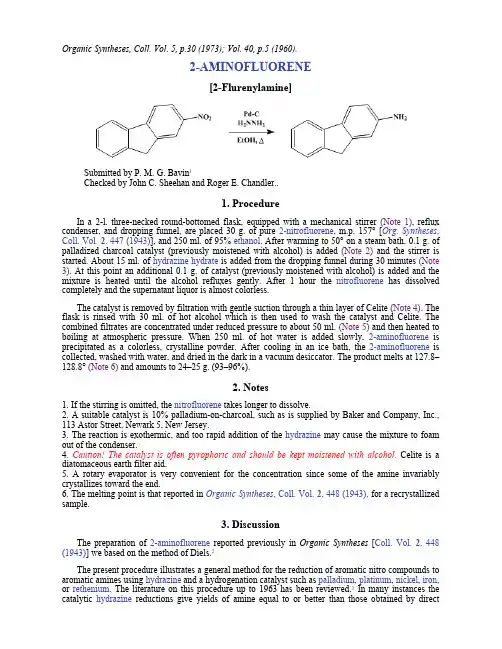
1. Procedure A. Cholest-4-en-3-one p-toluenesulfonylhydrazone. A 100-ml., round-bottomed flask equipped with a magnetic stirring bar and a reflux condenser is charged with 10.19 g. (0.0265 mole) of cholest-4-en-3-one (Note 1), 5.53 g. (0.0297 mole) of p-toluenesulfonylhydrazide (Note 1), and 17 ml. of 95% ethanol. The solution is stirred and heated at reflux for 10 minutes and allowed to cool to room temperature. The precipitated solid is collected by filtration and recrystallized from 95% ethanol, affording 13.1–13.3 g (89–91%) of cholest-4-en-3-one p-toluenesulfonylhydrazone, m.p. 139–141° (Note 2), in two crops.
B. 5β-Cholest-3-ene. A dry, 100-ml., two-necked, round-bottomed flask equipped with a magnetic stirring bar, a rubber septum, and a reflux condenser connected to a mercury bubbler (Note 3) is charged with 4.98 g. (0.00950 mole) of cholest-4-en-3-one p-toluenesulfonylhydrazone and 20 ml. of chloroform, and the apparatus is evacuated with an aspirator and filled with nitrogen three times. The solution is stirred and cooled at 0° as 1.29 g. (1.21 ml., 0.0108 mole) of catecholborane (Note 4) is injected through the septum into the flask. Stirring and cooling are continued for 2 hours, after which 2.5 g. (0.018 mole) of sodium acetate trihydrate and 20 ml. of chloroform are added. The mixture is allowed to warm to room temperature over ca. 30 minutes, heated under reflux for 1 hour, cooled to room temperature, and filtered. The solid material is washed with 50 ml. of chloroform, and the combined filtrates are evaporated under reduced pressure. The remaining oil is purified by chromatography on a 5 × 50 cm. column packed with 200 g. of alumina (Note 5). The column is eluted with hexane and 200-ml. fractions are collected. Evaporation of the second 200-ml. fraction affords 2.76–2.95 g. (83–88%) of 5β-cholest-3-ene as a colorless oil which eventually crystallizes on standing, m.p. 48–50°, [α]24 = 19.6° (c = 63, chloroform) (Note 6).
2. NotesD1. Cholest-4-en-3-one and p-toluenesulfonylhydrazideare available from Aldrich Chemical Company, Inc. Procedures for the preparation of cholest-4-en-3-one and p-toluenesulfonylhydrazide are described in Org. Synth., Coll. Vol. 4, 192, 195 (1963) and Coll. Vol. 5, 1055 (1973). The checkers used 5.70 g. of p-toluenesulfonylhydrazide, the purity of which was 97%. 2. The reported4 melting point is 139–142°.
3. Nitrogen is introduced via a syringe needle that pierces the septum. A positive pressure of nitrogen is maintained in the apparatus during the following operations. 4. Catecholborane with a purity of 95% was purchased from Aldrich Chemical Company, Inc. 5. Activity grade I, neutral alumina was supplied by Brinckmann Instruments, Inc., Westbury, New York. The checkers used a 3 × 30 cm. column. 6. A TLC analysis was carried out by the submitters on a precoated silica gel plate (type Q6) purchased from Quantum Industries, 341 Kaplan Drive, Fairfield, New Jersey 07006. The chromatogram was developed with cyclohexane and showed a single spot for the product after visualization by charring with concentrated sulfuric acid. 5β-Cholest-3-ene is reported5 to melt at 48–49°. The spectral properties of the product are as follows: IR (CHCl3) cm.−1: 2926, 1658, 1465, 831, 758, 678; 1H NMR (CDCl3), δ (multiplicity, number of protons, assignment): 0.66 (s, 3H, C-18 CH3), 0.82 (s, 3H, CH3), 0.92 (s, 3H, CH3), 0.94 (s, 3H, C-19 CH3), 5.2–5.7 (m, 2H, vinyl H); mass spectrum m/e: 370 (M+). The submitters prepared the dibromide derivative, 3α,4β-dibromo-5β-cholestane, m.p. 98–99°. The melting point of the dibromide is reported as 98–100°.6 The mass spectrum of the dibromide exhibits three molecular ions at m/e (relative intensity, assignment): 532 (25%,C27H46Br81Br), 530 (50%, C27H46Br81Br), 528 (25%, C27H46Br79Br).
3. Discussion The reduction of p-toluenesulfonylhydrazone derivatives of α,β-unsaturated ketones and aldehydes with aluminum7 or boron hydride reagents8,9,10,11 effects a formal "conjugate" hydride transfer and produces alkenes in which the double bond has migrated to the position between the α-carbon and the carbonyl carbon. The mechanism of the reaction is presumed to involve initial reduction of the C=N double bond, elimination of p-toluenesufinate, forming an allyl diazene, and concerted fragmentation of the diazene with 1,5-hydrogen transfer. One or both of the last two steps may take place during a subsequent hydrolysis. The reductions have been carried out with excess lithium aluminum hydride in tetrahydrofuran,7 with catecholborane in chloroform at 0° followed by hydrolysis at ca. 60° (Procedure A),8 with sodium cyanoborohydride in 1:1 (v/v) N,N-dimethylformamide–sulfolane acidified with concentrated hydrochloric acid at 100–105° (Procedure B),9,10 and with sodium borohydride in acetic acid at 70° (Procedure C).11 A selection of examples of these reductions is given in Table I.