
说课八上M5U2
- 格式:ppt
- 大小:1.96 MB
- 文档页数:22


部编版八年级初二语文上册第五单元《口语交际:复述与转述》说课稿一. 教材分析《口语交际:复述与转述》是人教版八年级语文上册第五单元的一篇口语交际训练文章。
本节课的主要内容是让学生掌握复述与转述的方法和技巧,提高口语表达能力。
教材通过生动的例句和实用的练习,让学生在实践中学会如何根据语境进行复述与转述,培养他们在日常生活中的口语交际能力。
二. 学情分析初二的学生在语言表达方面已有一定的基础,但他们仍然存在着一些问题,如表达不清晰、逻辑不严密等。
因此,在教学过程中,教师需要针对这些问题进行有针对性的指导,帮助学生提高口语表达能力。
同时,学生之间存在一定的差异,教师应关注到这一点,因材施教,使每个学生都能在课堂上得到锻炼和提高。
三. 说教学目标1.知识与技能目标:学生能理解复述与转述的概念,掌握复述与转述的方法和技巧。
2.过程与方法目标:通过小组讨论、实践练习等环节,培养学生的口语表达能力。
3.情感态度与价值观目标:激发学生学习口语交际的兴趣,提高他们在日常生活中的口语交际能力。
四. 说教学重难点1.复述与转述的概念及方法。
2.如何根据语境进行复述与转述。
3.培养学生口语表达能力。
五. 说教学方法与手段1.采用情境教学法,创设真实的口语交际情境,让学生在实践中学会复述与转述。
2.采用分组讨论法,让学生分组讨论,培养合作意识,提高口语表达能力。
3.采用问答法,教师提问,学生回答,激发学生思维,巩固所学知识。
4.利用多媒体手段,展示相关例句和练习,丰富教学手段,提高课堂趣味性。
六. 说教学过程1.导入新课:通过一个简单的口语交际场景,引出复述与转述的概念。
2.讲解复述与转述:讲解复述与转述的定义、方法和技巧。
3.实践练习:学生分组进行口语练习,尝试运用复述与转述的方法。
4.展示与评价:各小组展示练习成果,教师进行点评、指导。
5.总结与拓展:总结本节课所学内容,布置课后作业,拓展学生知识。
七. 说板书设计板书设计如下:复述:根据原文内容进行口头表达。
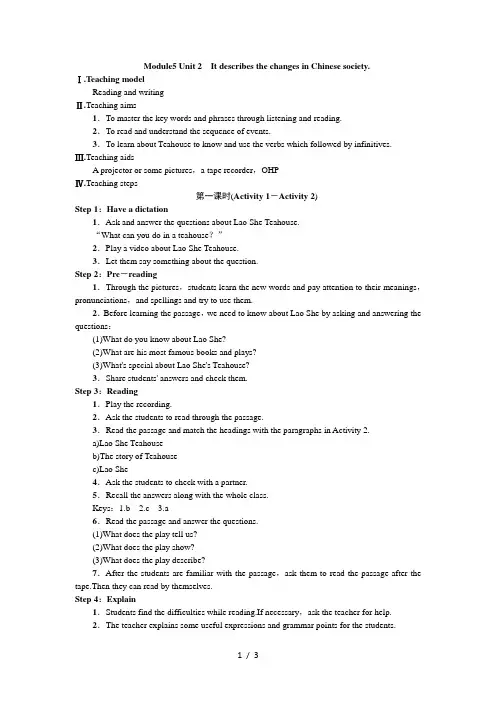
Module5 Unit 2It describes the changes in Chinese society.Ⅰ.Teaching modelReading and writingⅡ.Teaching aims1.To master the key words and phrases through listening and reading.2.To read and understand the sequence of events.3.To learn about Teahouse to know and use the verbs which followed by infinitives.Ⅲ.Teaching aidsA projector or some pictures,a tape recorder,OHPⅣ.Teaching steps第一课时(Activity 1-Activity 2)Step 1:Have a dictation1.Ask and answer the questions about Lao She Teahouse.“What can you do in a teahouse?”2.Play a video about Lao She Teahouse.3.Let them say something about the question.Step 2:Pre-reading1.Through the pictures,students learn the new words and pay attention to their meanings,pronunciations,and spellings and try to use them.2.Before learning the passage,we need to know about Lao She by asking and answering the questions:(1)What do you know about Lao She?(2)What are his most famous books and plays?(3)What's special about Lao She's Teahouse?3.Share students' answers and check them.Step 3:Reading1.Play the recording.2.Ask the students to read through the passage.3.Read the passage and match the headings with the paragraphs in Activity 2.a)Lao She Teahouseb)The story of Teahousec)Lao She4.Ask the students to check with a partner.5.Recall the answers along with the whole class.Keys:1.b 2.c 3.a6.Read the passage and answer the questions.(1)What does the play tell us?(2)What does the play show?(3)What does the play describe?7.After the students are familiar with the passage,ask them to read the passage after the tape.Then they can read by themselves.Step 4:Explain1.Students find the difficulties while reading.If necessary,ask the teacher for help.2.The teacher explains some useful expressions and grammar points for the students.Step 5:Homework1.Read the words and the passage.2.Copy the words and expressions.3.Finish some exercises in workbook.Blackboard DesignUnit 2It describes the changes in Chinese society.动词不规则过去式:write—wrote写send—sent发送leave—left离开teach—taught教双宾语结构:tell sb.sth.=tell sth.to sb.give sb.sth.=give sth.to sb.buy sb.sth.=buy sth.for sb.第二课时(Activity 3-Activity 7)Step 1:Review1.Give a brief introduction of Lao She and Teahouse.T:Teahouse is the most famous play written by Lao She.When and where did it take place?2.Share the answers in class.Step 2:Have a dictationGet the students to write the words and phrases in Unit 2,and check the answers to see if they have grasped the usages of the points.Step 3:Practice1.Read the passage again.2.Complete the timeline with information about Lao She in Activity 3.LAO SHE1957 ______________1924 ______________1918 ______________1913 ______________1899born_in_Beijing3.Check with a partner.4.Recall the answers with the whole class,and finish Activity 3.Answers:1957wrote_Teahouse1924_left_home_and_went_to_England1918finished_the_teacher's_school_and_became_a_head_teacher_of_a_primary_school1913_went_to_a_teacher's_school_5.Complete the passage with the words in the box in Activity 4.(1)Read through the passage in Activity 4.(2)Complete the passage with the correct form of the words from the box.(3)Check with a partner.(4)Call back the answers from the whole class.Answers:mon 2.society 3.century 4.writers 5.if 6.magicStep 4:Writing1.Complete the table about Teahouse.2.Write sentences about Teahouse with the information in Activity e the passage in Activity 2.The story of Teahouse takes place in Beijing.3.Join the sentences.Write a passage about Teahouse.4.Share the passage with others.One possible version:Lao She's play Teahouse takes place from the end of the nineteenth century to the middle of the twentieth century in a teahouse in old Beijing.It tells us the story of Wang Lifa and his customers.The play shows the audience the life in old China by asking us to see the teahouse as the centre of the neighborhood.In the end,Wang loses the teahouse and he dies.Step 5:Homework1.Revise the key points in Unit 2.2.Finish the workbook.Blackboard DesignUnit 2It describes the changes in Chinese society.The heading of each paragraph.1.b)The story of Teahouse2.c)Lao She3.a)Lao She Teahouse。

教学目标1. 能掌握并准确运用本单元的重点单词和短语。
2. 能读懂有关网上购物的文章,了解介绍事物利与弊的文章的方法。
3. 能根据所学陈述自己对超市购物的利与弊的看法。
教学重难点教学重点:1. 掌握并准确运用本单元的重点单词和短语;2.读懂有关网上购物的文章,了解介绍事物利与弊的文章的方法。
教学难点:根据所学陈述自己对超市购物的利与弊的看法。
教学过程Step 1 Greeting and lead inIntroduce myself and my hobbies, ask students to guess what I don’t like doing and lead in today’s topic: shopping.Step 2 Free talkAsk students to look at two pictures and answer the question: What are they doing and where are they? Students talk about two ways of shopping. Then guide them to talk about 4 questions:1. Do your family often buy things on the Internet?2. What can you buy on the Internet?3. How can you pay and get your products?4. Which is better, online shopping or traditional shopping?According to the answer to Q4,lead into the learning of today’s passage: Online shoppingStep 3 Reading1.Fast-readingMatch the headings with the paragraphs.Para1 the advantages of shopping onlinePara2 the disadvantages of shopping onlinePara3 how to buy things onlinePara4 Online shopping is changing our way of lifeStudents learn to read fast to get the main ideas of each paragraph. After getting the main idea, lead them to read Para1,2,3,4 one by one.2. Careful-reading1. Students read Paragraph 1 and answer this question.How to buy things on the Internet? Write down the answers on the hand-out. Ask several to answer.2. Students read Paragraph 2 & 3 and complete the table in A4 on page 29. Boystheir partner. Then, call back the answers by a debate between boys and girls.3. Ask students to read Paragraph 4, tell them this paragraph is the writer’s about online shopping .Guide them to think if online shopping is good or bad.4. Play the video for them to watch and then do the T/F .While listening, pay attention to the new words.Step 4 Writing1. Guide the m into today’s writing; conclude the way of describing the advantages and disadvantages in this passage.2. Students work in group of four and find out the advantages and disadvantages of shopping in a supermarket. The more, the better. They can ask for help if necessary.3. Ask several groups to show the result of discussion.4. Then, ask them to try to finish the writing.● Begin like this: Supermarket shopping is not difficult. First, you choose thethings on your shopping list.● List the advantages.● List the disadvantages.● Finish like this: Shopping at a supermarket is fun.学情分析学生升入初中的第二学期,英语基础知识和听就能力普遍较差,大部分学生须然在小学接触过英语,但应用能力十分薄弱,面对学生掌握英语的程度不一,采用分层教学和整体教学相结合的方式来完成教学任务,努力提高他们的英语水平。

统编版初中语文八年级上册第二课《首届诺贝尔奖颁发》说课稿尊敬的评委、各位老师,大家好!我是一名语文老师,今天很荣幸能为大家介绍我所教授的八年级上册第二课《首届诺贝尔奖颁发》。
一、课前准备本节课主要内容为阅读理解能力的提升和学生对文化底蕴的启发,为了更好地完成教学任务,需要提前做好如下几点准备:1.对本节课文的理解,勾画出核心思想;2.查阅有关阅读理解的教学方法和教学路径;3.准备多媒体工具,如投影仪、电脑等;4.制定教学计划,并在班内测评前讲授明早预习。
二、教学流程1.渐进式导入通过问一些问题,引导学生对课文进行思考和理解,或者播放一些视频等素材进一步激励学生的学习兴趣。
2.独立阅读让学生自行阅读本课文,同时突出重点段落进行解读,并在班内共同研读部分难句,透彻地理解课文核心信息。
3.整合学习内容将学生对本课文的理解和思考加以整合,梳理思路,提供教学辅助资料,如脑图等,促进学生对核心思想的理解加深。
4.学生合作通过分组讨论,在班内小组内发挥学生的主观能动性,让学生充分表达对本文读后感受,并搜集相关资料进行分享,提高学生对文化的理解。
同时,老师也需要对各组进行指导和督查,确保学生能够有效地完成任务。
5.学生评价最后老师需要利用课内或课后组织测验或问答来进行学生的评价。
通过这种方式可以了解到学生的学习情况和难点,同时对教学质量进行带教反思,提高教学质量。
三、教具使用多媒体设备:投影仪、电脑;翻译资料:提供相关翻译资料,帮助学生理解词汇和难句。
四、教学重点与难点教学重点:教学重点是培养学生的阅读理解能力和文化修养,帮助学生理解文化差异和知识补充。
教学难点:教学难点是理解文章中的文化困扰,充分理解知识,加深对文化差异的认识,并能引导学生用简单有力的语言进行对本文的总结和评价。
五、教学评价通过课后反馈,考察学生对本课的理解,同时也可以对教师的授课质量进行评估。
同时,也可以借鉴学生的反馈意见,不断优化教学方案,提高教学质量。