
Nous Case Study competition
- 格式:pptx
- 大小:453.92 KB
- 文档页数:7


2024年全国大学生英语竞赛c类样题范文全文共3篇示例,供读者参考篇12024 National College Students English CompetitionCategory C: Sample Questions & AnswersPart I: Reading Comprehension1. According to the passage, what are the benefits of studying abroad?Studying abroad provides students with the opportunity to immerse themselves in a new culture, learn a foreign language, and gain a global perspective. It also helps students develop independence, adaptability, and problem-solving skills.2. What challenges do international students face when studying abroad?International students may face challenges such as homesickness, language barriers, cultural differences, and academic pressure. They may also struggle with adapting to a new educational system and making friends in a foreign country.3. How can universities support international students?Universities can support international students by offering orientation programs, language assistance, cultural activities, and academic support services. They can also provide housing options, health services, and counseling to help international students adjust to life abroad.4. What are the key differences between studying in your home country and studying abroad?Studying abroad offers students a unique opportunity to explore a new culture, make international friends, and develop a global network. It also challenges students to step out of their comfort zone, adapt to unfamiliar surroundings, and learn to navigate a different educational system.Part II: Writing SkillsQuestion 1: Discuss the advantages and disadvantages of studying abroad.Answer: Studying abroad can be a life-changing experience that offers numerous benefits, such as cultural immersion, language acquisition, and personal growth. However, it also comes with challenges, such as homesickness, financial costs, and academic pressure. Overall, studying abroad can be arewarding but challenging experience that requires students to be open-minded, adaptable, and resilient.Question 2: Describe a memorable experience you had while studying abroad.Answer: One memorable experience I had while studying abroad was participating in a cultural festival in my host country.I had the opportunity to learn traditional dances, taste local cuisine, and interact with people from different backgrounds. It was a unique and enriching experience that helped me appreciate the diversity and beauty of the world.In conclusion, participating in the 2024 National College Students English Competition is a great opportunity for students to showcase their language skills, critical thinking abilities, and cultural awareness. By preparing for the competition and taking on the challenges presented, students can further develop their English proficiency and broaden their horizons. Good luck to all participants!篇2The 2024 National College English Competition Class C Sample TestPart I Listening Comprehension (30 marks)Section ADirections: In this section, you will hear 10 short conversations. At the end of each conversation, a question will be asked about what was said. Both the conversation and the question will be spoken only once. After each question, there will be a pause. During the pause, you must read the four choices marked A), B), C) and D), and decide which is the best answer. Then mark the corresponding letter on Answer Sheet 1 with a single line through the center.1. A) Pick up Mary at the airport. B) Make a phone call to Mary. C) Drop Mary at the bus station. D) Visit Mary at her home.2. A) The weather in New York. B) The best time to visit New York. C) Ways to find a good restaurant in New York. D) Jason's plan for his summer vacation.3. A) The man should do an experiment. B) The man should give up the idea. C) The man should ask for some advice. D) The man should follow the instructions in the book.4. A) She doesn’t like the physics course. B) She is always talking about physics. C) She is good at explaining things. D) She feels tired of the conversation.5. A) The woman was promoted. B) The woman was demoted. C) The woman's job remained the same. D) The woman was fired.6. A) The man will paint the wall. B) The man needs help with painting. C) The man doesn’t know how to paint. D) The man will sell the painting.7. A) Visit some museums. B) Find a job in Spain. C) Travel to Spain for vacation. D) Learn about Spain’s history.8. A) In two hours. B) In three hours. C) In four hours. D) In six hours.9. A) It's recommended to save some money. B) It’s important to keep track of expenses. C) It's not necessary to trust expensive ite ms. D) It’s worth spending more money on quality.10. A) The woman is a teacher. B) The woman is a designer. C) The woman is a singer. D) The woman is a writer.Section BDirections: In this section, you will hear 2 passages. At the end of each passage, you will hear some questions. Both the passage and the questions will be spoken only once. After you hear a question, you must choose the best answer from the fourchoices marked A), B), C) and D). Then mark the corresponding letter on Answer Sheet 1 with a single line through the center.Passage OneQuestions 11 to 13 are based on the passage you have just heard.11. A) It was a new policy. B) It was supported by the students. C) It was regarded as democratic. D) It was made by the university president.12. A) Parents were given a chance to vote. B) Students could choose their own leaders. C) Students were allowed to skip classes. D) Parents were invited to attend meetings.13. A) Borrow some books. B) Make some rules. C) Discuss some problems. D) Meet some teachers.Passage TwoQuestions 14 to 17 are based on the passage you have just heard.14. A) The importance of exercise for middle-aged adults.B) Different effects of exercise on different age groups.C) Daily exercises for people in different age groups.D) Different exercise routines suitable for the elderly.15. A) They don't require any equipment. B) They are not physically demanding. C) They can be done indoors. D) They are especially popular among the elderly.16. A) To help the elderly stay active. B) To encourage people to exercise more. C) To improve people's overall health. D) To promote the benefits of daily exercises.17. A) Being overweight. B) Having little free time. C) Lack of motivation. D) Fear of physical injury.Section CDirections: In this section, you will hear a passage. There is one blank in each of the following sentences. From the four choices marked A), B), C) and D), choose the one that best completes the sentence. Then mark the corresponding letter on Answer Sheet 1 with a single line through the center.Questions 18 to 20 are based on the passage you have just heard.18. The people who live alone have to take care of their_______________.A) children and parents B) wives and husbandsC) friends and neighbors D) own meals and laundry19. Many people who live alone often find their social lives less _______________.A) enjoyable B) satisfyingC) challenging D) interesting20. Some of them even start talking to _______________.A) cats and dogs B) themselvesC) strangers D) friendsPart II Reading Comprehension (40 marks)Section ADirections: In this section, there is a passage with ten blanks. You are required to select one word for each blank from a list of choices given in a word bank following the passage. Read the passage through carefully before making your choices. Each choice in the bank is identified by a letter. Please mark the corresponding letter on Answer Sheet 2 with a single line through the center.The idea that populations can migrate over long distances in response to _______(21) changes goes back to the distant past.Charles Darwin, for example, in his book On the Origin of Species, described how plants and animals could _______(22) long distances across the ocean to colonize remote islands. Today, as the earth’s temperature rises because of global warming, scientists are debating what _______(23) climate change will have on the movement of species. One possibility is that species will be able to move to areas that were previously too cold to_______(24) them. Research on several plant and animal species suggests that, indeed, climate change has already had an effect on their distribution. Scientists also know that climate _______(25) has affected the distribution of species in the past, _______(26) when the rise in temperature that ended the last ice age caused the range of many species to _______(27). These species had to migrate to new areas where they could survive. However, there are concerns that climate change, as a result of human activities, is happening much _______(28) than any previous climate shifts, leaving species _______(29) to migrate fast enough to keep up with changes. Even if a species can migrate, there is no guarantee that it will survive in a new location where food and other resources may be scarce. Studies of past climate changes suggest that many species were unable to migrate fast enough to survive and went _______(30) instead.A) accelerated B) adapt C) addresses D) allow E) benefitedF) extended G) fast H) impossible I) increased J) ledSection BDirections: In this section, you are going to read a passage with ten statements attached to it. Each statement contains information given in one of the paragraphs. Identify the paragraph from which the information is derived. You may choose a paragraph more than once. Each paragraph is marked with a letter. Answer the questions by marking the corresponding letter on Answer Sheet 2 with a single line through the center.The digital age has transformed the way we learn, work, and communicate. Technology allows us to access vast amounts of information at our fingertips, communicate instantly with people across the globe, and work flexibly from anywhere. 31. However, as technology has advanced, the concept of the traditional office 9-5 has become obsolete. Many people work remotely, traveling and working on the go, free from the constraints of a physical office.32. Employers are embracing remote work, recognizing the benefits it offers in terms of increased productivity, reduced commuting time, and improved work-life balance for employees.But remote work presents its own challenges. 33. Some people find it difficult to switch off, leading to longer workinghours and burnout. Others struggle with feelings of isolation and disconnection from colleagues.Some employees thrive on the flexibility remote work offers, 34. But for others, the lack of structure and routine can be overwhelming. It's essential for remote workers to establish boundaries between work and personal life, set clear goals and priorities, and communicate effectively with their colleagues to avoid misunderstandings.The rise of remote work has also led to a growing market for co-working spaces and digital nomad communities,35. providing remote workers with a sense of community and collaboration while maintaining flexibility.A. The benefits of remote work are recognized by many employers during the digital age.B. Remote work provides a sense of community and collaboration for individuals.C. Technology has made it possible for workers to communicate instantly across the globe.D. Some people find it challenging to balance work and personal life in a remote work environment.E. Technology has made the traditional office working hours less relevant in today's world.F. Remote work offers increased flexibility for workers but also presents challenges.G. The rise of remote work has led to the development of co-working spaces and digital nomad communities.H. Remote work has become popular for its ability to improve work-life balance.I. Remote work can lead to longer working hours and feelings of isolation for some individuals.J. Employees need to set clear goals, priorities, and boundaries to succeed in remote work.Part III Vocabulary and Structure (10 marks)Directions: There are 40 incomplete sentences in this part. For each sentence there are four choices marked A), B), C) and D). Choose the one that best completes the sentence. Then mark the corresponding letter on Answer Sheet 2 with a single line through the center.36. Could you please tell me how ____________ the nearest supermarket?A) can I get to B) I can get toC) can to get D) I get to37. Her mother was reported ____________ in a car accident.A) being injured B) to be injuredC) injured D) injure38. Sarah couldn't stand ____________ in front of an audience.A) to speak B) speakingC) speak D) to speaking39. We plan to leave ____________ the weather improves.A) until B) whenC) if D) while40. The ____________ of the murderer shocked the whole community.A) news B) messagesC) notice D) announcement...Overall, the 2024 National College English Competition Class C Sample Test is designed to challenge students' listening,reading, vocabulary, and structure skills in English. Participants will have the opportunity to demonstrate their understanding of the language through a variety of tasks. Good luck to all the contestants!篇3Title: 2024 National College English Competition C-level Sample Question and EssayIntroduction:The National College English Competition is an annual event that brings together students from across the country to test their English language skills. The C-level competition is known for its challenging questions that require students to demonstrate a high level of proficiency in reading, writing, listening, and speaking. In this sample question and essay, we will explore a typical C-level question and provide a model essay response.Sample Question:Read the following passage and answer the questions that follow:"In recent years, there has been a growing trend towards sustainable living, with more and more people adopting environmentally friendly practices in their daily lives. From reducing waste to conserving energy, individuals are taking steps to minimize their impact on the planet. However, despite these efforts, there is still a long way to go before we can achieve true sustainability. What role do you think individuals and governments should play in promoting sustainable living, and what can be done to encourage more people to embrace this lifestyle?"Essay:In today's world, the concept of sustainable living has become increasingly important as we face the challenges of climate change and environmental degradation. Individuals and governments both have a critical role to play in promoting sustainable living practices and encouraging more people to embrace this lifestyle.On an individual level, there are several steps that people can take to minimize their impact on the planet. This includes reducing waste by recycling and reusing materials, conserving energy by turning off lights and appliances when not in use, and using public transportation or carpooling to reduce emissions.By making small changes in our daily habits, we can all contribute to a more sustainable future.Governments also have a key role in promoting sustainable living through policies and regulations. This can include incentivizing renewable energy sources, implementing stricter emissions standards for industries, and investing in green infrastructure. By creating a supportive environment for sustainable practices, governments can encourage businesses and individuals to make environmentally friendly choices.To encourage more people to embrace sustainable living, education and awareness are vital. Schools and universities can teach students about the importance of environmental conservation and the impact of their actions on the planet. Public awareness campaigns can also help to raise consciousness about sustainable living practices and inspire people to make positive changes in their lives.In conclusion, achieving true sustainability requires the collective efforts of individuals and governments alike. By taking an active role in promoting sustainable living practices and spreading awareness about the importance of environmental conservation, we can all work towards a more sustainable future for our planet.Conclusion:The sample question and essay provided above demonstrate the type of critical thinking and language proficiency required to excel in the National College English Competition at the C-level. By analyzing complex issues and articulating well-reasoned arguments in English, students can showcase their abilities and compete at a high level.。
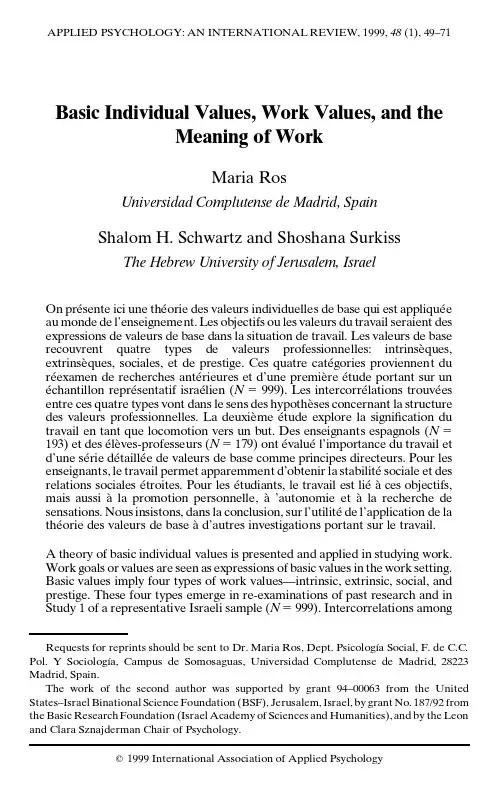
APPLIED PSYCHOLOGY: AN INTERNATIONAL REVIEW, 1999, 48(1), 49–71Requests for reprints should be sent to Dr. Maria Ros, Dept. Psicología Social, F. de C.C.Pol. Y Sociología, Campus de Somosaguas, Universidad Complutense de Madrid, 28223Madrid, Spain.The work of the second author was supported by grant 94–00063 from the United States–Israel Binational Science Foundation (BSF), Jerusalem, Israel, by grant No. 187/92 from the Basic Research Foundation (Israel Academy of Sciences and Humanities), and by the Leon and Clara Sznajderman Chair of Psychology.q 1999 International Association of Applied PsychologyBasic Individual Values, Work Values, and theMeaning of WorkMaria RosUniversidad Complutense de Madrid, SpainShalom H. Schwartz and Shoshana SurkissThe Hebrew University of Jerusalem, IsraelOn présente ici une théorie des valeurs individuelles de base qui est appliquée au monde de l’enseignement. Les objectifs ou les valeurs du travail seraient des expressions de valeurs de base dans la situation de travail. Les valeurs de base recouvrent quatre types de valeurs professionnelles: intrinsèques,extrinsèques, sociales, et de prestige. Ces quatre catégories proviennent du réexamen de recherches antérieures et d’une première étude portant sur un échantillon représentatif israélien (N 999). Les intercorrélations trouvées entre ces quatre types vont dans le sens des hypothèses concernant la structure des valeurs professionnelles. La deuxième étude explore la signi cation du travail en tant que locomotion vers un but. Des enseignants espagnols (N 193) et des élèves-professeurs (N 179) ont évalué l’importance du travail et d’une série détaillée de valeurs de base comme principes directeurs. Pour les enseignants, le travail permet apparemment d’obtenir la stabilité sociale et des relations sociales étroites. Pour les étudiants, le travail est lié à ces objectifs,mais aussi à la promotion personnelle, à ’autonomie et à la recherche de sensations. Nous insistons, dans la conclusion, sur l’utilité de l’application de la théorie des valeurs de base à d’autres investigations portant sur le travail.A theory of basic individual values is presented and applied in studying work.Work goals or values are seen as expressions of basic values in the work setting.Basic values imply four types of work values—intrinsic, extrinsic, social, and prestige. These four types emerge in re-examinations of past research and in Study 1 of a representative Israeli sample (N 999). Intercorrelations among50ROS, SCHWARTZ, SURKISS1The current article uses a theory of 10 types of basic individual values to explain individual differences in work values. Schwartz (this issue) presents a theory of seven types of values appropriate for comparing cultures but not individuals. For discussions of the differences between the individual and cultural levels of value theory and analysis, see Schwartz (this issue)and Smith and Schwartz (1997).these value types support theorising about the structure of work values. Study 2 explores the meaning of work as a vehicle for goal attainment. Spanish teachers (N 193) and education students (N 179) rated the importance of work and of a comprehensive set of basic values as guiding principles. For the teachers, work apparently serves to attain social stability and close social relations. For the students, work is associated with these goals and with promoting personal interests, independence, and excitement. In conclusion,we identify advantages of applying the theory of basic values to further studies of work.INTRODUCTIONA major goal of research on values has been to explore the ways in which individuals’ value priorities relate to their attitudes, behaviour, and social experiences and roles. One branch of this research has focused primarily on work (e.g. Elizur, 1984; Hofstede, 1980, 1991; Super, 1980). No attempt has been made, however, to clarify how work values and other aspects of work relate to basic individual values. For this purpose, we adopt a recent theory of the structure and content of the basic values distinguished by individuals (Schwartz, 1992, 1994). This theory has been used to predict and explain how whole value systems relate to various attitudes and behaviours (e.g.cooperation–competition, voting, contact with outgroups, religiosity; Ros,1994; Ros, Grad, & Martinez, 1996; Schwartz & Sagiv, 1995; Schwartz, 1996;Schwartz & Huismans, 1995). This is the rst attempt to integrate this general theory of the basic values of individuals with research on work.1As background for the studies to be reported, the current article brie y presents the theory of basic individual values and notes some results of validation studies. Then, in Study 1, we employ this theory as an approach for clarifying the nature of work values, specifying the types of work values people are likely to distinguish, and postulating the structure of relationships expected among these work values. We also use the theory to organise some of the prominent theorising about work values found in the literature.Finally, we report an empirical study of a national sample in Israel that tested hypotheses regarding the relations of basic values to work values.In Study 2, we employ the theory of basic values to explore the signi cance of work as a vehicle for reaching cherished goals. That is, we seek to infer the types of goals that people believe their work may enable them to attain. We do this by investigating the associations of work, treated as a value, with the different basic human values. We examine this question in two Spanish samples, secondary school teachers and education students.BASIC VALUES AND WORK VALUES51 Both samples focus on the same type of work—teaching. One sample had direct experience with teaching while the other did not. By comparing the associations of work with basic values in the two samples, we sought to deduce the effects of occupational experience as a teacher on the meaning of work. This study exempli es the use of basic values to uncover group differences in, and in uences of experience on, the meaning of work.A THEORY OF BASIC INDIVIDUAL VALUESThe theory of basic human values has two core components (see Schwartz, 1992, 1994, for a fuller elaboration). First, it speci es 10 motivationally distinct types of values that are postulated to be recognised by members of most societies and to encompass the different types of values that guide them. Second, the theory speci es how these 10 types of values relate dynamically to one another. That is, it speci es which values are compatible and mutually supportive, and which are opposed and likely to con ict with one another. The theory de nes values as desirable, trans-situational goals that vary in importance as guiding principles in people’s lives (cf. Kluckhohn, 1951; Rokeach, 1973). The crucial content aspect that distinguishes among values is the type of motivational goals they express. A typology of the different contents of values was derived using the following reasoning: in order to cope with the challenges inherent in human existence, groups and individuals translate the needs and demands they experience into concepts about which they can communicate, expressing them in the language of values. Values represent, in the form of conscious goals, responses to three universal requirements with which all individuals and societies must cope: needs of individuals as biological organisms, requisites of coordinated social interaction, and requirements for the smooth functioning and survival of groups.Ten motivationally distinct types of values were derived from these three universal requirements (Schwartz, 1992). Table 1 lists these value types, de ning each in terms of its central goal and noting, in parentheses, speci c single values that primarily represent it.The key to identifying the structure of value relations is the assumption that actions taken in the pursuit of each type of values have psychological, practical, and social consequences that may con ict or may be compatible with the pursuit of other value types. Analyses of the con icts and compatibilities likely to arise when people pursue these types of values simultaneously suggest a potentially universal set of relations among values. For example, the pursuit of achievement values often con icts with the pursuit of benevolence values; seeking personal success for oneself is likely to obstruct actions aimed at enhancing the welfare of close others who need one’s help. In like manner, the pursuit of tradition values con icts with the52ROS, SCHWARTZ, SURKISSTABLE 1De nitionsPOWER: Social status and prestige, control or dominance over people and resources (Social Power, Authority, Wealth).ACHIEVEMENT: Personal success through demonstrating competence according to social standards (Successful, Capable, Ambitious, In uential).HEDONISM: Pleasure and sensuous grati cation for oneself (Pleasure, Enjoying Life). STIMULATION: Excitement, novelty and challenge in life (Daring, a Varied Life, an Exciting life).SELF-DIRECTION: Independent thought and action-choosing, creating, exploring (Creativity, Freedom, Independent, Curious, Choosing own Goals). UNIVERSALISM: Understanding, appreciation, tolerance and protection for the welfare of all people and for nature (Broadminded, Wisdom, Social Justice, Equalty, A World at Peace, a World of Beauty, Unity with Nature, Protecting the Environment). BENEVOLENCE: Preservation and enhancement of the welfare of people with whom one is in frequent personal contact (Helpful, Honest, Forgiving, Loyal, Responsible). TRADITION: Respect, commitment and acceptance of the customs and ideas that traditional culture or religion provides (Humble, Accepting my Portion in Life, Devout, Respect for Tradition, Moderate).CONFORMITY: Restraint of actions, inclinations and impulses likely to upset or harm others and violate social expectations or norms (Politeness, Obedient, Self-discipline, Honouring Parents and Elders).SECURITY: Safety, harmony and stability of society, of relationships, and of self (Family Security, National Security, Social Order, Clean, Reciprocation of Favours).De nitions of motivational types of values in terms of their goals and the single values that represent them.pursuit of stimulation values; accepting cultural and religious customs and ideas handed down from the past is likely to inhibit seeking novelty, challenge, and excitement. On the other hand, the pursuit of benevolence and of conformity values is compatible; both entail behaving in a manner approved by one’s close group. And the pursuit of security and power is also compatible; both stress avoiding uncertainty by controlling relationships and resources.The total pattern of relations of con ict and compatibility among value priorities that is postulated to structure value systems is represented in Fig. 1. Competing value types emanate in opposing directions from the centre; compatible types are in close proximity going around the circle. The location of tradition outside of conformity implies that these two value types share a single motivational goal—subordination on self in favour of socially imposed expectations.As shown in Fig. 1, the total value structure is organised into two sets of opposing higher-order value types, arrayed on two bipolar dimensions. These higher-order types will be used to link basic values to work values. The rst dimension—openness to change versus conservation—opposesBASIC VALUES AND WORK VALUES53FIG. 1.The structure of relations among the value types according to the theory. values that emphasise own independent thought and action and favour change (self-direction and stimulation) to values that emphasise submissive self-restriction, preservation of traditional practices, and protection of stability (security, conformity, and tradition). The second dimension—self-transcendence versus self-enhancement—opposes values that emphasise acceptance of others as equals and concern for their welfare (universalism and benevolence) to values that emphasise the pursuit of one’s relative success and dominance over others (power and achievement). Hedonism includes elements of both openness to change and self-enhancement.Analyses of responses to a questionnaire developed to measure the 10 value types, in 155 samples from 55 countries, provide substantial support54ROS, SCHWARTZ, SURKISSfor the postulates of the values theory (Schwartz, 1994; Schwartz & Sagiv, 1995; plus unpublished data). Results of separate analyses of the match between the observed and theorised content and structure of values in each sample suggest that all 10 of the postulated value types are indeed discriminated in the vast majority of cultures. Moreover, the value types are usually related to one another in the pattern of oppositions and compatibilities described in Fig. 1. In addition, the four higher-order value types, arrayed on two bipolar dimensions, organise values in virtually all societies studied. That is, values that emphasise self-enhancement oppose those that emphasise self-transcendence, and values that emphasise open-ness to change oppose those that emphasise preservation of the status quo. The analyses also permitted an assessment of the conceptual meaning of each single value in each sample. The results suggest that 45 of the values have cross-culturally consistent meanings. These values can be used to form indexes of the importance of each of the 10 value types for individuals, for use in group comparisons. This addresses the common problem of comparing values whose meanings are not the same across groups, a problem not tackled directly by other values research.STUDY 1 BASIC INDIVIDUAL VALUES AND WORKVALUESFrom the viewpoint of the theory of basic human values, work goals or values are speci c expressions of general values in the work setting. This study employs the theory of basic individual values to generate and test hypotheses regarding the different types of work values that people are likely to distinguish, and regarding the structure of relationships among these work values. We also directly relate basic values and work values. Like basic values, work values are beliefs pertaining to desirable end-states (e.g. high pay) or behaviour (e.g. working with people). The different work goals are ordered by their importance as guiding principles for evaluating work outcomes and settings, and for choosing among different work alternatives. Because work values refer only to goals in the work setting, they are more speci c than basic individual values. But the work values usually studied are still quite broad; they refer to what a person wants out of work in general, rather than to the narrowly de ned outcomes of particular jobs. Finally, work values, like basic values, are verbal representations of individual, group, and interaction requirements.Work value researchers have assumed that a limited number of broad orientations towards work underlie people’s ideas of what is important to them when making occupational choices. Researchers have therefore sought to identify a set of general types of work values. Viewing work values as speci c expressions of basic values in the work setting implies that thereBASIC VALUES AND WORK VALUES 552Elizur, Borg, Hunt, and Beck (1991) also distinguish work values on a second facet—as resources that workers obtain merely by being located in the system (e.g. work conditions) or as rewards that are contingent on workers’ performance (e.g. job status). This facet does not relate to the motivational aspect of values of concern here.should be four general types of work values, each parallel to one of the four higher-order basic types of individual values. Moreover, these four types of work values should form two dimensions that parallel the self-enhancement versus self-transcendence and the openness to change versus conservation dimensions of basic individual values.Despite a plethora of different labels, most work researchers appear to identify the same two or three types of work values: (1) intrinsic or self-actualisation values, (2) extrinsic or security or material values, (3)social or relational values (e.g. Alderfer, 1972; Borg, 1990; Crites, 1961;Mottaz, 1985; Pryor, 1987; Rosenberg, 1957). Elizur (1984) arrived at a related trichotomous classi cation of work values by considering the modality of their outcomes: instrumental outcomes such as work conditions and bene ts; cognitive outcomes such as interest and achievement; affective outcomes such as relations with associates. This classi cation largely overlaps extrinsic, intrinsic, and social, respectively.2These three types of work values can be viewed as conceptually parallel to three of the higher-order basic human values: intrinsic work values directly express openness to change values—the pursuit of autonomy, interest,growth, and creativity in work. Extrinsic work values express conservation values; job security and income provide workers with the requirements needed for general security and maintenance of order in their lives. Social or interpersonal work values express the pursuit of self-transcendence values;work is seen as a vehicle for positive social relations and contribution to society.The theory of basic individual values suggests that there should be a fourth distinctive type of work values, one that parallels the basic self-enhancement higher-order value type. This type of work values, like self-enhancement, should be concerned with prestige or power. Items that refer to prestige, authority, in uence, power, and achievement in work are common in empirical research on work. These values have usually been classi ed as extrinsic (Ginzberg, Ginsburg, Axelrod, & Herma, 1951;Herzberg, Mausner, & Snyderman, 1959; Rosenberg, 1957) or intrinsic (Borg, 1990; Crites, 1961; Elizur, 1984). Few theorists have recognised a distinctive prestige or power type (O’Connor & Kinnane, 1961; Pryor, 1987).Re-examination of many past studies reveals that there is empirical evidence for a fourth, prestige type even in data that the researchers interpreted as revealing three types. To illustrate the results of our re-examination, we consider data from Elizur (1984). Elizur (1984) asked a56ROS, SCHWARTZ, SURKISSrepresentative Israeli sample how important each of 21 work outcomes (values) is to them. He analysed the intercorrelations among these items with the same multidimensional technique used to validate the theory of basic individual values. Elizur partitioned the empirical space formed by the 21 work values into three regions that matched his conceptual distinctions between instrumental, effective, and cognitive outcomes of work. Several anomalies in Elizur’s results can be resolved by distinguishing a fourth, prestige value type. Speci cally, the region of values that Elizur labelled cognitive outcomes can be divided into intrinsic and prestige regions that make better sense of the data. The work values in the intrinsic region (meaningfulness, responsibility, use of one’s abilities) are values that contribute to a sense of personal growth and whose attainment derives directly from the nature of the work experience. The work values in the prestige region (achievement, advancement, status, recognition, independence, company that you are proud to work for, in uence in work, in uence in the organisation) are values whose attainment entails a comparison of self with others that implies personal superiority.In a cross-cultural study, Elizur et al. (1991) partitioned a different set of work values into three regions following Elizur’s instrumental, affective, and cognitive distinctions. Examination of the results in the samples from each of the eight countries (USA, Taiwan, China, Korea, Hungary, the Netherlands, Israel) revealed that the region designated as cognitive by the authors could be split into two separate regions of intrinsic and of prestige values in every single sample. Among the distinctive intrinsic work values were interesting work, meaningful work, opportunity for growth, and use of ability and knowledge. Among the prestige values were company that you are proud to work for, advancement, in uence in the organisation, and in uence in work. In this case, the implications of the theory of basic values regarding the number and content of work values that should be found pointed to a clear distinction in the data that had been overlooked. The assumption that a separate type of work values should parallel each higher-order type of basic values enabled us to identify distinctive sets of intrinsic (parallel to openness to change) and prestige (parallel to self-enhancement) work values. The distinction between these two types of work values is probably of substantial practical importance. Their associations with other variables are most likely very different, as is the case for the higher-order basic value types on which they are based (Schwartz, 1994, 1996).Evidence from some factor analytic studies also suggests that there are four types of work values, with one including largely prestige items (Pryor, 1980; Robey, 1974). In sum, secondary analyses of data from earlier research support the existence of four types of work values that correspond to the four higher-order types of basic values. The current study directly examined associations between work values and basic individual values.BASIC VALUES AND WORK VALUES 573In principle, responses lie on a bipolar scale from values that respondents rate most important to revere and pursue to those most important to condemn and avoid. Testing in multiple cultures revealed that respondents view most values as worthy of pursuit and very few as worthy of avoidance. The current scale provides more positive and fewer negative discriminations, thereby eliciting a distribution of responses that optimally captures the actual distribution of respondents’ value assessments.MethodSamples and ProceduresA representative national sample of the adult, urban Jewish population in Israel (N 999) completed a questionnaire as part of a survey conducted in 1992. Respondents rst completed the measure of basic values and then answered a work values questionnaire. Background and opinion data were also gathered.AnalysesHypotheses regarding the content and structure of values were tested with smallest space analysis (SSA; Guttman, 1968), a nonmetric multidimensional scaling technique used widely in the literature on work values (e.g. Elizur et al., 1991) and basic values (Schwartz, 1992, 1994). SSA represents items (here, single values) as points in a multidimensional space such that the distances between the points re ect the intercorrelations among the items. To test whether the hypothesised distinctive types of values were discriminated, we examined whether the items intended to measure each value type formed separate regions in the space. To test the structure of relations among the value types—their con icts and compatibilities—we examined whether the regions were located in the space relative to one another in a way that ts the hypothesised structure of relations.InstrumentsBasic Value Survey An abbreviated version of the Schwartz Value Survey that included 37 single values, chosen to cover the comprehensive set of ten value types (Schwartz, 1992), was used. Respondents rated the importance of each value as a guiding principle in their life on a 9-point scale from “opposed to my values” (1), “not important” (0), to “important” (3),to “of supreme importance” (7).3The values were presented in three sets of 12, 12, and 13, listed on cards. Before rating each set, respondents chose the most and least important value in the set, in order to anchor their use of the response scale.To index the importance of each basic value type for each individual, the ratings given to the single values that represent the value type were summed58ROS, SCHWARTZ, SURKISS4Item 6 emerged with the prestige values in all occupational groups but professionals. This suggests that being your own boss meant being free of others’ control and having control over resources. For professionals, it emerged with the intrinsic values, apparently signifying freedom to pursue independent goals. Item 10 emerged with different value types in different occupational groups, suggesting considerable variation in the meaning of advancement: greater independence (intrinsic) for professionals; greater independence and power over others (intrinsic and prestige) for managers; greater income and security (extrinsic) for skilled blue collar workers.and divided by the number of values included. The values included in each index are listed in Table 1. They were selected on the basis of a priori theory,corrected for the results of a smallest space analysis of the intercorrelations among the values in this study.Work Value Survey Ten items, selected to represent the four types of work values we postulated, were included. These items were based on items widely used in the work values literature. Respondents rated each item on a scale from 1 (very important) to 4 (not at all important) in response to the question: How important is each of the following to you in choosing an occupation? Table 2 lists the 10 items, categorising them according to the a priori value type they were intended to represent. Both multidimensional scaling analysis (SSA) and principal components factor analysis with oblique rotation were performed on the matrix of intercorrelations among the 10items. Table 2 provides the result of the factor analysis.Both types of analysis supported the a priori assignment of work values to value types. As shown in Table 2, for example, four factors (with eigenvalues greater than 1.0) emerged, equivalent to the four postulated types of work values. In the SSA, four regions emerged, with item 10 in the centre of the space. Both types of analyses were also performed in subsamples formed of ve occupational groups (unskilled blue collar, skilled blue collar, clerical,managerial, professional). The analyses yielded similar results for all but items 6 (being your own boss) and 10 (advancement in work).4To index the importance of each of the four types of work values for each individual, the ratings given to the single values that represent the value type were summed.Items 6 and 10 were excluded because they had multiple and inconsistent loadings in the factor analyses, and central or inconsistent locations in the SSAs in the different subsamples.Results and DiscussionFirst we examined whether the structure of relations among the four types of work values took the form implied by the view of these values as expressions,in the work setting, of basic individual values. Intrinsic work values were hypothesised to oppose extrinsic work values because these types presumably express the opposing higher-order openness to change versusBASIC VALUES AND WORK VALUES59TABLE 2I II III IV Work Value Type and Item Social Extrinsic Prestige Intrinsic Social7.Contributing to people andsociety0.790.090.060.15 4.Work with people0.770.010.040.24 9.Social contact with co-workers0.670.080.120.18 Extrinsic1.Good salary and work conditions0.130.900.040.102.Job security (permanent job,pension)0.090.790.070.07 Prestige8.Authority to make decisions overpeople0.180.080.690.14 5.Prestigious, highly valued work0.150.050.630.03 Intrinsic3.Interesting and varied work0.300.170.100.80 6.Work in which you are your ownboss0.210.170.610.50 Mixed10.Opportunities for occupationaladvancement0.200.430.320.34 Percent of Variance Explained31%14%11%8%N999.conservation basic value types, respectively. Prestige work values were expected to oppose social work values because these types presumably express the opposing higher-order self-enhancement versus self-transcendence basic value types, respectively. The SSA con rmed these hypotheses. The regions representing the four types of work values were ordered in a two dimensional space in precisely this manner.Second, we directly tested the conceptual relationship between the four types of work values and the four higher-order basic individual values by correlating their indexes (see Table 3). As expected, extrinsic work values correlated positively with conservation values (0.24) and negatively with openness to change values (0.28), whereas intrinsic work values correlated negatively with conservation values (0.23) and positively with openness to change values (0.23; all P0.001). Neither of these types of work values was signi cantly related to the other bipolar dimension of basic values. Also as expected, social work values correlated positively with self-transcendence。

safefy export记得曾经偶尔看到关于十大搞笑中式英语的投票,网上搜了一下,找到一供投票所列举出来的搞笑Chinglish,其中有好几个都是我们经常说的,MS已经成为了中国式的俗语了,比如下面的几句:Long time no see; Good good study, day day up当然还有些感觉是纯粹为了搞笑而恶搞的:How are you? How old are you? 怎么是你,怎么老是你?Four glad meatball 四喜丸子,直译的四个开心的肉球(不过这个还真曾在某个饭店看到过)You ask me, me ask who? 你问我,我问谁If you want mondy, i have no; if you want life, i have one!要钱没有,要命一条。
We two, who and who? 咱俩谁跟谁As far as you go to die. 有多远走多远另外还有:Dragon born dragon, checken born chicken, mouse's son can make hole. 龙生龙凤生凤,老鼠的儿子会打洞Chickens that did not have sexual Experience 童子鸡One car come, one car go, two car pengpeng, one car died.关于一场车祸的描述。
Hourse hourse tiger tiger. 马马虎虎No three no four 不三不四Heart flower angry open. 心花怒发Know is know, noknow is noknow.知之为知之不知为不知You have seed, i will give you some color to see see. Brothers, together up! 你有种,我要给你点颜色看看,兄弟们,一起上!Go past, no mistake past. 走过路过,不要错过TOP ahuun∙帖子:184∙陨石:1109∙组别:新手五阶∙个人空间∙相册∙2009-08-14 17:50 | 只看楼主收藏| 17 #最近看到很多雷人的“中式英语”广告和招牌,真让人好笑!现拷贝几个吓到老外的“中式英语”广告和招牌:1。

摘要:蚯蚓能够通过自身生命活动和对土著土壤生物的调控作用而直接或间接影响土壤活性有机碳的变化。
为探索蚯蚓影响土壤有机碳变化的机理,在混入水稻秸秆的灭菌/未灭菌土壤中接种蚯蚓(Eisenia fetida ),以不接种蚯蚓的处理为对照,比较30d 微宇宙培养后不同处理土壤有机碳含量及土壤微生物群落结构的变化。
结果显示,接种蚯蚓增加了土壤微生物量碳(MBC )和CO 2累积排放量,但仅在灭菌土壤中存在显著性差异。
接种蚯蚓对土壤总有机碳(TOC )、活性有机碳(LOC )和可溶性有机碳(DOC )的影响则因土壤是否灭菌而异。
末端限制性片段长度多样性(T-RFLP )分析显示,在灭菌土壤中接种蚯蚓获得了更多的末端片段(TRFs ),而在未灭菌土壤中蚯蚓的存在并未明显改变TRFs 的数量,且接种蚯蚓与无蚯蚓的处理共享了近50%的TRFs 。
冗余分析(RDA )显示土壤细菌群落结构因蚯蚓是否存在而不同,但仅在灭菌土壤中接种蚯蚓的处理同时与LOC 、DOC 、MBC 和CO 2累积排放量呈较好的正相关关系。
因此认为,在该实验的灭菌土壤中,来源于蚯蚓肠道的微生物可能通过快速繁殖并成为优势种进而影响土壤有机碳的变化,但这一作用在未灭菌土壤中则有可能因为土壤土著微生物的竞争作用而被削弱。
关键词:蚯蚓;秸秆还田;土壤有机碳;土壤灭菌;土壤微生物中图分类号:S154文献标志码:A 文章编号:1672-2043(2015)01-0110-08doi:10.11654/jaes.2015.01.016赤子爱胜蚓(Eisenia fetida )对秸秆施入后土壤有机碳和微生物的影响姚影1,何静1,张一2,李钰飞3,伍玉鹏1*(1.华中农业大学资源与环境学院,武汉430070;2.中国农业大学资源与环境学院,北京100193;3.北京市农林科学院植物营养与资源研究所,北京100097)Effects of Eisenia fetida Inoculation on Soil Organic Carbon and Soil Microorganisms Under Rice StrawApplicationYAO Ying 1,HE Jing 1,ZHANG Yi 2,LI Yu-fei 3,WU Yu-peng 1*(1.College of Resources and Environment,Huazhong Agricultural University,Wuhan 430070,China;2.College of Resources and Environment Sciences,China Agricultural University,Beijing 100193,China;3.Institute of Plant Nutrition and Resources,Beijing Academy of Agriculture and Forestry Sciences,Beijing 100097,China )Abstract :Earthworms influence soil organic carbon dynamics directly through their biological activities and indirectly via modified indige -nous soil organisms.In this microcosm study,un-sterilized and sterilized soils (indigenous organism ′s free soil )were used to compare the differences in soil organic carbon and microorganisms induced by earthworm (Eisenia fetida )over the 30-day study period.Soils inoculated with earthworms increased cumulative CO 2emissions and microbial biomass carbon compared with no earthworm soil,while significant dif -ferences were observed only in the sterilized soil.The effects of earthworms on soil total organic carbon,labile organic carbon and dissolved organic carbon varied depending on sterilization.The presence of earthworm decreased soil labile organic carbon from 5.39g ·kg -1to 5.06g ·kg -1in un-sterilized soil,while significantly increased from 5.62g ·kg -1to 6.45g ·kg -1in sterilized soil.Meanwhile,terminal restriction frag -ments (TRFs )were more diverse in sterilized soil with earthworms than one without earthworm,while no obvious changes were found in un-sterilized soils,in which the presence and absence of earthworms shared almost 50%of TRFs.Redundancy analysis showed that there were no obvious clustering phenomena among all treatments,indicating the changes in bacterial community structure by earthworm inoculation.收稿日期:2014-07-12基金项目:国家自然科学基金(41401267);中央高校基本科研业务费专项资金(2662013BQ015)作者简介:姚影(1991—),女,安徽阜阳人,硕士研究生,主要从事土壤生态学研究。