
英美报刊选读chapter 2 News Headlines
- 格式:ppt
- 大小:2.49 MB
- 文档页数:27
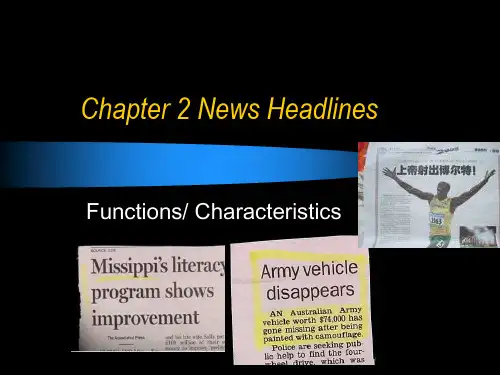

英美报刊课程论文Course PaperOn the importance of the course of Selected Readings from American and British Newspapers and MagazinesCollege:西南林业大学外国语学院Specialty and Grade:10级英语2班Number;20100351004Name:严青为Submitted time: 2012/10/16Title: O n Linguistic Features of Financial Coverage inEnglish News PublicationsAbstract:Based on first-hand examples characteristic of journalistic style, this,paper probes into the seven major linguistic features of financial coverage in English news publication. It adopts the view that the language used in financial news, whose primary function is to inform, is supposed to be specific, accurate and concise. Though sharing the common features of journalistic English in terms of writing style, financial coverage stands out for its own uniqueness.Key words:Financial news significance features English learning1.The significance of the financial coverageFinancial news is an important style of news report in modern time. With the development of technology and social level, people concentrate more on the economy. Financial news plays an increasing role in human’s daily life, and individuals are supposed to acquire the information and knowledge from it. The significance of the financial news can be classified into tow points.1.1The improvement of English levelsIt is believed that reading is an essential way of learning English. Reading English newspapers can not only help the students increase knowledge, and helps develop students’ ability of observation, understanding, thinking and judgment. English newspapers are attention to current events. The novel is very interesting. Reading English newspapers can effectively avoid out of touch with real life, helps to stimulate interest in learning English and to strengthen their confidence and motivation for learning English. At the same time also allows us to better understand the way of news features and news. Newspaper reading is not only used the simple and obvious words, popular language, illustrated, but also introduce learning methods and techniques of column, helping to improve the ability to actually use the language.1.2 The enlargement of knowledge of EconomyThe main aim of news is to transfer information. Reading is the beginning. What we should do when we read is scope knowledge. It is crucial for us to get the effective information.Having read financial news, we have learnt that many governments and parties have taken effective and drastic measures to protect the country from the economic recession and step forwards to recovery. At the same time, we get to know some economic specialized terms, words such as Fluctuation, Recession, Stocks, Overheated, IMF (the International Monetary Fund), phrases and expressions such as the Adjustment of Industrial Structure, Wall Street, Regional economy. They are either specialized words or set phrases, which can help us with a better understanding of economy—related texts and enlarge our storage of the knowledge of economy.2. The features of financial news2.1Features of Words1. SpecialtyOn the one hand, there are many terminologies (professional language) and some words have their special meanings.For instance: long(多头)、short(空头)、rally(价格回稳)、call(看涨)、put(看跌) On the other hand, sometimes there are slang and oral words used in Economic News. Like: Clinton has vowed to veto the bill on grounds that it is unfair to America's have-nots.( have-nots means poor, it always used in spoken English.)2. Creativity (New words and minor term)Creating new words and using minor terms are tow effective ways to get the meanings across to readers.For instance, rout=defeat completely ; swap=influence.3. Midget WordsUsing midget words is very common in a piece of financial coverage. These midge words can be used to describe many phenomena, so they also called synonyms words (万能同义词).For instance:a. Quake Death Toll May Top 2000= The Death Toll in the Earthquake exceeds 2000b. Governor to Axe Aide?=Is the governor going to cut his aides?c. FBI Foils Bid to Hijack Plane to Iran=FBI has prevented gangsters’attempt to hijack plane to Iran4. VividnessIt is commonly believed that economy is a serious topic, but the news is read by ordinary people. In order to stay close to the life and the readers, there are not only various of terminologies, but also some common sayings and vividly metaphors or similes are used in financial news at the same timeSuch as:The company, , is arguably the hottest ticket on the runaway train of electronic commerce.“the hottest ticket on the runaway train” describe the influence of this company in electronic commerce.Express the phrases in various waysrise上升fall下降jump跳升drop下落skyrocket爆涨dump狂泻surge急涨plunge猛跌soar剧增retreat回落climb攀升dive下跌spurt突升tumble急落advance上涨decline下降inch up缓升slip下滑notch up升高shed跌落fly飞升dip下降rebound反弹roll back回落gain增长lose降低5. AbbreviationThe w ord ‘abbreviation’, strictly means a shortening or abridgment, commonly refers to a letter or a group of letters taken from a single word or phrase, a nd used for brevity’s sake, to represent that word or phrase. In financial news, abbreviations are very often used to save space and time. This conforms to the conciseness characteristic of financial news. However, when we use the abbreviations, we should know their meanings and know where they are appropriateFinancial news has large quantity of information, and updates fast. So, using abbreviation satisfied the fast characteristic of financial news. It greatly improved the speed of the language expression.Like:MOC---Ministry of CommerceGDB---Guangdong Development BankCNOOC---National Offshore Oil CorpF.A.Q (=fair average quality) 平均中等品质 D.W.T (=dead weight on) 载重吨位PCT (=percent) 百分比3) Abbreviations and Simplified 简化Words Commonly Used 常用in Cables and Telexes PLS (=please) ASAP (=as soon as possible) DOC (=document) 4) Country Codes 国家代码CN (=China) US (=United States) WTO (=World Trade Organization) 6) Currency Codes 货币代码CNY (=Chinese Yuan) USD (=United State Dollar)a. World Bank, IMF— Do They HelpOr Hurt Third Worldb. PM to see MPs over big factory closures( The Times, 1981)3.1 the features of language1. Timelessness ( it is very objective and instructive)This feature means when we read Economic News , we will get the information from the News and we can know the policy of the government , in this case, we will make right choice when we want to invest or do something about Economy.2. ComparisonThere are many short and powerful comparable verbs in Economic News.Increase ( rise, go up, amount, advance, jump, lift, peak, inch up, grow, leap) Decrease ( fall, drop, go drown, dive, lop, reach a low point, fall off, decline) Example: The report says members of the association forecast the operating rates will slump to an average of 70.7 percent next year.3. AccuracyWhen it comes to data, the Economic News will show their accuracy to us.For example: According to the new measures, which will be in place for a year, the import taxes Brazil imposes on bicycles and car tires will increase from 16 percent to 25 percent, on mineral oil from 4 percent to 25 percent, on aluminum plating from 14 percent to 20 percent, and on potatoes from 14 percent to 25 percentSometimes, when explain the data, the Economic News always make it smaller to understand.Like: The world arms expenditure last year reached an unprecedented number, altogether 550billion, that is, about 1million every minute.4. The features of headlinesHeadline is a key factor of the economic news, featuring unique stylistic characteristics. This paper, based on the functional stylistic theory, makes a tentative study of the economic news’ headline from the perspective of grammatical characteristics, news vocabulary and rhetoric feature.4.1 Grammatical featuresOmissionOmission of articles / pronoun/ “and” / auxiliary verbsChina launches first ICBM into pacificBoys on cliff rescuedMother, daughter share Fulbright yearWitty, Inventive furniture dominates Milan ExpositionForecast of Mexican quake accurate, but ignoredTourist arrested for espionage chargesI.冠词的省略:Consumer confidence hits 8-month highII.连词and 省略:Incomes, spending rise in NovemberIII.系动词be的省略:Caller-pays system still far awayIV.组动词be的省略:Succession Pace Stepped UpTensea. Simple present is the most commonly used tense in headline to give the reader a sense of “timeliness”by giving a vivid, eyewitness account.US and Egypt hold air exercisesWomen’s soccer calls for supportBut: Unemployment in U.K. increased in Octoberb. Future is always indicated by infinitive “to + do”, or in simple present tenseRussia to hold Polish border manoeuvresShanxi to invest large sums for tourism2 EC officials to visit U.S. to pave way for trade talksPredicate(1) Adjective as predicateUS carmaker ready to cut outputBuenos Aires “close” to deal on fresh IMF loanEU and China closer to deal on Beijing’s WTO entry(2) Participial phrase as predicateIdentities of Hijack suspects releasedU.S. Attacked: Hijacked jets destroy twin towers and hit pentagon in day of terror Fed expected to make a half-point cut in ratesUS weather forecasters caught out by stormTop Pakistan judge dismissed after refusing to take oath(3) Infinitive as predicateGermany to lift ban on transport of N-wasteChina to continue fiscal program to aid economyJapan to help elderly joblessPunctuationEleven dead, 200 injured in concert blastProtests sweep Israel, PalestineEconomy grows slowly as unemployment, inflation rise --- economistKissinger reasserts: Sino-US ties crucial4.2Rhetorical features1. Rhyme & alliterationAfter the boom everything is gloomWeather worriesPei’s pyramids puzzle2.PunThe pun in this case is in the words burning questions. The questions are about fires, hence burning questions, but burning question is another way of saying an important or urgent question.The term gender has to do with male and female; and the newspaper article in question deals with the return of tension in the working relationships of men and women in London post offices. The headline is a pun on the instruction Return to sender, which is stamped on letters that cannot be delivered and must be sent back to the people who wrote them.Burning questions on tunnel safety unanswered (About the possibility of fires in the Channel tunnel)Return to gender (About a reoccurrence of sexual harassment in London post offices)5. ConclusionThe linguistic features of financial coverage in English news publications are various and worth to study.By studying the features and readying the financial news, we can not only get the information, knowledge, expanding horizons, enrich the spare life, learn English, and will enable us to recognize the meaning and value of learning English, experience the fun of learning English so boring life more colorful. In today’s information society, to get valuable information, learn the modern English textbooks alone are not enough. In constant development and change in English and Chinese, foreigners learning Chinese, have to read Chinese newspapers and periodicals, and modern we learn English, also have to read English newspapers. Students cultivate a good habit of reading English newspapers and periodicals, we can closely follow the trend of English language, discover a wealth of learning materialsin the newspaper reading, improving listening comprehension, reading comprehension, verbal communication and writing, language ability effectively.References:[1] Xinhua online&Wright, Laura and J. Hope. Stylistics: A Practical Coursebook. [M]. Beijing: FLTRP, 2000[2].Widdowson, H. G. Practical Stylistics Oxford. [M]. Oxford University Press,1992.[3].Itude, Bruce D.& Douglas A. Anderson News Writing and Reporting for Today's Media[M].5th ed. New Youl: McGraw—Hill, 2006.[4].Luo Xianglin, The Thinking towards the course of Selected Readings from American and British Newspapers and Magazines [M],2006, 6.。


Unit2 Gender IssuesMen turn to jobs women usually do 1.HOUSTON - Over the last decade, American menof all backgrounds have begun flocking to fields such as teaching, nursing and waiting tables that have long been the province of women.2."The way I look at it is that anything, basically,that a woman can do, a guy can do," said Miguel Alquicira, who graduated from high school when construction and manufacturing jobs were scarce and became a dental assistant.3.The trend began well before the crash,andappears to be driven by a variety of factors, including financial concerns, quality-of-life issues and a gradual erosion of g ender stereotypes.4.In interviews, about two dozen men played downthe economic considerations, saying that the stigma associated with choosing such jobs had faded, and that the jobs were appealing not just because they offered stable employment, but because they were more satisfying.5."I.T. is just killing viruses and clearing paper jamsall day," said Scott Kearney, 43, who tried information technology and other fields before becoming a nurse in the pediatric intensive care unit at Children's Memorial Hermann Hospital in Houston.6.An analysis of United States census data by TheNew York Times shows that from 2000 to 2010,occupations that are more than 70 percent female accounted for almost a third of all job growth for men, double the share of the previous decade.7.That does not mean that men are displacingwomen - those same jobs accounted for almost two-thirds of women's job growth. But in Texas, for example, the number of men who are registered nurses nearly doubled in that time period.8.The shift includes low-wage jobs as well.Nationally, two-thirds more men were bank tellers, almost twice as many were receptionists and two-thirds more were waiting tables in 2010 than a decade earlier.9.Even more striking is the type of men who aremaking the shift. From 1970 to 1990, according to a study by Mary Gatta, senior scholar at Wider Opportunities for Women, an organization based in Washington, D.C., and Patricia A. Roos, a sociologist at Rutgers University in New Jersey, men who took so-called pink-collar jobs tended to be foreign-born, non-English speakers with low education levels.10.Now, though, the trend has spread among men ofnearly all races and ages, more than a third of whom have a college degree. In fact, the shift is most pronounced among young, white, college-educated men like Charles Reed, a sixth-grade math teacher at Patrick Henry Middle School in Houston.11.Mr. Reed, 25, intended to go to law school after atwo-year stint with Teach for America, a nationalteacher corps of recent college graduates who spend two years helping under-resourced urban and rural public schools. But Mr. Reed fell in love with teaching. He says the recession had little to do with it, though he believes that, by limiting prospects for new law school graduates, it made his father, a lawyer, more accepting.12.To the extent that the shift to "women's work" hasbeen accelerated by recession, the change may reverse when the economy recovers. "Are boys today saying, 'I want to grow up and be a nurse?'"asked Heather Boushey, senior economist at the Center for American Progress. "Or are they saying, 'I want a job that's stable and recession-proof?'"13.Daniel Wilden, a 26-year-old Army veteran andnursing student, said he had gained respect for nursing when he saw a female medic use a Leatherman tool to save the life of his comrade."She was a beast," he said admiringly.14.More than a few men said their new jobs were farharder than they imagined. But these men can expect success. Men earn more than women even in female-dominated jobs. And white men in particular who enter those fields easily move up to supervisory positions, a phenomenon known as the glass escalator, said Adia Harvey Wingfield,a sociologist at Georgia State University.15."I hated my job every single day of my life," saidJohn Cook, 55, who got a modest inheritance that let him drop a $150,000-a-year database consultant's job to enter nursing school.16.His starting salary will be two thirds lower, butdatabase consulting does not typically earn hugs like the one Mr. Cook received from a girl after he took care of her premature baby sister. "It's like, people get paid for doing this kind of stuff?" Mr.Cook said, tears coming to his eyes as he recounted the episode.17.Several men cited the same reasons for seekingout pink-collar work that have drawn women to such careers: less stress and more time at home.At John G. Osborne Elementary School, Adrian Ortiz, 42, joked that he was one of the few Mexicans who made more in his native country, where he was a hard-working lawyer, than he did in the United States as a kindergarten teacher in a bilingual classroom. "Now," he said, "my priorities are family, 100 percent."18.Betsey Stevenson, a labor economist at theUniversity of Pennsylvania, said she was not surprised that changing gender roles at home, where studies show men are shouldering more of the domestic burden, are showing up in career choices. "We tend to study these patterns of what's going on in the family and what's going on in the workplace as separate, but they're very much intertwined," she said. "So as attitudes in the family change, attitudes toward the workplace have changed."19.In a classroom at Houston Community College,Dexter Rodriguez, 35, said his job in tech support had not been threatened by the tough economy.Nonetheless, he said, his family downsized the house, traded the new cars for used ones and began to live off savings, all so Mr. Rodriguez could train for a career he regarded as more exciting.20."I put myself into the recession," he said, "becauseI wanted to go to nursing school."Unit3 E-CommerceThe Post-Cash Economy1.In London, travelers can buy train tickets withtheir phones - and hold up the phones for the conductor to see. And in Starbucks coffee shops in the United States, customers can wave their phones in front of the cash register and pay for their soy chai lattes.2.Money is not what it used to be, thanks to theInternet. And the pocketbook may soon be destined for the dustbin of history - at least if some technology companies get their way.3.The cellphone increasingly contains theessentials of what we need to make transactions."Identification, payment and personal items," as Hal Varian, the chief economist at Google, pointed out in a new survey conducted by the Pew Research Center in Washington, D.C. "All this will easily fit in your mobile device and will inevitably do so."4.The phone holds and records plenty more vitalinformation: It keeps track of where you are, what you like and who your peers are. That data can all be leveraged to sell you things you never knew you needed.5.The survey, released last month by the PewResearch Center's Internet and American Life Project along with Elon University's Imagining the Internet Center in North Carolina, asked justover 1,000 technologists and social scientists to opine on the future of the wallet in 2020. Nearly two-thirds agreed that "cash and credit cards will have mostly disappeared" and been replaced with "smart" devices able to carry out a transaction.But a third of the survey respondents countered that consumers would fear for the security of transactions over a mobile device and worry about surrendering so much data about their purchasing habits.6.Sometimes, those with fewer options are the onesto embrace change the fastest. In Kenya, a service called M-Pesa (pesa is money in Swahili) acts likea banking system for those who may not have abank account. With a rudimentary cellphone, M-Pesa users can send and receive money through a network of money agents, including cellphone shops. And in India, several phone carriers allow their customers to pay utility bills and transfer small amounts of money over their cellphones. 7.Several technology companies, big and small, arebusy trying to make it easier for us to buy and sell all kinds of things without our wallets. A start-up, WePay, describes itself as a service that allows the smallest merchant - say, a dog walker - to get paid;the company verifies the reputations of payers and sellers by analyzing, among other things, their Facebook accounts.8. A British start-up, called Blockchain, offers a freeiPhone application allowing customers to use a crypto-currency called bitcoins, which users can mint on their computers.9. A company called Square began by offering asmall accessory to enable food cart vendors and other small merchants to accept credit cards on phones and iPads. Square's latest invention allows customers to register an account with Square merchants and pay simply by saying their names.The customer's picture pops up on the merchant's iPad.10.Google Wallet has been designed to sit in yourphone, be linked to your credit card, and let you pay by tapping your phone on a reader, using what is known as near field technology. But Google Wallet works on only four kinds of phones, and not many merchants are equipped for near field technology.11.Meanwhile, PayPal, which allows people to makepayments over the Internet, has quietly begun to persuade its users to turn to their cellphones.PayPal posted about $118 billion in total transactions last year and became the fastest-growing segment of eBay, its parent company. 12."The physical wallet, which had no innovation inthe last 50 years, will become an artifact," John J.Donahoe, the chief executive of eBay, told me recently. The wallet would move into the cloud, and ideally, from his perspective, into PayPal. No more would the consumer worry about losing a wallet. Everything, he declared, would be contained within PayPal. It would also enable the company to collect vast amounts of data about customer habits, purchases and budgets.13.Mr. Donahoe said he wanted his company tobecome "a mall in your pocket."14.I recently described PayPal's plans to AlessandroAcquisti, an economist who studies digital privacy at Carnegie Mellon University in Pittsburgh. Mr. Acquisti smiled. If today all you need to do is enter your phone number and PIN when you visit a store, perhaps tomorrow, he said, that store will be able to detect your phone by its unique identifier. Perhaps, you won't have to shop at all. Your shopping data would be instead collected, analyzed and used to tell you exactly what you need: a motorcycle from Ducati or purple rain boots in the next size for your growing child. Money will be seamlessly taken from your account. A delivery will arrive at your doorstep."In the future, maybe you won't have to pay," Mr.Acquisti offered, only half in jest."The transaction will be made for you."Unit4 Cultural ExchangeAsia’s Endangered Species: the Expat1.Forget expats. Western companies doing businessin Asia are now looking to locals to fill the most important jobs in the region.2.Behind the switch, experts say, are several factors,including a leveled playing field in which Western companies must approach newly empowered Asian companies and consumers as equals and clients—not just manufacturing partners.panies now want executives who can securedeals with local businesses and governments without the aid of a translator, and who understand that sitting through a three-hour dinner banquet is often a key part of the negotiating process in Asia, experts say.4.In fact, three out of four senior executives hired inAsia by multinationals were Asian natives already living in the region, according to a Spencer Stuart analysis of 1,500 placements made from 2005 to 2010. Just 6% were noncitizens from outside of Asia.5."It's a strategic necessity to be integrated in theculture. Otherwise, the time to learn all of it takes forever," said Arie Y. Lewin, a professor of strategy and international business at Duke University's Fuqua School of Business. He adds that locals may better navigate a business culture where copycats and competitors often play by different rules.6.What's more, a failed expatriate hire can be acostly mistake and slow a firm's progress in the region, said Phil Johnston, a managing director at recruiter Spencer Stuart.7.To help companies fill Asia-based executive roles,at least two search firms—Spencer Stuart and Korn/Ferry International—say they have begun classifying executives in four broad categories: Asia natives steeped in local culture but educated in the U.S. or Europe; the foreigner who has lived or worked in Asia for a long time; a person of Asian descent who was born or raised in a Western country but has had little exposure to Asia; and the local Asian executive who has no Western experience.8.For companies seeking local expertise, both firmssaid the first category is by far the most sought-after. But Mr. Johnston said those candidates are difficult to find and retain, and they can command salaries of $750,000 to $1 million—on par with, and sometimes more than, their expat counterparts.9.German conglomerate Siemens AG in 2010 hiredMei-Wei Cheng, a China-born Cornell University graduate, to head its Chinese operations—a role previously held by European executives.10.While Siemens's European executives had madeinroads with Chinese consumers—building sales in the region to nearly one-tenth of global revenue—the firm realized it needed someone who could quickly tap local business partners.11.After an extensive search, Siemens hired Mr.Cheng, formerly CEO at the Chinese subsidiariesof Ford Motor Co. and General Electric Co. GE 12.The decision to hire locally seems to have paidoff for Siemens: In his first 18 months on the job, Mr. Cheng forged two wind-power jointventures with Shanghai Electric Group Co.13.Mr. Cheng communicates easily with localofficials, a major advantage when it comes to selling energy technology to individual cities, says Brigitte Ederer, head of human resources for Siemens and a member of the company's managing board. Many local officials don't speak English.14.Bob Damon, president of recruiter Korn/FerryInternational's North American operations, said the current talent pool for executive roles is so limited that most top Asian executives simply rotate from one Western company to another, as Mr. Cheng did.15.Other companies are adding to the demand bycreating new positions in Asia. Campbell Soup Co.CPB last week announced the appointment of Daniel Saw as its first-ever president of Asia operations, while Canadian conglomerate Bombardier Inc. BBD.B.T hired Albert Li to fill a new role overseeing its aerospace business in China. Both executives were born in Asia and have worked as regional managers for Western multinationals.16.Meanwhile, younger Chinese professionals arepositioning themselves to meet the need for executive talent in the years to come. Nearly four in 10 American M.B.A. programs say China was their fastest-growing source of foreign applicants last year, according to the Graduate Management Admission Council, which administers the Graduate Management Admission Test.17.Foreigners with no Asia experience, on the otherhand, need not apply, recruiters said. Spencer Stuart's Mr. Johnston said he occasionally receives inquiries from Western middle managers, proclaiming that they are finally ready to make a career move to the region. He advises them that "there is nothing about their experience that is interesting or relevant to Asia."18.In hubs like Singapore and Hong Kong, expatsreceive as much as $200,000 a year in subsidies for housing, transportation and private schooling, Mr. Johnston said. Payments to offset taxes for these benefits add up to another $100,000.Altogether, a bad match can cost a company as much as $1 million, after figuring in relocation costs, he said.19.Monster Worldwide Inc. Chief Executive SalIannuzzi said the company has been hiring locally for several years, in part because he found deploying expatriates cost too much. "It takes them six months to figure out how to take a ferry, they're there for 12 months, and then they spend the next six months figuring out how to get home," he said.20.Like some other companies, Monster now tracksits own workers to ensure a pipeline of talent.21.The online job-search company's current head ofChina operations, Edward Lo, a former fraternity brother of Mr. Iannuzzi, understands the local scene, is well connected in China and knows how to recruit, Mr. Iannuzzi said. Among Mr. Lo's duties: finding his own successor before he retires.22.Starwood Hotels & Resorts Worldwide Inc. basedin White Plains, N.Y., also develops its own leaders for Asia, plucking people who have come up through the company ranks. For example, the head of Asia Pacific started in the 1970s on the finance team in Hong Kong, and the head of the Middle East region was a hotel manager who worked his way up.23.Having grown up in their markets, managersunderstand customer needs, said Starwood CEO Frits van Paasschen. Regional heads in China, for instance, know that when dealing with land owners or developers, deals are less "transactional," and more "trust-based," he said.They also know that Chinese travelers—who now comprise the majority of hotel guests in the region—feel more at home when they're supplied with tea kettles, slippers and chopsticks, he added.24.For fast-food company Yum Brands Inc. CEODavid Novak calls his Asia-bred regional head and executive team "our single biggest competitive advantage." China has become the company's biggest earnings driver, comprising more than 40% of operating profit.25.Thanks to Yum's China leaders, Mr. Novak says,KFC in China began serving rice porridge and soy milk for breakfast, and Pizza Hut now offers an afternoon tea menu—both of which have been big hits among local customers.Unit5 Auto-WorldThe Future of the Car :Clean, Safe and it Drives itselfCars have already changed the way we live. They are likely to do so again1.SOME inventions, like some species, seem tomake periodic leaps in progress. The car is one of them. Twenty-five years elapsed between Karl Benz beginning small-scale production of his original Motorwagen and the breakthrough, by Henry Ford and his engineers in 1913, that turned the car into the ubiquitous, mass-market item that has defined the modern urban landscape. By putting production of the Model T on moving assembly lines set into the floor of his factory in Detroit, Ford drastically cut the time needed to build it, and hence its cost. Thus began a revolution in personal mobility. Almost a billion cars now roll along the world’s highways.2.Today the car seems poised for another burst ofevolution. One way in which it is changing relates to its emissions. As emerging markets grow richer, legions of new consumers are clamouring for their first set of wheels. For the whole world to catch up with American levels of car ownership, the global fleet would have to quadruple. Even a fraction of that growth would present fearsome challenges, from congestion and the price of fuel to pollution and global warming.3.Yet, as our special report this week argues, stricterregulations and smarter technology are making cars cleaner, more fuel-efficient and safer than ever before. China, its cities choked in smog, is following Europe in imposing curbs on emissions of noxious nitrogen oxides and fine soot particles.Regulators in most big car markets are demanding deep cuts in the carbon dioxide emitted from carexhausts. And carmakers are being remarkably inventive in finding ways to comply.4.Granted, battery-powered cars have disappointed.They remain expensive, lack range and are sometimes dirtier than they look—for example, if they run on electricity from coal-fired power stations. But car companies are investing heavily in other clean technologies. Future motorists will have a widening choice of super-efficient petrol and diesel cars, hybrids (which switch between batteries and an internal-combustion engine) and models that run on natural gas or hydrogen. As for the purely electric car, its time will doubtless come.Towards the driverless, near-crashless car 5.Meanwhile, a variety of “driver assistance”technologies are appearing on new cars, which will not only take a lot of the stress out of driving in traffic but also prevent many accidents. More and more new cars can reverse-park, read traffic signs, maintain a safe distance in steady traffic and brake automatically to avoid crashes. Some carmakers are promising technology that detects pedestrians and cyclists, again overruling the driver and stopping the vehicle before it hits them.A number of firms, including Google, are busytrying to take driver assistance to its logical conclusion by creating cars that drive themselves to a chosen destination without a human at the controls. This is where it gets exciting.6.Sergey Brin, a co-founder of Google, predicts thatdriverless cars will be ready for sale to customers within five years. That may be optimistic, but the prototypes that Google already uses to ferry itsstaff (and a recent visitor from The Economist) along Californian freeways are impressive.Google is seeking to offer the world a driverless car built from scratch, but it is more likely to evolve, and be accepted by drivers, in stages.7.As sensors and assisted-driving softwaredemonstrate their ability to cut accidents, regulators will move to make them compulsory for all new cars. Insurers are already pressing motorists to accept black boxes that measure how carefully they drive: these will provide a mass of data which is likely to show that putting the car on autopilot is often safer than driving it. Computers never drive drunk or while texting.8.If and when cars go completely driverless—forthose who want this—the benefits will be enormous. Google gave a taste by putting a blind man in a prototype and filming him being driven off to buy takeaway tacos. Huge numbers of elderly and disabled people could regain their personal mobility. The young will not have to pay crippling motor insurance, because their reckless hands and feet will no longer touch the wheel or the accelerator. The colossal toll of deaths and injuries from road accidents—1.2m killed a year worldwide, and 2m hospital visits a year in America alone—should tumble down, along with the costs to health systems and insurers.9.Driverless cars should also ease congestion andsave fuel. Computers brake faster than humans.And they can sense when cars ahead of them are braking. So driverless cars will be able to drive much closer to each other than humans safely can.On motorways they could form fuel-efficient “road trains”, gliding along in the slipstream of the vehicle in front. People who commute by car will gain hours each day to work, rest or read a newspaper.Roadblocks ahead10.Some carmakers think this vision of the future is(as Henry Ford once said of history) bunk. People will be too terrified to hurtle down the motorway in a vehicle they do not control: computers crash, don’t they? Carmakers whose self-driving technology is implicated in accidents might face ruinously expensive lawsuits, and be put off continuing to develop it.11.Yet many people already travel, unwittingly, onplanes and trains that no longer need human drivers. As with those technologies, the shift towards driverless cars is taking place gradually.The cars’ software will learn the tricks that humans use to avoid hazards: for example, braking when a ball bounces into the road, because a child may be chasing it. Google’s self-driving cars have already clocked up over 700,000km, more than many humans ever drive;and everything they learn will become available to every other car using the software. As for the liability issue, the law should be changed to make sure that when cases arise, the courts take into account the overall safety benefits of self-driving technology.12.If the notion that the driverless car is round thecorner sounds far-fetched, remember that TV and heavier-than-air flying machines once did, too.One day people may wonder why earlier generations ever entrusted machines as dangerous as cars to operators as fallible as humans.Unit6 RomanceThe Modern Matchmakers现代红娘Internet dating sites claim to have brought scienceto the age-old question of how to pair offsuccessfully. But have they?互联网相亲网站声称已经将科技运用如何成功配对的问题之上。