英国文学整理
- 格式:docx
- 大小:46.96 KB
- 文档页数:23
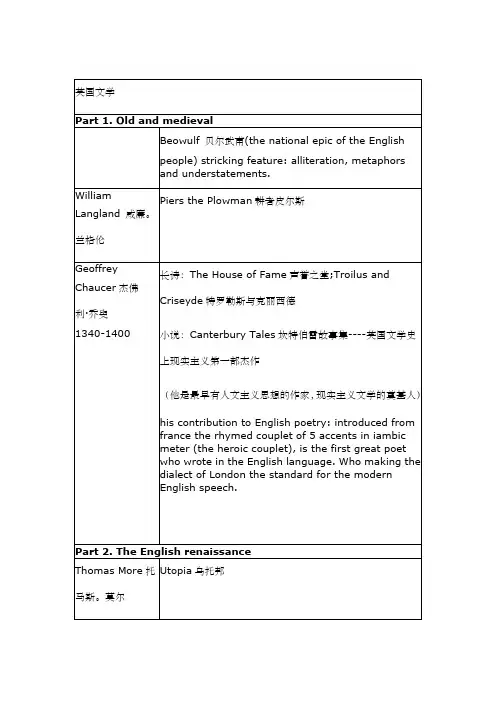
Chapter One The Anglo-Saxon period (Old English Literature)Historical BackgroundCelts 400B.C----under the rule of Roman Empire 50B.C-------Anglo-Saxon 450A.D----Norman Invasion 1066 A.DLiteratureTwo highlights in the development of the Anglo-Saxon literature1.Northumbrian School1)Center: the monasteries and abbeys in the kingdom of Northumbrian2)Figures:A.Caedmon流派:Northumbrian School作品:Paraphrase(Bible in verse form)评价:the first Anglo-Saxon poet(from abbeys)B.Venerable Bade流派:Northumbrian School作品:The Ecclesiastical History of the English People评价:a monk; “Father of English History”; covers the whole length of early Englishhistory, full of religious stories and miracles.2.King Alfred1)Figure: King Alfred(king of Wessex)2)流派:Wessex LiteratureA.Religious group(biblical themes)B.Secular group(the harness of circumstances and the sadness of the human lot)3)贡献:A.Translate Latin books into West Saxon dialectpile the Anglo-Saxon chronicle编年史C.Form a style of Anglo-Saxon proseBeowulf (Anglo-Saxon poetry)类型:Long epic poetry(heroic poetry)Features:1)3183 lines, an Oral Epic, recited in court, handed down in generations until finally it wasrecorded by certain poet2) A mixture of history and legend3)Composed in West Saxon dialect of Old English4)First “post-classical” (古典时代后)European epic5)The “historical” events occurred before 600 AD6) A story of a hero, Beowulf, mixing Pagan and ChristianThemes:to show how the primitive people fight against the forces of the natural world under a wise and mighty leader.Chapter Two The Norman PeriodHistorical backgroundThe Norman Conquest in 1066. Duke William of Normandy claimed himself William I, king of England (the battle of hastings)Kings---Barons-----Knights, a feudal system of hierarchy was formedLanguageUpper class: French and LatinLower class: Anglo-Saxon Dialect/ Old EnglishLiterature1.Religious literatureAbout Christian teaching: personal salvation, Biblical story, putting emphasis on the moral and spiritual responsibilities of the individual rather than on his ethnical and social responsibilities.2.Sedular literature(including Romance, and some poems or popular ballads)Roman骑士文学(a type of literature that was very popular in the Middle Ages)1.概述:1)Quite popular in Middle Ages2)It is about the life and adventure undertaken by a knight3)It reflected the spirit of chivalry. The content of Romance: love, chivalry and religion2.Subject MattersIn subject matters, romance naturally falls under three categories:1)The matter of France: a number of romances deal with the exploits of Charlemagne theGreat and Roland, a French national hero in the 8th century. The most well known piece is Chanson de Roland2)The matter of Rome: some romances deal with Alexander the Great and the siege of Troy3)The matter of Britain: there are many cycles of Arthurian Romances, among which aretales about Sir Gawain, Launcelot, Merlin, the quest for the Holy Grail, and the death of King Arthur3.主要作品Sir Gawain and the Green Knight类型:Romance概述:1)Features: vivid portrayal; unified and exciting plot; mixture of Anglo-Saxon poetry;alliterative verse with metrical verse; three hunting scenes2)Theme: ideal of feudal knighthoodChapter Three Chaucer AgesHistorical Background1.Chaucer and William Langland and the writer of Sir Gawain were contemporaries. But Chaucerwas such an important writer in English literature. He was heralding the coming of a new age.2.The Hundred Years’ War between England and France.------The English won and theycontrolled large French territory. An awakening of national consciousness in England.3.The peasant uprising of 1381-----suppressed; William Langland and John Wycliff expressed thepeople’s hatred for the corrupt church and governmentLiteratureJohn Wycliff1.The first figure to revolt against the Church2.Translated the Bible into Standard English3.“Father of English prose”William Langland代表作品:Piers Plowman作品评价:1)an allegory that gives a realistic picture of 14th century English2)the form of a dream vision, a popular medieval poetic form, in which the author presents thestory under the guise of the poet having dreamed it, using alliteration3) a picture of feudal England4)the exposure of ruling class5)political and church situation6)conditions of peasants7)search for truthGeoffrey Chaucer1.文学成就(three periods of Chaucer’s works and the chief poem of each period)A.Imitation of France: The book of the DuchessB.Imitation of the Italian literature: Troilus and Gryseyde ; The parliament of Fowls; TheHouse of FameC.The period of original creation: The Canterbury Tales2.人物贡献评价A.Forerunner of humanism, a nd English realistic literature(Father of English poetry)B.He introduced from Italy and France the rhymed stanza of various types especially heroiccoupletC.The first great poet who wrote in English language, thus establishing English as theliterary languageD.He did much in making the London dialect the foundation for modern EnglishE.Touches of mild irony or light satire3.The Canterbury Tales1)类型:Couplet2)概述:prehensive literary formsThe tales,22 in verse, two in prose, cover all the major types of medieval literature:courtly romance, folk tale, beast fable, story of travel, adventure, saint’s life,allegorical tale, sermonA comprehensive picture of Chaucer’s time and people of different ranks andoccupations.B.Dramatic structureA fascinating accord between the tellers and their stories, and overtones from whatwe see in Prologue and what is revealed in storiesLink: the interchanges among pilgrims connecting the stories; Prologue and Link areto connect the stories.Chapter Four The Fifteenth Century (still Romance)Historical Background1.The Hundred Years’ War: King Henry VI: all English territory in France was lost2.The War of Roses: civil war fought between the two great families, both of which claimed theright to the English throne. House of Lancaster VS House of York3.The discovery of America and the new sea routes4.Reformation of the ChurchPopular Ballads1.特点:A short anonymous poem that tells a story, often sung with the company of music and dance1)The beginning is often abrupt2)Strong dramatic elements3)Often told through dialogue and action4)The theme is often tragic5)Simplicity6)The ballad meter民谣体is used2.概述1)Originally narrative poems in oral form2)Didn’t recorded until late 18th and 19th centuries, Bishop Percy compiled Reliques ofAncient English PoetryThomas Malory流派:Romance作品:The Death of Arthur评价:1)Compiled together the stories of King Arthur and his knights2)Contributed to the development of English prose3)Both Robin Hood and King Arthur symbolize the sentimental looking back at medieval spiritof chivalryEarly English Plays1.Mystery play: based on stories from the Bible2.Miracle play: based on lives of Christian Saints3.Morality play: to teach and illustrate religious and moral doctrinesChapter Five The English Renaissance (Modern English)Historical background1.The reign of Queen Elizabeth -------England enjoyed a period of peace and prosperity.2.Defeat the Spanish Armada in 1588-----greatly strengthened the power of monarch andaccelerated the awakening of national consciousness------gradually became a mighty naval power3.Enclosure movementRising of the burgher class------discovery of the new sea routes-----the demands for wool increased-------turned vast arable land into pastures-----large numbers of peasants became landless men4.Humanism人文主义the ideal of Renaissance. The welfare of human being is very important. It emphasized the worth of life in this world and the dignity of human beingLiteratureEdmund Spenser (poet)1.流派类型:humanist2.作品:1)The Shephearde’s CalenderA. A pastoral poem田园诗歌B.Main themes: love, poetry and religionC.Set the pastoral fashion in English literature2)The Faerie QueeneA.An unfinished allegorical romanceB.Theme: to fashion a gentleman or noble person in virtuous and gentle discipline3.评价:1)“Poet’s Poet’, the greatest poet of English Renaissance2)Takes up the epic form, and unities the classical and Christian traditions with Renaissanceideas3)Contribute to the form an technique of poetry composition4)Nine-line Spenserian stanza5)The first one to skillfully use modern English and distinguish it from Chaucer’s middleEnglishChristopher Marlowe1.流派:University Wit2.作品:1)The plays: important ones of 6 plays: Tamburlaine; The Tragic History of Doctor Faustus;The Jew of Malta and Eduard II2)The non-dramatic poetry: Hero and Leander, ”the passionate shepherd to his love”3)The verse translation: Ovid’s Amores3.作品和作者评价:A.Tamburlaine: Marlowe voiced the supreme desire of the man of the Renaissance forinfinite power and authorityB.Dr. Faustus: from German legend. It celebrates the human passion for knowledge, powerand happiness.C.Marlowe perfected the blank verse and brought vitality and grandeur into blank versewith his “mighty lines/ magic lines”D.His creation of the Renaissance hero for English drama. Such hero is always individualisticand full of ambition.William Shakespeare1.作品:1)History play(period of experimentation; early years): King Henry VI; Richard III; Twogentlemen of Verona; Love’s Labour Lost2)Period of rapid growth: Midsummer Night’s Dream, Romeo and Juliet; The Merchant ofVenice; the two parts of Henry VI; As You Like It; Julie Caesar3)Period of groom: Hamlet; Othello4)Period of restored serenity: The Winter’s Tale; The Tempest2.评价:1)Represent the trend of history in getting voice to the desires and aspirations of the people2)Shakespeare’s humanism: reflect the spirit of his age; the humanist outlook prevails inhis comedies as well as his late tragedies. Early-----optimistic; late------pessimistic3)Shakespeare’s characterization: Shakespeare’ characters have many aspects or dimensionstrue of the common sense of humanity4)Shakespeare’s originality: his plays are original because he installed into the old materialsa new spirit t hat gives new life to his play5)Shakespeare as a great poet. He was well versed in writing lyrical verse 抒情诗as well aspoetry of great passion and agony6)Master of English languageChapter Six The Seventeenth Century (Bourgeois Revolution and Restoration period)Historical Background1.English Bourgeois RevolutionDuring the reign of Elizabeth, England enjoyed a time of prosperity and fast development.When Charles I came to the throne, relations between the monarch and Parliament, which mainly represented the interests of the burgher class , became worse. The burghers wanted free trade but the king controlled trade and imposed heavy taxes on merchants. Charles I raised money by granting or selling monopolies, which is one of the causes of English bourgeois.Another cause of bourgeois revolution was the persecution of the Puritans. The Puritans were Christians who wanted to make reforms in the Anglican Church. They were opposed to CharlesI and demanded more freedom of religion. Puritanism represented the interests of thebourgeois.King VS The Parliament(has the support of the capitalists and businessmen, and also the Puritans)2.Restoration PeriodCharles I was beheaded. After the civil war, the Parliament was in power. Cromwell became the Lord Protector. After the death of Cromwell, the bourgeoisie invited the son of Charles I to be the king of England.-----------James II(was driven out)----------William Orange signed “The bill of Rights” which greatly restricted the power of king. ---------------constitutional monarchyThe revolution period is also called puritan age, because the English revolution was carried out under a religious cloak.LiteratureThe King James Bible of 1611The Old Testament originally written in Hebrew; the New Testament is originally written in Greek. Francis Bacon代表作品:Of Great Place, Of Studies评价:studied in Cambridge; generally regarded as the chief figure in English prose in the first half of the 17th century and his essays began the long tradition of the English essay in the history of English literature.Feature of works: abstract; his works are known for conciseness, brevity, simplicity and forcefulness.Praised by Marx as the ”the progenitor of English materialism”Metaphysical poets and Cavalier poets1.简介Two schools of poets during the reign of Charles I: Metaphysical poets and Cavalier poets1)Metaphysical poetryA.Characteristics of metaphysical poetry:Rebellion against the conventional imagery of the Elizabethan lyricPoems are intellectually complexIrregular rhythms, stanzasColloquial, condensed language, give and take of actual speechUse of metaphysical conceit(妙喻): ingenious, strained; links images from differentcontexts; intellectual; subtle argumentComplexity of thought, frequent use of paradoxB.Representatives: John Donne(inventor); John Milton; John Dryden; John BunyanC.Main themes: love, death, religion2)Cavalier poetryA.Characteristics of cavalier poetryCourtliness, urbanity and polishReflected the extravagance and moral looseness of court lifeB.Main themes: love and “Carpe Diem”C.Representatives: Ben Johnson (poet, playwright)2.John Donne1)派别:Metaphysical2)代表作品: The Songs and Sonnets; Death, Be Not Proud; The Flea; A Valediction: Forbidding Mourning3)评价:A.leading figure of the metaphysical schoolB.two stages of life: one courtier, the second Dr. John Donne, Dean of St. Paul’s Cathedral C.most striking feature: frequent use of conceitD.best-known lyrics: Song and Sonnets; Love is the basic theme. Donne holds that the nature of love is the union of soul and bodyE.love lyrics may be classified into two groups:✧negative attitude towards love: cynical tone to satirize women’s inconstancy✧positive attitude towards love: expresses his genuine sentiments of love, andeven sanctifies love as something holy3.John Milton1)派别: Metaphysical ; Chief Puritan poet2)代表作品:Three epics(long poem): Paradise Lost(long epic and blank verse); ParadiseRegained(long epic); Samson Agonistes On His Blindness3)评价:ton is a great revolutionary poet of the 17th century. He is also an outstandingpolitical pamphleteer of the Revolution period. He dedicated himself to therevolutionary cause. He has exerted far-reaching influence on the later English poetry.Many English poets have drawn inspiration from himton is a great stylist. His poetry is of a grand style. He has made a life-long study ofclassical and biblical literature. His poetry is noted for sublimity of thought andmajesty of expressionton is a great master of blank verse. He is the forerunner to introduce blank verseinto non-dramatic poetry. His blank verse is full of poetic imagination and nevermonotonous.4.John Dryden(poet, dramarist, critic ,prose writer, satrist)1)派别:metaphysical; neo-classicism2)代表作品:play: All for Love poems: Absolom and Achitophel3)评价:A.His poetry is characterized by a witty satirical style, although he did write somereligious verseB.One of the leading neo-calssical(Augustan) poets along with Swift, Addison and Pope.In an attempt to move away from the work of the Elizabethan poets, they drewinspiration from Roman poetsC.Father of English Criticism: An Essay of Dramatic PoesyD.Forerunner of the English Classical school of literature in the next century, theadvocate of neoclassicism that upheld reason, law and order in literature5.John Bunyan1)派别:metaphysical, chief Puritan writer of prose2)代表作品: The Pilgrim’s progress(allegory and drama)3)评价A.Puritan wirter whose style was modeled after of the English BibleB.His language is concrete and vividC.The Pilgrim’s Progress is the most successful religious allegoryD.His miserable life as a poor man and his religious fervor drove him to have day-dreamsoftenDifferent aspects between the literature of Elizabethan Period and the literature of the Revolution Period1.The revolution period was of confusion in literature. English literature of the period witnessesa decline and degeneration, witnessed a conflict between the two antagonistic campes. It isdifferent from the literature of Elizabethan period in three aspects:2.E-literature had a marked unity and the feeling of patriotism and devotion to the Queen, butin R-period, all this was changed. The king became the open enemy of the people, and country was divided by the struggle for political and religious liberty. So literature was as divided in spirit as were the struggling parties3.E-literature was generally inspiring. It throbbed with youth, hope and vitality. Literature in thePuritan Age expressed age and sadness.4.E-literature was intensely romantic, but in literature of the Puritan period, we cannot findromantic ardor.Chapter Seven The Eighteenth Century (The Age of Enlightenment in England;Age of Reason)Historical background1.The constitutional monarchy------Parliament became the actual leader of the country------twoparties(Tori and Whig)2.England grew from a second rate country to a powerful country by defeating other Europeanpowers esp. France3.Some special features:1)Political writings2)Newspaper and journals: newspapers and journals become the means for people of thetime of the upper class to utter political opinions3)Coffeehouse4)The new morality: Age of Reason; Reason in England was a tool for bourgeois toconsolidate its rule5)Science and technology: Newton6)The French influence: prose, novel, neo-classicism4.The 18th century marked the beginning of an intellectual movement in England, theEnlightenment. English enlighteners intended to reform social life according to a more reasonable principle. Everything had to justify its existence by reason. The literature of this type mainly appealed to the middle class readers. Three stages of Enlightenments:1)Neo- Classicism: a revival in the seventeenth and eighteenth centuries of classicalstandards of order, balance, and harmony in literature. John Dryden and Alexander Pope were major exponents of the neo-classical school. People stressed reason rather than emotion,form rather than content, therefore didactic and satiric literature, closed couplet for its elegance, correctness, appropriateness and restraint.2)The beginning of Modern NovelAs the Middle Ages delighted in long romantic narrative poems, the Elizabethans in drama, so the public of 18th century is enamored of the novel3)Sentimentalism and Pre-Romanticism简单来说:a.The main literary stream of the 18th century was Realismb.An age of prosec.Novel writing made a big advance in this centuryd.In this stage satire was much used in writingLiteratureDaniel Defoe (realistic novelist)代表作:Robinson Crusoe; Captain Singleton; Moll Flanders; Roxana: the Fortunate Mistress; A Journal of the Plague Year评价贡献:1. A pioneer novelist of England, a journalist and a pamphleteer. Good at making a “good story”2.In Robinson Crusoe, Defoe established the real story about a sailor with his own imaginationand some adventure stories. Robinson Crusoe is a representative of the English bourgeoisie at the earlier stage of its development. The story of Friday shows a germ of colonization thoughts Literary features1.His inimitable gift in crating characters alive and his stories credible. Invent extraordinarysituations so naturally that everybody believe it’s true2.His style is smooth, easy and colloquial, never coarse. He loves short, crisp and plainsentences3.One of the forerunners of English realistic novel4.The rise and growth of the realistic novel is the most prominent achievement of the 18thcentury English literature5.The modern European novel began after the RenaissanceJonathan Swift (satirist, novelist, essayist, political pamphleteer)代表作:Gulliver’s Travels; A tale of a tub (satire, prose); The battle of the Books (sent); A modest proposal评价贡献:1.Swift is a master satirist. His satire is usually masked by an outward gravity and an apparentearnestness which renders his satire all the more powerful.2.His “ A modest proposal” is generally taken as a perfect model. By suggesting that poor Irishparents sell their one-year-old babies to the rich English lords and ladies as food, Swift is making the most devastating protest against the inhuman exploitation and oppression of the Irish people by the English ruling class. The apparent eagerness, sincerity and detachment of the author adds force to the bitter irony and biting sarcasm.3.Swift is one of the greatest masters of English prose. He is almost unsurpassed in the writingof simple, direct, precise prose. He defined a good style as “proper words in proper places”.Clear, simple, concrete diction, uncomplicated sentence structure, economy and conciseness of language mark all his writings-------essays, poems and novels.Joseph Addison and Richard SteeleJoseph Addison: poet, playwright, essayist, publisher of newspaperRichard Steele: studies at Oxford, secretary of State两人代表作:Periodical: The Tatler, The Spectator, The Guardian评价贡献:The significance of their essaysa.Their writings in The Tatler and The Spectator provide a new code of social morality for therising bourgeoisb.They give a true picture of the social life of England in the 18th centuryc.In their hands, the English essay completely established itself as a literary genre. Using it as aform of character sketching and story telling, they ushered in the dawn of the modern novel. Alexander Pope1.流派:neo-classicism, satirist, poet2.代表作品:Essay on Criticism; The Rape of the Lock; Pope’s Homer; Pope’s Shakespeare; TheDunciad; Essay on Man3.评价贡献:1) A representative of neo-classicism and enlightenment movement in England and also themost important poet in the first half of the 18th century2)He was a master in the art of poetry. By frequently writing in the form of heroic couplet,he became so perfect in it that no one has been able to approach him3)At his best, he is singularly direct and compact4)Pope’s style also depends upon his great patience in elaborating his art.Samuel Johnson1.流派类型:neo-classicism, poet, dramatist, prose romancer, biographer, essayist, critic,lexicographer and publicist2.代表作: London; The Vanity of Human Wishes; Rasselas; Lives of the English Poets; Journey tothe Western; Islands of Scotland3.评价贡献:1)Johnson’s style is typically neo-classical, but it is at the opposite extreme from Swift’ssimplicity or Addison’s neatness.2)His language is characteristically general, often Latinate and frequently polysyllabic.3)His sentences are long and well structured, i nterwoven with parallel words and phrases.However, no matter how complex his sentences are ,the thought is always clearly expressed; though he tended to use ”learned words”, they are always accurately used.Henry Fielding1.流派类型:playwright, novelist2.代表作:Comedy not welcome; Parody: Shamela; 4 novels: Joseph Andrews; Jonathan Wildthe Great; Tome Jones; Amelia3.评价贡献:1)Founder of the realistic English novel2)The first to give the modern novel its structure and style3)Before him, the relating of a story in a novel was either in the epistolary form书信体, asin Richardson’s Oamela, or the picaresque form流浪体through the mouth of the principal character, as in Defoe’s Robinson Crusoe, but Fielding adopted “ the third-person narration”, in which the author becomes the “all-knowing God”.4)He “thinks the thought” of all his characters, so he is able to present not only their externalbehaviors but also the internal workings of their minds. Besides the tries to retain the grand epical form大史诗形式of the classical works and keeps faithful to his realistic presentation of common life as it is5)Firmly believed in the educational function of literature6)Shared the contemporary view of the English enlighteners that the purpose of the novelwas to present a faithful picture of life, “the just copies of human manners”, with sound teaching woven into their texture, so as to reach men to know themselves, their proper spheres and appropriate manners.Tobias George Smollett (novelist, poet, playwright)流派:picaresque novelist流浪体小说代表作:The Expedition of Humphry Clinker(in the form of letter)------作者最后绝笔 A Complete History of England, The Adventure of Roderick Random,and The Adventures of Peregrine Pickle, Travels through France and Italy评价:1)Scottish poet, author2)Best known for his picaresque novels, such as The Adventure of Roderick Random,andThe Adventures of Peregrine PickleThomas Gray流派:Sentimentalism and Graveyard School1)Sentimentalism感伤主义In the middle of the eighteenth century, discontent with social reality and bored withrules and reasons respected by neo-classicism, the enlightened writers turned to thecountryside for the writing materials and appealed to sentiment and human heart.The poetry of sentimentalists displays a sincere sympathy for the poverty-strickenpeasants, though still in classical style, in contrast to the classicists’ like Pope’s concernwith the middle class and the bourgeois. They craved for something more natural andspontaneous in thought and language. In their poetry, emotions and sentimentsbegan to play a leading role again.The sentimentalist poetry marks the midway transition from classicism to its oppositeRomanticism in English poetry.2)Graveyard School暮园派“Graveyard poets” is a critical term applied in retrospect to a number of English poetsof the 1750s to the 1790s who write in the vein of Thomas Gray’s Elegy in a CountryChurchyard. These poets are also sometimes called “pre-Romantics”Besides, the term encompasses at least two major works written before Gray’s Elegy:James Thomas’s The Seasons, and Edward Young’s Night Thoughts.代表作品:Elegy Written in a Country Churchyard; “Ode on a Distant Prospect of Eton College”; “Ode on the Death of a Favorite Cat”评价贡献:1)An educated poet with small literary output2)The leader of the sentimental poetry, esp. poetry of “the Graveyard School”3)His poems mostly devote to a sentimental lamentation on life, past and presentRichard Brinsley Sheridan流派:Dramatist/Playwright; Sentimentalism作品:The School for Scandal; The Rivals评价贡献:1)An important comic playwrights of the English drama2)The School for Scandal is considered one of the finest English comedies of manners. A satire on gossip, hypocrisy and the corrupting influence of fashionable city life.Great for its ingenious plot construction and witty dissection of character.3)Other outstanding comedy: RivalsRobert Burn流派:Pre-Romanticism(Graveyard School)代表作品:Auld Lang Syne; A Red, Red Rose; Is There for Honest Poverty Scots评价贡献:1)Wrote poems and songs in the Scottish dialect and in the tradition of Scottish folk song.2)Themes: love, patriotic and political3)Had a profound love for the common Scottish people and their literature. And his poems and songs premeated with the Scottish national spiritWilliam Blake流派:Pre-Romanticism(Graveyard School)代表作品:Songs of Innocence; Songs of Experience; The lamb; Holy Thursday; Prophetic Books 评价:Many poems in the two collections contradict each otherSongs of Innocence: express the poet’s delight in life, even in the face of sorrow and suffering.Songs of experience: atmosphere is no longer sunny but sad and gloomy. Evil is found everywhere in this world.。