
Bromosporine__DataSheet_MedChemExpress
- 格式:pdf
- 大小:118.63 KB
- 文档页数:1

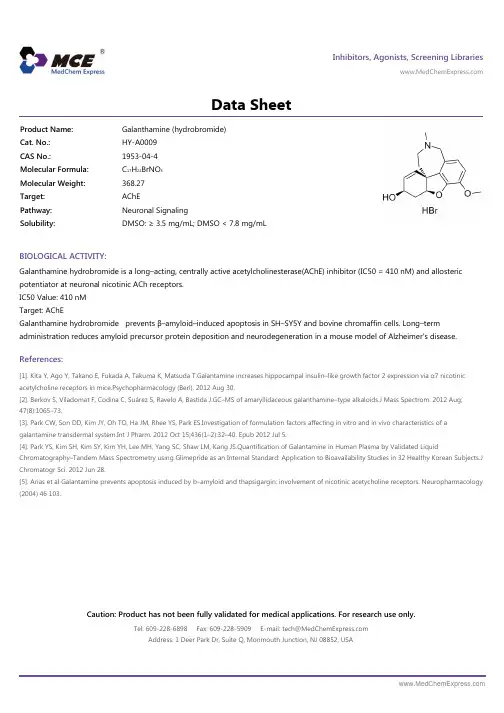
Inhibitors, Agonists, Screening Libraries Data SheetBIOLOGICAL ACTIVITY:Galanthamine hydrobromide is a long–acting, centrally active acetylcholinesterase(AChE) inhibitor (IC50 = 410 nM) and allosteric potentiator at neuronal nicotinic ACh receptors.IC50 Value: 410 nMTarget: AChEGalanthamine hydrobromide prevents β–amyloid–induced apoptosis in SH–SY5Y and bovine chromaffin cells. Long–termadministration reduces amyloid precursor protein deposition and neurodegeneration in a mouse model of Alzheimer's disease.References:[1]. Kita Y, Ago Y, Takano E, Fukada A, Takuma K, Matsuda T.Galantamine increases hippocampal insulin–like growth factor 2 expression via α7 nicotinic acetylcholine receptors in mice.Psychopharmacology (Berl). 2012 Aug 30.[2]. Berkov S, Viladomat F, Codina C, Suárez S, Ravelo A, Bastida J.GC–MS of amaryllidaceous galanthamine–type alkaloids.J Mass Spectrom. 2012 Aug;47(8):1065–73.[3]. Park CW, Son DD, Kim JY, Oh TO, Ha JM, Rhee YS, Park ES.Investigation of formulation factors affecting in vitro and in vivo characteristics of a galantamine transdermal system.Int J Pharm. 2012 Oct 15;436(1–2):32–40. Epub 2012 Jul 5.[4]. Park YS, Kim SH, Kim SY, Kim YH, Lee MH, Yang SC, Shaw LM, Kang JS.Quantification of Galantamine in Human Plasma by Validated LiquidChromatography–Tandem Mass Spectrometry using Glimepride as an Internal Standard: Application to Bioavailability Studies in 32 Healthy Korean Subjects.J Chromatogr Sci. 2012 Jun 28.[5]. Arias et al Galantamine prevents apoptosis induced by b–amyloid and thapsigargin: involvement of nicotinic acetycholine receptors. Neuropharmacology (2004) 46 103.Product Name:Galanthamine (hydrobromide)Cat. No.:HY-A0009CAS No.:1953-04-4Molecular Formula:C 17H 22BrNO 3Molecular Weight:368.27Target:AChE Pathway:Neuronal Signaling Solubility:DMSO: ≥ 3.5 mg/mL; DMSO < 7.8 mg/mLCaution: Product has not been fully validated for medical applications. For research use only.Tel: 609-228-6898 Fax: 609-228-5909 E-mail: tech@ Address: 1 Deer Park Dr, Suite Q, Monmouth Junction, NJ 08852, USA。
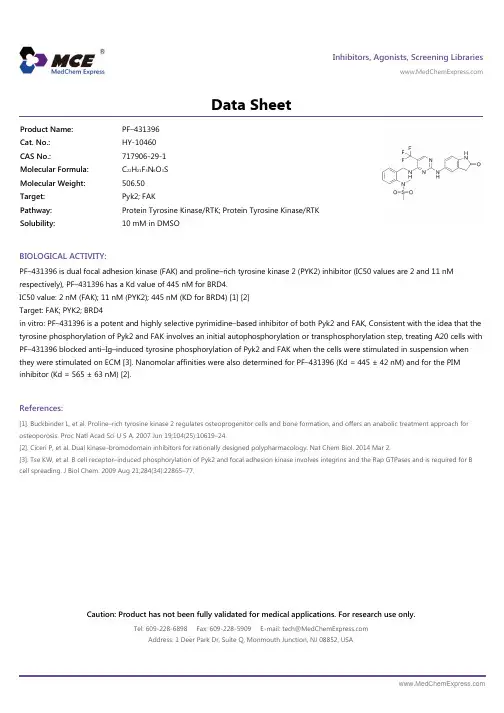
Inhibitors, Agonists, Screening Libraries Data SheetBIOLOGICAL ACTIVITY:PF–431396 is dual focal adhesion kinase (FAK) and proline–rich tyrosine kinase 2 (PYK2) inhibitor (IC50 values are 2 and 11 nM respectively), PF–431396 has a Kd value of 445 nM for BRD4.IC50 value: 2 nM (FAK); 11 nM (PYK2); 445 nM (KD for BRD4) [1] [2]Target: FAK; PYK2; BRD4in vitro: PF–431396 is a potent and highly selective pyrimidine–based inhibitor of both Pyk2 and FAK, Consistent with the idea that the tyrosine phosphorylation of Pyk2 and FAK involves an initial autophosphorylation or transphosphorylation step, treating A20 cells with PF–431396 blocked anti–Ig–induced tyrosine phosphorylation of Pyk2 and FAK when the cells were stimulated in suspension when they were stimulated on ECM [3]. Nanomolar affinities were also determined for PF–431396 (Kd = 445 ± 42 nM) and for the PIM inhibitor (Kd = 565 ± 63 nM) [2].References:[1]. Buckbinder L, et al. Proline–rich tyrosine kinase 2 regulates osteoprogenitor cells and bone formation, and offers an anabolic treatment approach for osteoporosis. Proc Natl Acad Sci U S A. 2007 Jun 19;104(25):10619–24.[2]. Ciceri P, et al. Dual kinase–bromodomain inhibitors for rationally designed polypharmacology. Nat Chem Biol. 2014 Mar 2.[3]. Tse KW, et al. B cell receptor–induced phosphorylation of Pyk2 and focal adhesion kinase involves integrins and the Rap GTPases and is required for B cell spreading. J Biol Chem. 2009 Aug 21;284(34):22865–77.Product Name:PF–431396Cat. No.:HY-10460CAS No.:717906-29-1Molecular Formula:C 22H 21F 3N 6O 3S Molecular Weight:506.50Target:Pyk2; FAK Pathway:Protein Tyrosine Kinase/RTK; Protein Tyrosine Kinase/RTK Solubility:10 mM in DMSOCaution: Product has not been fully validated for medical applications. For research use only.Tel: 609-228-6898 Fax: 609-228-5909 E-mail: tech@ Address: 1 Deer Park Dr, Suite Q, Monmouth Junction, NJ 08852, USA。

Inhibitors, Agonists, Screening LibrariesSafety Data Sheet Revision Date:Oct.-04-2018Print Date:Oct.-04-20181. PRODUCT AND COMPANY IDENTIFICATION1.1 Product identifierProduct name :Aclidinium (Bromide)Catalog No. :HY-14144CAS No. :320345-99-11.2 Relevant identified uses of the substance or mixture and uses advised againstIdentified uses :Laboratory chemicals, manufacture of substances.1.3 Details of the supplier of the safety data sheetCompany:MedChemExpress USATel:609-228-6898Fax:609-228-5909E-mail:sales@1.4 Emergency telephone numberEmergency Phone #:609-228-68982. HAZARDS IDENTIFICATION2.1 Classification of the substance or mixtureGHS Classification in accordance with 29 CFR 1910 (OSHA HCS)Acute toxicity, Oral (Category 4), H302Acute aquatic toxicity (Category 1), H400Chronic aquatic toxicity (Category 1), H4102.2 GHS Label elements, including precautionary statementsPictogramSignal word WarningHazard statement(s)H302 Harmful if swallowed.H410 Very toxic to aquatic life with long lasting effects.Precautionary statement(s)P264 Wash skin thoroughly after handling.P270 Do not eat, drink or smoke when using this product.P273 Avoid release to the environment.P301 + P312 IF SWALLOWED: Call a POISON CENTER or doctor ⁄ physician if you feel unwell.P330 Rinse mouth.P391 Collect spillage.P501 Dispose of contents ⁄ container to an approved waste disposal plant.2.3 Other hazardsNone.3. COMPOSITION/INFORMATION ON INGREDIENTS3.1 SubstancesSynonyms:LAS 34273;LAS-W 330Formula:C26H30BrNO4S2Molecular Weight:564.55CAS No. :320345-99-14. FIRST AID MEASURES4.1 Description of first aid measuresEye contactRemove any contact lenses, locate eye-wash station, and flush eyes immediately with large amounts of water. Separate eyelids with fingers to ensure adequate flushing. Promptly call a physician.Skin contactRinse skin thoroughly with large amounts of water. Remove contaminated clothing and shoes and call a physician.InhalationImmediately relocate self or casualty to fresh air. If breathing is difficult, give cardiopulmonary resuscitation (CPR). Avoid mouth-to-mouth resuscitation.IngestionWash out mouth with water; Do NOT induce vomiting; call a physician.4.2 Most important symptoms and effects, both acute and delayedThe most important known symptoms and effects are described in the labelling (see section 2.2).4.3 Indication of any immediate medical attention and special treatment neededTreat symptomatically.5. FIRE FIGHTING MEASURES5.1 Extinguishing mediaSuitable extinguishing mediaUse water spray, dry chemical, foam, and carbon dioxide fire extinguisher.5.2 Special hazards arising from the substance or mixtureDuring combustion, may emit irritant fumes.5.3 Advice for firefightersWear self-contained breathing apparatus and protective clothing.6. ACCIDENTAL RELEASE MEASURES6.1 Personal precautions, protective equipment and emergency proceduresUse full personal protective equipment. Avoid breathing vapors, mist, dust or gas. Ensure adequate ventilation. Evacuate personnel to safe areas.Refer to protective measures listed in sections 8.6.2 Environmental precautionsTry to prevent further leakage or spillage. Keep the product away from drains or water courses.6.3 Methods and materials for containment and cleaning upAbsorb solutions with finely-powdered liquid-binding material (diatomite, universal binders); Decontaminate surfaces and equipment by scrubbing with alcohol; Dispose of contaminated material according to Section 13.7. HANDLING AND STORAGE7.1 Precautions for safe handlingAvoid inhalation, contact with eyes and skin. Avoid dust and aerosol formation. Use only in areas with appropriate exhaust ventilation.7.2 Conditions for safe storage, including any incompatibilitiesKeep container tightly sealed in cool, well-ventilated area. Keep away from direct sunlight and sources of ignition.Recommended storage temperature:Powder-20°C 3 years4°C 2 yearsIn solvent-80°C 6 months-20°C 1 monthShipping at room temperature if less than 2 weeks.7.3 Specific end use(s)No data available.8. EXPOSURE CONTROLS/PERSONAL PROTECTION8.1 Control parametersComponents with workplace control parametersThis product contains no substances with occupational exposure limit values.8.2 Exposure controlsEngineering controlsEnsure adequate ventilation. Provide accessible safety shower and eye wash station.Personal protective equipmentEye protection Safety goggles with side-shields.Hand protection Protective gloves.Skin and body protection Impervious clothing.Respiratory protection Suitable respirator.Environmental exposure controls Keep the product away from drains, water courses or the soil. Cleanspillages in a safe way as soon as possible.9. PHYSICAL AND CHEMICAL PROPERTIES9.1 Information on basic physical and chemical propertiesAppearance Off-white to pink (Solid)Odor No data availableOdor threshold No data availablepH No data availableMelting/freezing point No data availableBoiling point/range No data availableFlash point No data availableEvaporation rate No data availableFlammability (solid, gas)No data availableUpper/lower flammability or explosive limits No data availableVapor pressure No data availableVapor density No data availableRelative density No data availableWater Solubility No data availablePartition coefficient No data availableAuto-ignition temperature No data availableDecomposition temperature No data availableViscosity No data availableExplosive properties No data availableOxidizing properties No data available9.2 Other safety informationNo data available.10. STABILITY AND REACTIVITY10.1 ReactivityNo data available.10.2 Chemical stabilityStable under recommended storage conditions.10.3 Possibility of hazardous reactionsNo data available.10.4 Conditions to avoidNo data available.10.5 Incompatible materialsStrong acids/alkalis, strong oxidising/reducing agents.10.6 Hazardous decomposition productsUnder fire conditions, may decompose and emit toxic fumes.Other decomposition products - no data available.11.TOXICOLOGICAL INFORMATION11.1 Information on toxicological effectsAcute toxicityClassified based on available data. For more details, see section 2Skin corrosion/irritationClassified based on available data. For more details, see section 2Serious eye damage/irritationClassified based on available data. For more details, see section 2Respiratory or skin sensitizationClassified based on available data. For more details, see section 2Germ cell mutagenicityClassified based on available data. For more details, see section 2CarcinogenicityIARC: No component of this product present at a level equal to or greater than 0.1% is identified as probable, possible or confirmed human carcinogen by IARC.ACGIH: No component of this product present at a level equal to or greater than 0.1% is identified as a potential or confirmed carcinogen by ACGIH.NTP: No component of this product present at a level equal to or greater than 0.1% is identified as a anticipated or confirmed carcinogen by NTP.OSHA: No component of this product present at a level equal to or greater than 0.1% is identified as a potential or confirmed carcinogen by OSHA.Reproductive toxicityClassified based on available data. For more details, see section 2Specific target organ toxicity - single exposureClassified based on available data. For more details, see section 2Specific target organ toxicity - repeated exposureClassified based on available data. For more details, see section 2Aspiration hazardClassified based on available data. For more details, see section 212. ECOLOGICAL INFORMATION12.1 ToxicityNo data available.12.2 Persistence and degradabilityNo data available.12.3 Bioaccumlative potentialNo data available.12.4 Mobility in soilNo data available.12.5 Results of PBT and vPvB assessmentPBT/vPvB assessment unavailable as chemical safety assessment not required or not conducted.12.6 Other adverse effectsNo data available.13. DISPOSAL CONSIDERATIONS13.1 Waste treatment methodsProductDispose substance in accordance with prevailing country, federal, state and local regulations.Contaminated packagingConduct recycling or disposal in accordance with prevailing country, federal, state and local regulations.14. TRANSPORT INFORMATIONDOT (US)This substance is considered to be non-hazardous for transport.IMDGUN number: 3077 Class: 9 Packing group: III EMS-No: F-A, S-FProper shipping name: ENVIRONMENTALLY HAZARDOUS SUBSTANCE, SOLID, N.O.S.Marine pollutant: Marine pollutantIATAUN number: 3077 Class: 9 Packing group: IIIProper shipping name: Environmentally hazardous substance, solid, n.o.s.15. REGULATORY INFORMATIONSARA 302 Components:No chemicals in this material are subject to the reporting requirements of SARA Title III, Section 302.SARA 313 Components:This material does not contain any chemical components with known CAS numbers that exceed the threshold (De Minimis)reporting levels established by SARA Title III, Section 313.SARA 311/312 Hazards:No SARA Hazards.Massachusetts Right To Know Components:No components are subject to the Massachusetts Right to Know Act.Pennsylvania Right To Know Components:No components are subject to the Pennsylvania Right to Know Act.New Jersey Right To Know Components:No components are subject to the New Jersey Right to Know Act.California Prop. 65 Components:This product does not contain any chemicals known to State of California to cause cancer, birth defects, or anyother reproductive harm.16. OTHER INFORMATIONCopyright 2018 MedChemExpress. The above information is correct to the best of our present knowledge but does not purport to be all inclusive and should be used only as a guide. The product is for research use only and for experienced personnel. It must only be handled by suitably qualified experienced scientists in appropriately equipped and authorized facilities. The burden of safe use of this material rests entirely with the user. MedChemExpress disclaims all liability for any damage resulting from handling or from contact with this product.Caution: Product has not been fully validated for medical applications. For research use only.Tel: 609-228-6898 Fax: 609-228-5909 E-mail: tech@Address: 1 Deer Park Dr, Suite Q, Monmouth Junction, NJ 08852, USA。
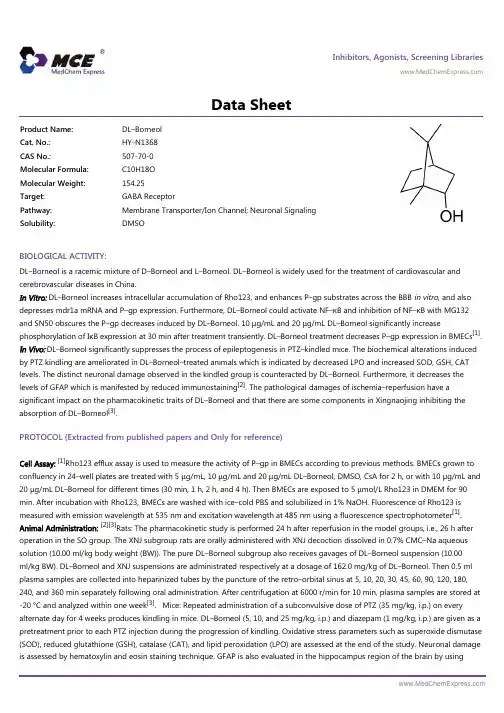
Inhibitors, Agonists, Screening Libraries Data SheetBIOLOGICAL ACTIVITY:DL–Borneol is a racemic mixture of D–Borneol and L–Borneol. DL–Borneol is widely used for the treatment of cardiovascular and cerebrovascular diseases in China.In Vitro: DL–Borneol increases intracellular accumulation of Rho123, and enhances P–gp substrates across the BBB in vitro , and also depresses mdr1a mRNA and P–gp expression. Furthermore, DL–Borneol could activate NF–κB and inhibition of NF–κB with MG132and SN50 obscures the P–gp decreases induced by DL–Borneol. 10 μg/mL and 20 μg/mL DL–Borneol significantly increasephosphorylation of IκB expression at 30 min after treatment transiently. DL–Borneol treatment decreases P–gp expression in BMECs [1].In Vivo: DL–Borneol significantly suppresses the process of epileptogenesis in PTZ–kindled mice. The biochemical alterations induced by PTZ kindling are ameliorated in DL–Borneol–treated animals which is indicated by decreased LPO and increased SOD, GSH, CAT levels. The distinct neuronal damage observed in the kindled group is counteracted by DL–Borneol. Furthermore, it decreases the levels of GFAP which is manifested by reduced immunostaining [2]. The pathological damages of ischemia–reperfusion have a significant impact on the pharmacokinetic traits of DL–Borneol and that there are some components in Xingnaojing inhibiting the absorption of DL–Borneol [3].PROTOCOL (Extracted from published papers and Only for reference)Cell Assay:[1]Rho123 efflux assay is used to measure the activity of P–gp in BMECs according to previous methods. BMECs grown to confluency in 24–well plates are treated with 5 μg/mL, 10 μg/mL and 20 μg/mL DL–Borneol, DMSO, CsA for 2 h, or with 10 μg/mL and 20 μg/mL DL–Borneol for different times (30 min, 1 h, 2 h, and 4 h). Then BMECs are exposed to 5 μmol/L Rho123 in DMEM for 90min. After incubation with Rho123, BMECs are washed with ice–cold PBS and solubilized in 1% NaOH. Fluorescence of Rho123 is measured with emission wavelength at 535 nm and excitation wavelength at 485 nm using a fluorescence spectrophotometer [1].Animal Administration:[2][3]Rats: The pharmacokinetic study is performed 24 h after reperfusion in the model groups, i.e., 26 h after operation in the SO group. The XNJ subgroup rats are orally administered with XNJ decoction dissolved in 0.7% CMC–Na aqueous solution (10.00 ml/kg body weight (BW)). The pure DL–Borneol subgroup also receives gavages of DL–Borneol suspension (10.00ml/kg BW). DL–Borneol and XNJ suspensions are administrated respectively at a dosage of 162.0 mg/kg of DL–Borneol. Then 0.5 ml plasma samples are collected into heparinized tubes by the puncture of the retro–orbital sinus at 5, 10, 20, 30, 45, 60, 90, 120, 180,240, and 360 min separately following oral administration. After centrifugation at 6000 r/min for 10 min, plasma samples are stored at -20 °C and analyzed within one week [3]. Mice: Repeated administration of a subconvulsive dose of PTZ (35 mg/kg, i.p.) on everyalternate day for 4 weeks produces kindling in mice. DL–Borneol (5, 10, and 25 mg/kg, i.p.) and diazepam (1 mg/kg, i.p.) are given as a pretreatment prior to each PTZ injection during the progression of kindling. Oxidative stress parameters such as superoxide dismutase (SOD), reduced glutathione (GSH), catalase (CAT), and lipid peroxidation (LPO) are assessed at the end of the study. Neuronal damage is assessed by hematoxylin and eosin staining technique. GFAP is also evaluated in the hippocampus region of the brain by usingProduct Name:DL–Borneol Cat. No.:HY-N1368CAS No.:507-70-0Molecular Formula:C10H18O Molecular Weight:154.25Target:GABA Receptor Pathway:Membrane Transporter/Ion Channel; Neuronal Signaling Solubility:DMSOimmunohistochemistry[2].References:[1]. Fan X, et al. Borneol Depresses P–Glycoprotein Function by a NF–κB Signaling Mediated Mechanism in a Blood Brain Barrier in Vitro Model. Int J Mol Sci. 2015 Nov 18;16(11):27576–88.[2]. Tambe R, et al. Antiepileptogenic effects of borneol in pentylenetetrazole–induced kindling in mice. Naunyn Schmiedebergs Arch Pharmacol. 2016 May; 389(5):467–75.[3]. Xu P, et al. Comparative pharmacokinetics of borneol in cerebral ischemia–reperfusion and sham–operated rats. J Zhejiang Univ Sci B. 2014 Jan;15(1):84–91.Caution: Product has not been fully validated for medical applications. For research use only.Tel: 609-228-6898 Fax: 609-228-5909 E-mail: tech@Address: 1 Deer Park Dr, Suite Q, Monmouth Junction, NJ 08852, USA。