Unit 6 When was it invented
- 格式:doc
- 大小:137.50 KB
- 文档页数:10
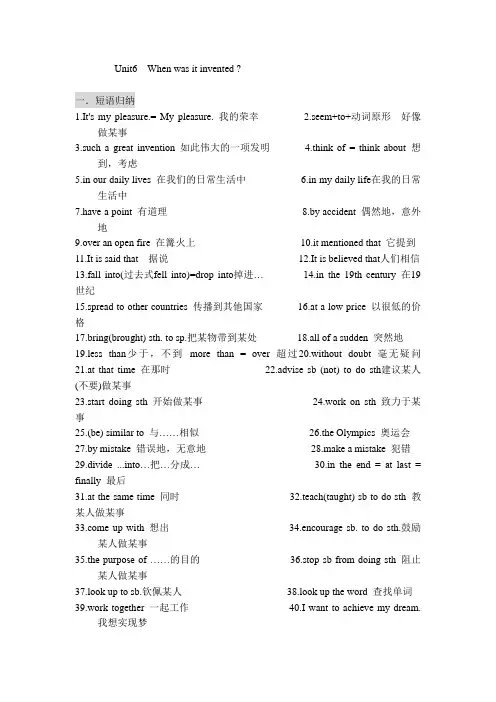
1 九年级预科 Unit 6 When was it invented? 一、教学目标: 1) 能掌握以下单词: style n.样式,款式 low adj.低的,矮的 project n.工程,项目 translate v.翻译 pleasure n.高兴,愉快 lock v.锁上/住 n.锁 daily adj.每日的,日常的 earthquake n.地震 website n.网站 sudden adj.突然的 pioneer n.先锋,先驱 biscuit n.饼干 list v.列表,列清单n.名单,清单 cookie n.曲奇饼 mention v.提到,说到 musical adj.音乐的,有音乐天赋的 ruler n.统治者,支配者 instrument n.器械,工具,仪器 boil v.煮沸,烧开 sour adj.酸的 remain v.保持不变,剩余 customer n.顾客,客户
smell n.气味 v.发出。。。气味,闻到 Canadian adj.加拿大(人)的,n.加拿大人 trade n.贸易,交易,v.做买卖,从事贸易 divide v.分开,分散
national adj.国家的,民族的 basket n.篮,筐 doubt n.v.怀疑,疑惑 hero n.英雄 fridge n.冰箱 professional adj.职业的,专业的
能掌握以下句型: —When was the telephone invented? —I think it was invented in 1876. 2) 能谈论物品被发明的时间、发明者,表达某发明的用途。 二、教学重难点 1. 教学重点: 1) 本课时的单词、词组和句型,学习运用一般过去时态的被动语态。 2) 学会询问发明时间及用途的基本句型: 2. 教学难点: 运用一般过去时态的被动语态来讨论发明的发明时间及用途。 2
三、教学过程 I. Warming up 1. T: Do you know who invented the car/telephone? S1: Karl Benz/Alexander Bell. Printing -- Bisheng Paper -- Cailun Gunpowder -- Gehong 2. 引导学生们学习一般过去时态的被动语态结构转换以下句子。 如: T: Karl Benz invented the first car in 1885. The first car was invented (by Karl Benz) in 1885. .......... Ⅱ. Useful words, phrases and sentences 1. I think the TV was invented before the car. ► I (don’t) think (that) ..... ► invent invention inventor 2. ---- Can you help me think of an invention? ---- With pleasure! / Of course. / I’d like to, but.... / No, I’m afraid I can’t. ► pleasure 乐意 pleased 高兴的,满意的,主语只能是人 pleasant 使人感到高兴的、愉快的,主要是物 It’s a ___________ journey to Paris. It’s my ___________ to help you. He was ___________ to give a speech in public. 3. I have a pair of shoes with special heels. ► with 具有,带有 He has a coat with four pockets. China is a country with long history. 3
4. The designer changed the style of the shoes. ► the style of 款式/风格 Out of style 过时 in style = be fashionable 时尚的,流行的 5. For example, it mentioned that the zipper was invented in 1893. ► for example ► mention 提到 Don’t mention it. = You are welcome. 6. Did you know that tea, the most popular drink in the world, was invented by accident? ► by accident = by chance She found out the truth by accident. 7. Some leaves from a tea plant fell into the water and remained there for some time. ► fall into 落入,陷入,也可作“开始”解 He fell into the river yesterday. He fell into conversation with me. ► remain 留下,保持,剩下,残余 Peter became a manager, but Jack remained a worker. There is little remained after the earthquake. ► some time 一段时间 some times 表示次数或倍数 sometime 某日,有朝一日,日后 sometimes = at times有时,表频率 eg: I’ll stay here for some time. Our school is some times larger than theirs. I will go to New York sometime. Joan goes to school on foot, but sometimes by bike. 8. It produced a nice smell so he tasted the brown water. ► taste感官动词,也叫联系动词,后面跟形容词,作表语. 4
taste/ feel/ sound good smell nice This cake tastes delicious. 9. In England, tea didn’t appear until around 1660, but in less than 100 years, it had become the national drink. ► not … until … 直到 。。。才。。。 ► around = about ► less than少于,不如, 不及 more than 多于,不止 The young man is less than 20 years old. 10. The tea trade from China to Western countries took place in the 19th century. The sun moves steadily from the east to the west. 11. Even though many people now know about tea culture, the Chinese are without doubt the ones who best understand the nature of tea. ► know bout ► doubt 怀疑 --- believe I doubt whether he can make it. without doubt Without doubt, she is the best English learner in our class. 12. The fridge was sold at a low price. ► at a low/high price ( low/high价格高低; expensive/cheap 物品的贵贱) The price of this suit is too high.= This suit is too expensive. 13. Different writers translated the book into different languages. 14. The earthquake happened all of a sudden, but luckily the villagers were brought to a safe place. ► all of a sudden ► luck n. lucky adj. luckily – unluckily adv. good luck to sb 15. The door was locked when we arrived. ► lock n. & vt.