
3 简单句句子和词汇
- 格式:ppt
- 大小:1.77 MB
- 文档页数:22


五大简单句基本句型
五大简单句基本句型是主谓结构、主谓宾结构、主系表结构、主谓双宾结构和主谓宾宾结构。以下是符合要求的10个句子:
1. 主谓结构:小明学习。
2. 主谓宾结构:我喜欢读书。
3. 主系表结构:她是一位演员。
4. 主谓双宾结构:我送给妈妈一束鲜花。
5. 主谓宾宾结构:他给我买了一本书。
6. 主谓结构:这个问题很难。
7. 主谓宾结构:他帮助了我。
8. 主系表结构:这个花园变得美丽。
9. 主谓双宾结构:我给她讲了一个故事。
10. 主谓宾宾结构:他送给他的女朋友一份礼物。
这些句子展示了五大简单句基本句型的不同用法。通过使用不同的句型,可以使句子更加丰富多样,表达的含义更加清晰明了。同时,这些句子也符合文章要求,使用了丰富的词汇描述,句子结构清晰,易于阅读。
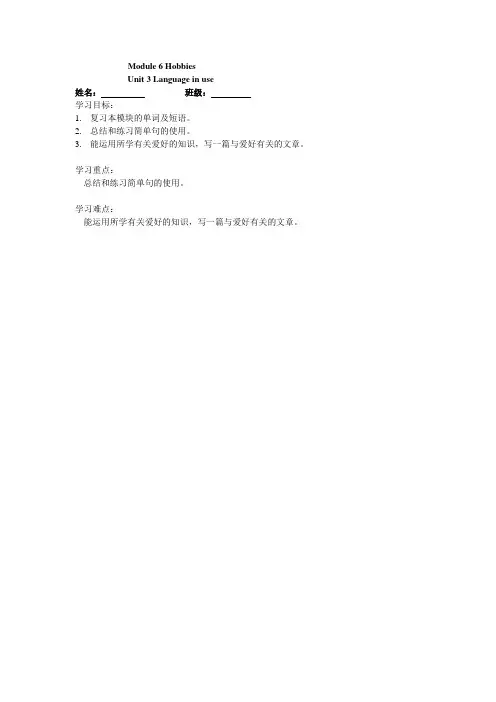
Module 6 Hobbies
Unit 3 Language in use
姓名: 班级:
学习目标:
1. 复习本模块的单词及短语。
2. 总结和练习简单句的使用。
3. 能运用所学有关爱好的知识,写一篇与爱好有关的文章。
学习重点:
总结和练习简单句的使用。
学习难点:
能运用所学有关爱好的知识,写一篇与爱好有关的文章。
一、简单句的六种基本句型。
只有一个主语或并列主语和一个谓语或并列谓语的句子叫简单句。例如:
We learn English. 我们学英语。
Both my father and my mother go to work at seven in the morning and come back home at six in
the evening.
我父母都是早上七点上班,晚上六点回到家。
简单句分为六种基本句型:
①主语+系动词+表语(s+v+p)
常见的系动词有be, look, seem, smell, taste, sound, become, get, grow, turn 等。例如:
My father is a teacher. 我爸爸是老师。
She always looks happy.
她看上去总是很快乐。
②主语+不及物动词(s+v)
不及物动词后不能跟宾语,但可跟必要的状语修饰。例如:
The new term usually begins in September.
新学年通常从九月份开始。
We work hard at English.
我们努力学习英语。
③主语+及物动词+宾语(s+v+o)
及物动词后必须跟宾语。例如:
He enjoys music very much.
他非常喜爱音乐。
I collected stamps last year.
1 / 14
简单句、并列句和复合句
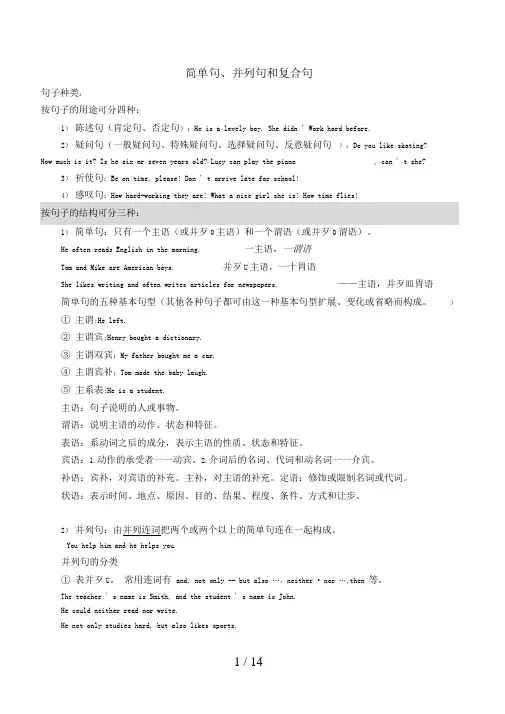
句子种类:
按句子的用途可分四种:
1) 陈述句(肯定句、否定句):He is a lovely boy. She didn ' Work hard before.
2) 疑问句(一般疑问句、特殊疑问句、选择疑问句、反意疑问句 ):Do you like skating?
How much is it? Is he six or seven years old? Lucy can play the piano , can ' t she?
3) 祈使句:Be on time, please! Don ' t arrive late for school!
4) 感叹句:How hard-working they are! What a nice girl she is! How time flies!
按句子的结构可分三种:
1) 简单句:只有一个主语(或并歹0主语)和一个谓语(或并歹0谓语)。
He often reads English in the morning. 一主语,一谓语
Tom and Mike are American boys. 并歹U主语,一十胃语
She likes writing and often writes articles for newspapers. ——主语,并歹皿胃语
简单句的五种基本句型(其他各种句子都可由这一种基本句型扩展、变化或省略而构成。 )
① 主谓:He left.
② 主谓宾:Henry bought a dictionary.
③ 主谓双宾:My father bought me a car.
④ 主谓宾补:Tom made the baby laugh.
⑤ 主系表:He is a student.
主语:句子说明的人或事物。
谓语:说明主语的动作、状态和特征。
表语:系动词之后的成分,表示主语的性质、状态和特征。
简单句讲义
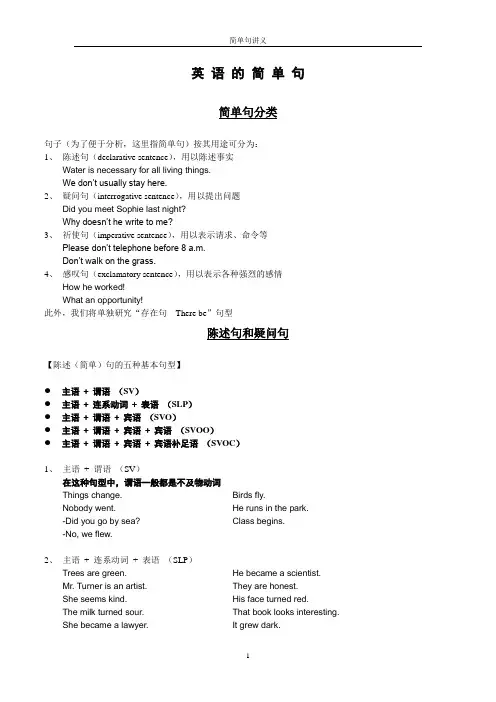
1 英 语 的 简 单 句
简单句分类
句子(为了便于分析,这里指简单句)按其用途可分为:
1、 陈述句(declarative sentence),用以陈述事实
Water is necessary for all living things.
We don’t usually stay here.
2、 疑问句(interrogative sentence),用以提出问题
Did you meet Sophie last night?
Why doesn’t he write to me?
3、 祈使句(imperative sentence),用以表示请求、命令等
Please don’t telephone before 8 a.m.
Don’t walk on the grass.
4、 感叹句(exclamatory sentence),用以表示各种强烈的感情
How he worked!
What an opportunity!
此外,我们将单独研究“存在句---There be”句型
陈述句和疑问句
【陈述(简单)句的五种基本句型】
主语 + 谓语 (SV)
主语 + 连系动词 + 表语 (SLP)
主语 + 谓语 + 宾语 (SVO)
主语 + 谓语 + 宾语 + 宾语 (SVOO)
主语 + 谓语 + 宾语 + 宾语补足语 (SVOC)
1、 主语 + 谓语 (SV)
在这种句型中,谓语一般都是不及物动词
Things change. Birds fly.
Nobody went. He runs in the park.
-Did you go by sea? Class begins.
-No, we flew.
2、 主语 + 连系动词 + 表语 (SLP)
Trees are green. He became a scientist.