
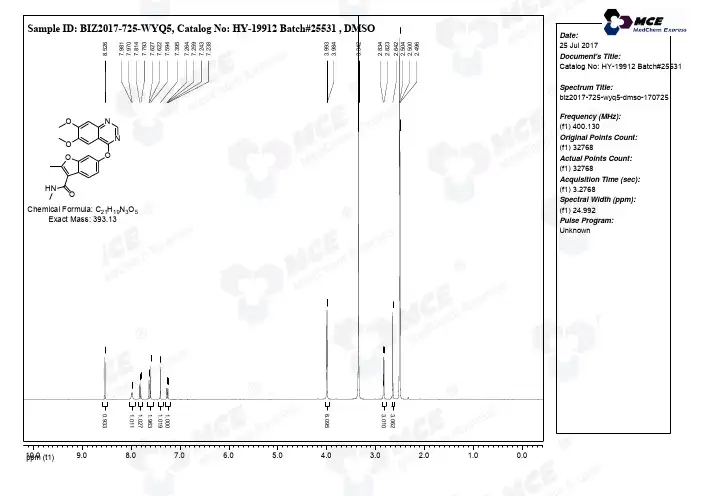
Fruquintinib_HNMR_25531_MedChemExpress
- 格式:pdf
- 大小:365.81 KB
- 文档页数:1
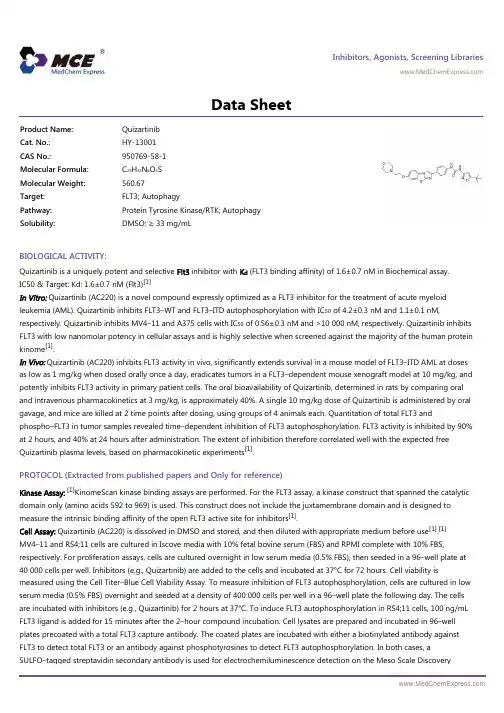
Inhibitors, Agonists, Screening Data SheetBIOLOGICAL ACTIVITY: Quizartinib is a uniquely potent and selective Flt3 inhibitor with Kd (FLT3 binding affinity) of 1.6±0.7 nM in Biochemical assay.IC50 & Target: Kd: 1.6±0.7 nM (Flt3)[1]In Vitro: Quizartinib (AC220) is a novel compound expressly optimized as a FLT3 inhibitor for the treatment of acute myeloidleukemia (AML). Quizartinib inhibits FLT3–WT and FLT3–ITD autophosphorylation with IC50 of 4.2±0.3 nM and 1.1±0.1 nM,respectively. Quizartinib inhibits MV4–11 and A375 cells with IC50 of 0.56±0.3 nM and >10 000 nM, respectively. Quizartinib inhibitsFLT3 with low nanomolar potency in cellular assays and is highly selective when screened against the majority of the human proteinkinome[1]. In Vivo: Quizartinib (AC220) inhibits FLT3 activity in vivo, significantly extends survival in a mouse model of FLT3–ITD AML at dosesas low as 1 mg/kg when dosed orally once a day, eradicates tumors in a FLT3–dependent mouse xenograft model at 10 mg/kg, andpotently inhibits FLT3 activity in primary patient cells. The oral bioavailability of Quizartinib, determined in rats by comparing oraland intravenous pharmacokinetics at 3 mg/kg, is approximately 40%. A single 10 mg/kg dose of Quizartinib is administered by oralgavage, and mice are killed at 2 time points after dosing, using groups of 4 animals each. Quantitation of total FLT3 andphospho–FLT3 in tumor samples revealed time–dependent inhibition of FLT3 autophosphorylation. FLT3 activity is inhibited by 90%at 2 hours, and 40% at 24 hours after administration. The extent of inhibition therefore correlated well with the expected freeQuizartinib plasma levels, based on pharmacokinetic experiments[1].PROTOCOL (Extracted from published papers and Only for reference) Kinase Assay:[1]KinomeScan kinase binding assays are performed. For the FLT3 assay, a kinase construct that spanned the catalyticdomain only (amino acids 592 to 969) is used. This construct does not include the juxtamembrane domain and is designed tomeasure the intrinsic binding affinity of the open FLT3 active site for inhibitors[1].Cell Assay: Quizartinib (AC220) is dissolved in DMSO and stored, and then diluted with appropriate medium before use[1].[1]MV4–11 and RS4;11 cells are cultured in Iscove media with 10% fetal bovine serum (FBS) and RPMI complete with 10% FBS,respectively. For proliferation assays, cells are cultured overnight in low serum media (0.5% FBS), then seeded in a 96–well plate at40 000 cells per well. Inhibitors (e.g., Quizartinib) are added to the cells and incubated at 37°C for 72 hours. Cell viability ismeasured using the Cell Titer–Blue Cell Viability Assay. To measure inhibition of FLT3 autophosphorylation, cells are cultured in lowserum media (0.5% FBS) overnight and seeded at a density of 400 000 cells per well in a 96–well plate the following day. The cellsare incubated with inhibitors (e.g., Quizartinib) for 2 hours at 37°C. To induce FLT3 autophosphorylation in RS4;11 cells, 100 ng/mLFLT3 ligand is added for 15 minutes after the 2–hour compound incubation. Cell lysates are prepared and incubated in 96–wellplates precoated with a total FLT3 capture antibody. The coated plates are incubated with either a biotinylated antibody againstFLT3 to detect total FLT3 or an antibody against phosphotyrosines to detect FLT3 autophosphorylation. In both cases, aSULFO–tagged streptavidin secondary antibody is used for electrochemiluminescence detection on the Meso Scale DiscoveryProduct Name:QuizartinibCat. No.:HY-13001CAS No.:950769-58-1Molecular Formula:C29H32N6O4SMolecular Weight:560.67Target:FLT3; AutophagyPathway:Protein Tyrosine Kinase/RTK; AutophagySolubility:DMSO: ≥ 33 mg/mL

Inhibitors, Agonists, Screening Certificate of Analysis
PHYSICAL AND CHEMICAL PROPERTIES Molecular Formula:C21H20O11Molecular Weight:448.38Storage:Powder-20°C3 years4°C2 yearsIn solvent-80°C6 months-20°C1 monthChemical Structure:
ANALYTICAL DATA Appearance:Light yellow to yellow (Solid)1 H NMR Spectrum:Consistent with structureLCMS:Consistent with structurePurity (LCMS):99.24%Conclusion:The product has been tested and complies with the given specifications.Product Name:IsoorientinCat. No.:HY-N0767CAS No.:4261-42-1Batch No.:25753Chemical Name:4H-1-Benzopyran-4-one, 2-(3,4-dihydroxyphenyl)-6-β-D-glucopyranosyl-5,7-dihydroxy-
Caution: Product has not been fully validated for medical applications. For research use only.Tel: 609-228-6898 Fax: 609-228-5909 E-mail: tech@Address: 1 Deer Park Dr, Suite Q, Monmouth Junction, NJ 08852,

fruquininib合成路线
呋喹替尼(Fruquintinib)是一种口服的高度选择性的血管内皮生长因子受体(VEGFR)1、2和3的抑制剂,已被批准用于治疗转移性结直肠癌。合成呋喹替尼的路线通常涉及多个步骤,包括化学反应、纯化和结晶等过程。
在合成呋喹替尼的过程中,起始原料的选择至关重要。通常,合成路线的起始原料是一些常见的有机化合物,如醇、酮、酯等。这些原料经过一系列的化学反应,如取代、加成、氧化、还原等,逐步转化为目标分子。
在合成过程中,中间体的纯化和分离也是非常重要的环节。由于合成路线中可能产生多种副产物和杂质,因此需要通过适当的纯化方法,如柱层析、重结晶等,将目标分子与杂质分离,以获得高纯度的产品。
此外,合成路线的优化和改进也是不断进行的。研究人员会尝试不同的反应条件、催化剂和溶剂等,以提高反应的效率和产物的纯度。同时,也会探索新的合成方法,以简化合成步骤、降低成本并提高生产效率。
总的来说,呋喹替尼的合成路线是一个复杂而精细的过程,需要严谨的实验设计和操作技巧。通过不断的优化和改进,人们可以不断提高呋喹替尼的合成效率和纯度,为临床治疗和药物研发提供更好的支持。
请注意,具体的合成路线可能因实验室和研究人员的不同而有所差异。因此,在实际操作中,需要根据具体情况进行调整和优化。同时,合成过程中的安全和环保问题也需要引起足够的重视。

Inhibitors, Agonists, Screening Certificate of Analysis
PHYSICAL AND CHEMICAL PROPERTIES Molecular Formula:C21H19N3O5Molecular Weight:393.39Storage:Powder-20°C3 years4°C2 yearsIn solvent-80°C6 months-20°C1 monthChemical Structure:
ANALYTICAL DATA Appearance:White to off-white (Solid)1 H NMR Spectrum:Consistent with structureLCMS:Consistent with structurePurity (LCMS):99.46%Conclusion:The product has been tested and complies with the given specifications.Product Name:FruquintinibCat. No.:HY-19912CAS No.:1194506-26-7Batch No.:25531Chemical Name:3-Benzofurancarboxamide, 6-[(6,7-dimethoxy-4-quinazolinyl)oxy]-N,2-dimethyl-
Caution: Product has not been fully validated for medical applications. For research use only.Tel: 609-228-6898 Fax: 609-228-5909 E-mail: tech@Address: 1 Deer Park Dr, Suite Q, Monmouth Junction, NJ 08852,