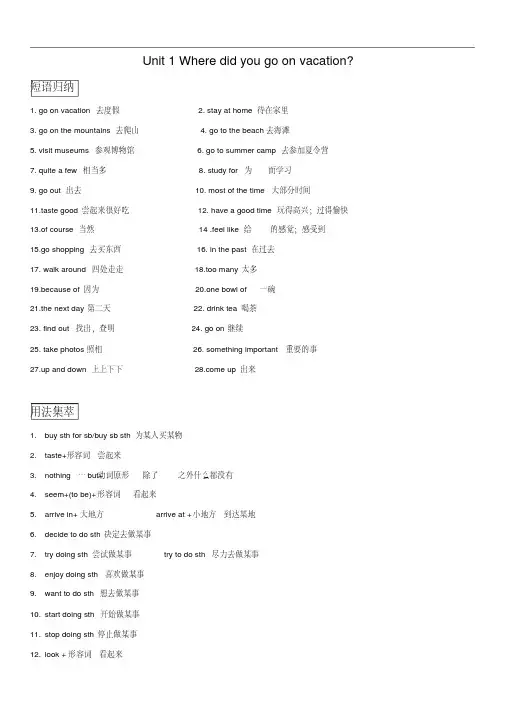
Unit1Wheredidyougoonvacation知识点汇总
- 格式:doc
- 大小:95.50 KB
- 文档页数:12
Unit 1 Where did you go on vacation?
重点语法: 一,一般过去时 用法:表示过去某时发生的动作或状态。以句中表示过去的时间状语作为标志词。 例如:
构成:谓语动词用过去式。Eg:He went to the beach yesterday。 否定句: 一般疑问句: 特殊疑问句: 动词过去式变形: 规则变化 构成规则 原形 过去式 一般在动词原形末尾加-ed play clean played cleaned 结尾时e的动词加-d dance danced 末尾只有一个辅音字母的重读闭音节词,先双写这个辅音字母,再加-ed stop run stopped
runned 以辅音字母+y结尾的动词,变y为i,再加-ed study studied
练习: 1,用所给词的适当形式填空 1. We_________(play)basketball yesterday afternoon. 2. My uncle_________(live) in Beijing in 2000. 3. They_______(plan)to build a new bridge last year. 4. I _______(study) for a test last night. 5. Lily’s father_______(work)in the office two years ago.,
2,句型转换, 1,I was late for school yesterday.(改成否定句)
2,His father had lunch in his factory.(改成一般疑问句) 3,They went to the mountains on vacation.(改成否定句) 4,Ann put her book in the desk just now.(划线部分提问)
3,单项选择 ( )1. ---________did you go on vacation? ---Hong Kong. A. What B. How C. Where D. When
1. yesterday或以其构成的短语:yesterday morning(afternoon, evening)等; 2. 由“last+一时间名词”构成的短语:last night, last year (winter, month, week)等; 3. 由“时间段+ago”构成的短语:a moment ago, a short time ago, an hour ago等; 4. 其它:just now等 5. 由某些表示过去时态的从句等。 ( )2. I_____my homework last night. I went to the cinema with my parents. A. did B. didn’t C. didn’t do D. don’t do ( )3. ---Did they clean the house yesterday afternoon? ---_________. They cleaned it this morning. A. No, they don’t B. Yes, they did C. No, they didn’t C. Yes, they do ( )4. ---_____Tom and Jim_____a walk yesterday evening? ---No, they____. A. Do; take; doesn’t B. Did; take; didn’t C. Did; take; did D. Do; take; don’t ( )5. ---The coat looks good on you. Where______you______it? ---In a supermarket. A. do; buy B. did; buy C. will; buy D. does; buy
二、 复合不定代词 Did you go with anyone? Did you find anything special? 构成: thing where body one some any every no no one
用法:1,作主语时,谓语动词用单数 Everone (be)here. 2, 被形容词修饰时,形容词必须后置。 Eg:I have something interesting to tell you. 3, 含some-开头的不定代词用于肯定陈述句中,any-开头的则用于否定句和疑问句中。 Eg: There is wrong with my eyes, I can’t see A something something B anything anything C something anything D anything something
练习: ( )1. ---Where would you like to spend your vacation? ---I’d like to go_____. I hat hot days A. cool somewhere B. somewhere cool C. hot somewhere D. somewhere hot ( )2. ---Did you see my pen________? ---Sorry, I didn’t A. somewhere B. anywhere C. nowhere D. Everywhere ( )3. There is_______in today’s newspaper. Let’s read a storybook. A. something interesting B. nothing interesting C. interesting something D. interesting nothing ( )4. ---Is there________wrong with your computer? ---Yes, it doesn’t work. A. something B. anything C. nothing D. everything ( )5. ---Have you got______ready for the sports meeting? ---Not yet. We still have__________to do. A. anything; nothing B.something; everything C. everything; something C. something; nothing 三、 反身代词 oneself My/our Your Him/her/it/them 单数 self 复数 selves 用法:enjoy oneself= have a good time by oneself 独立、独自 I do the homework by myself. dress oneself 自己穿衣服 make yourself at home 客气语,像自己家一样,不用客气 look after oneself 照看自己 练习: ( )1. My sister is twenty years old. She can look after_________. A. she B. her C. hers D. herself ( )2. Nobody taught me English. I learned it by_________. A. I B. my C. mine D. myself ( )3. I bought something _____my parents. But________for myself. A. to; anything B. for; nothing C. for; anything
重点词汇与短语: 1,visited my uncle 看望了我的叔叔 visit是及物动词,意为“拜访;探望”,后接表示人的名词或代词。 visit还可以意为“参观;游览”,后接表示地点的名词。 a.I visited my grandmother last week. 上周我去______了我的外婆。 b.Do you want to visit Shanghai? 你想______上海吗? 拓展:visitor意为“参观者;游客”。 eg: These visitors come from America._______________________
2, buy anything special 买特别的东西。 1)buy及物动词,意为“买;购买”。其过去式为______。 拓展:buy sth. for sb.=buy sb. sth. 意为“给某人买某物”。 My uncle_____ _____a bike. = My uncle_____ _____for me.
3.We took quite a few photos there.我们在那里拍了不少照片。 take photos 意为“ ”。 eg:We______ ______on the Great Wall.我们在长城上照了相。 辨析:quite a few与quite a little quite a few 意为“很多;不少”,修饰 ; quite a little 意为“很多;不少”,修饰 。 a. He stays here for _____ _____ _____days. b.There is _____ _____ _____water in the bottle(瓶子).
4, I just stayed at home most of the time to read and relax. 我大部分时间只是待在家里读书休息。 most of the time意为“大部分时间”,其中most为代词,意为“大部分;大多数”。 拓展:most of…意为“……中的大多数”,它作主语时,谓语动词取决于most of后所修饰的名词。 a. Most of us_____(be)going to the park. 我们大多数人要去公园。 b. Most of the food_____(go)bad. 大部分的食物都变质了。