
第二部 专题八 介词和介词短语
- 格式:ppt
- 大小:643.50 KB
- 文档页数:10


2024年初中英语语法学习之介词与介词短语介词是英语中最为活跃的词汇之一,掌握介词的规律对于英语学习至关重要。
根据的资料,以下是一些常见的英语介词种类:in/on/at:这些介词都表示在某个位置或时间上。
例如,“in the morning”(早上),“on the table”(桌子上),“at noon”(中午)。
for/to:这些介词都表示方向或目的。
例如,“for example”(例如),“to the nearest hospital”(去最近的医院)。
with/by:这些介词都表示伴随或方式。
例如,“with my friends”(和我的朋友们一起),“by train”(乘火车)。
at/in/on:这些介词都可以表示时间。
例如,“at night”(晚上),“in the morning”(早上),“on a sunny day”(晴天)。
for/over/through:这些介词都可以表示时间长度。
例如,“for a year”(一年),“over the weekend”(周末),“through the night”(整个夜晚)。
以上仅是一些常见的介词种类,英语介词还有很多其他种类,需要学习者在学习和实践中不断积累和掌握。
介词是英语中非常重要的语法部分,也是中考和高考的重点之一。
在考试中,正确使用介词可以帮助我们更好地表达意思,避免语法错误。
以下是一些常见的介词考点:in,on,at,over这些介词都可以用来表示时间,但用法略有不同。
例如,in可以用来表示周、月、季节、年和泛指的上午、下午、晚上(指在一段时间内)。
而on可以用来表示某天、某一天的上、下午(指具体的某一时)。
at则用于表示时刻、时间的某一点。
此外,over可以用来表示覆盖、超过、越过等意思。
on这个介词可以用来表示具体某一天的时间,例如on Monday表示在周一。
它还可以用来表示在某个具体的时间点,例如on time表示准时。

介词与介词短语一、介词:是一种用来表示词与词、词与句之间的关系的虚词,在句中不能单独作句子成分。
介词后面一般有名词代词或相当于名词的其他词类,短语或从句作它的宾语。
介词的分类:(1)表示时间,处所:从自自从于打到往在当朝向顺着沿着随着(2)表示方式:按照按照依依照本着经过通过根据以凭(3)表示目的:为为了为着(4)表示原因:因由于因为(5)表示对象,范围:对对于把向跟与同给关于(6)表示排除:除除了除去除非(7)表示被动:被叫让给(8)表示比较:比和同上述介词中的“着,了,过”是语素,不是动态助词。
介词at, in, on的区别:1.表示时间,注意以下用法:(1)表示时间的某一点、某一时刻或年龄等用at。
如:I get up at six in the morning. 我早上六点钟起床。
He got married at the age of 25.他 25 岁结婚。
(2)泛指一般意义的上午、下午或晚上以及月或年等较长的时间,一般用in。
如:We watch TV in the evening,我们晚上看电视。
He went to Japan in 1946,他于 1946 去了日本。
(3)若表示星期几或某一特定的日期,则用on。
如:He left here on the fifth of May,他于 5 月 5 日离开这儿。
2.表示地点、场所、位置等,注意以下用法:(1)表示某一点位置,用at。
如:We live at No 87 Beijing Road.我们住在北京路 87 号。
The hospital is at the end of the street.医院在这条街的尽头。
与名词所有格连用表示地点,也用at。
如:at my sister’s 在我姐姐家 at the doctor,s 在医务室(2)表示空间或范围,用in。
如:What,s in the box?这盒子里有什么?He lives in Paris with his wife,他同他妻子住在巴黎。

高中英语知识点归纳介词短语与介词的固定搭配高中英语知识点归纳:介词短语与介词的固定搭配在学习英语的过程中,介词短语和介词的固定搭配是我们需要掌握和灵活运用的重要知识点。
本文将对高中英语中常见的介词短语和介词的固定搭配进行归纳总结,以帮助同学们更好地掌握和运用这些知识点。
一、介词短语1. in front of:在...前面She is standing in front of the building.她站在那座建筑物前面。
2. in the middle of:在...的中间There is a tree in the middle of the garden.花园的中间有一棵树。
3. at the back of:在...后面The parking lot is at the back of the building.停车场在那栋建筑物的后面。
4. on the left/right:在左边/右边The library is on the left side of the main gate.图书馆在主门的左边。
5. next to:紧挨着,旁边My house is next to the supermarket.我的房子旁边是超市。
6. in the corner of:在...的角落There is a small coffee shop in the corner of the street.街角有一家小咖啡馆。
7. by the side of:在...旁边The hospital is by the side of the river.医院在河边。
8. at the end of:在...的尽头The classroom is at the end of the corridor.教室在走廊的尽头。
9. across from:在...的对面The supermarket is across from the post office.超市在邮局的对面。
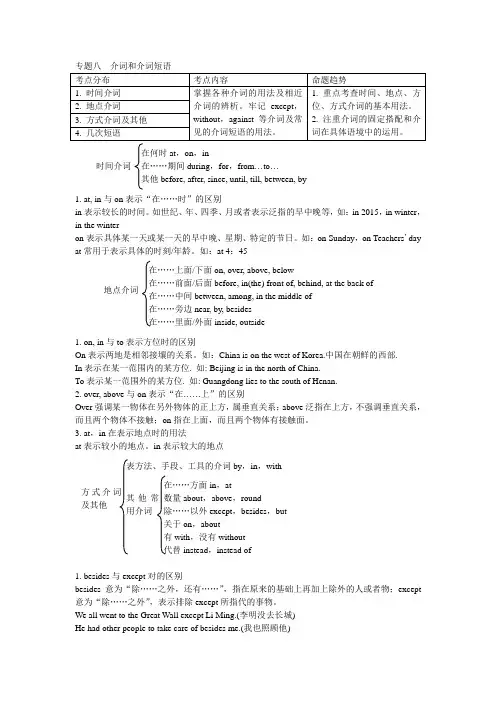
专题八 介词和介词短语1. at, in 与on 表示“在……时”的区别in 表示较长的时间。
如世纪、年、四季、月或者表示泛指的早中晚等,如:in 2015,in winter ,in the winteron 表示具体某一天或某一天的早中晚、星期、特定的节日。
如:on Sunday ,on Teachers ’ day at 常用于表示具体的时刻/年龄。
如:at 4:451. on, in 与to 表示方位时的区别On 表示两地是相邻接壤的关系。
如:China is on the west of Korea.中国在朝鲜的西部. In 表示在某一范围内的某方位. 如: Beijing is in the north of China.To 表示某一范围外的某方位. 如: Guangdong lies to the south of Henan.2. over, above 与on 表示“在……上”的区别Over 强调某一物体在另外物体的正上方,属垂直关系;above 泛指在上方,不强调垂直关系,而且两个物体不接触;on 指在上面,而且两个物体有接触面。
3. at ,in 在表示地点时的用法at 表示较小的地点。
in 表示较大的地点1. besides 与except 对的区别besides 意为“除……之外,还有……”,指在原来的基础上再加上除外的人或者物;except 意为“除……之外”,表示排除except 所指代的事物。
We all went to the Great Wall except Li Ming.(李明没去长城)He had other people to take care of besides me.(我也照顾他)时间介词 在何时at ,on ,in在……期间during ,for ,from …to …其他before, after, since, until, till, between, by 地点介词 在……上面/下面on, over, above, below在……前面/后面before, in(the) front of, behind, at the back of 在……中间between, among, in the middle of在……旁边near, by, besides在……里面/外面inside, outside 方式介词及其他 表方法、手段、工具的介词by ,in ,with 其他常用介词 在……方面in ,at 数量about ,above ,round 除……以外except ,besides ,but关于on ,about有with ,没有without代替instead ,instead of2. of 和for 的区别It ’s very kind of you to help me with my English.It ’s very important for us to master a foreign language.介词短语1.2. used to do sth. 过去常常做某事be/get used to doing sth. 习惯于做某事be used to do sth. 被用来做某事be made of … 由……制成,能看出原材料from …由……制成,看不出出原材料up of … 由……构成,强调由单个个体构成。