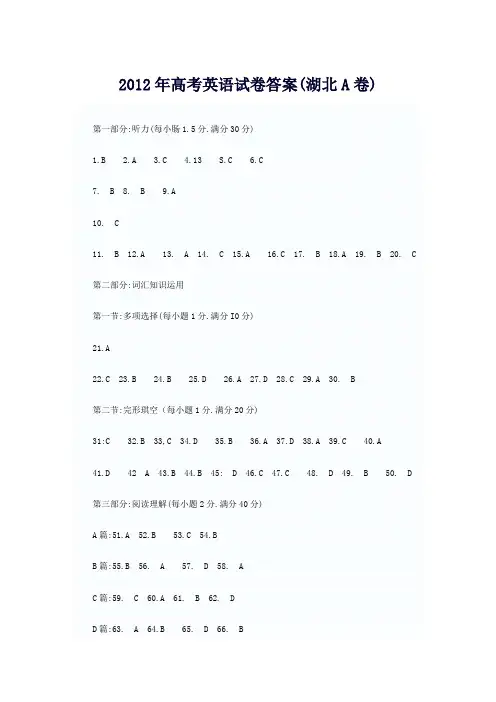
2012年普通高等学校招生全国统一考试答题适应性训练(湖北卷)英语第二部分:词汇知识运用(共两节,满分30分)第一节:多项选择(共10小题;每小题1分,满分10分)从A、B、C、D四个选项中,选出可以填入空白处的最佳选项,并在答题卡上将该项涂黑。
例:To make members of a team perform better, the trainer first of all has to know their ___ and weaknesses.A. strengths B. benefits C. techniques D. values 答案:A21. As the quality of the city’s a ir continues to give rise to _____, the residents are encouraged to set off fewer fireworks.A. concernsB. compromiseC. descriptionsD. emergency22. The _____ in Chinese exports in recent years has resulted in a flood of inexpensive goods for American consumers.A. immigrationB. introductionC. explosionD. investment23. One reason why the housing prices in big cities are going up all the time is that people are _____ into overcrowded cities in great numbers.A. breakingB. pouringC. fillingD. squeezing24. Do not fear them; for there is nothing covered that will not be _____, and nothing hidden that will not be made known.A. criticizedB. definedC. estimatedD. revealed25. If the world becomes less unfair and people have better education, much of the poverty can be ______.A. taken outB. left outC. wiped outD. put out26. Fierce as they are faced with pressure, the students remain ______ and try hard to achieve their goals.A. consciousB. optimisticC. influentialD. competitive27. I don’t trust this dishonest woman; I think her certificates are _____.A. mistakenB. wrongC. falseD. incorrect28. Firms that provide ______ high wages and good working conditions do not seem to have problems attracting employees.A. regularlyB. naturallyC. eventuallyD. relatively29. Take a vocabulary notebook with you all the time. Collect any good words, sentences or articles, _____ wisdoms and wise sayings.A. speciallyB. particularlyC. absolutelyD. consequently30. After the break, the lecturer went on to talk ______ about the new academic concept.A. at lengthB. in allC. in turnD. at most第二节:完形填空(共20小题;每小题1分,满分20分)Cindy Green had a serious telephone problem. The brand-new $100 million Ribrock Plaza Hotel opened nearby and had 31 almost the same telephone number as Cindy’s. From the moment the hotel opened, Cindy was 32 by calls not for her. Since she had the same phone number for years, she felt that she should 33 the hotel management to change its number. 34 , the management refused. The phone company was not 35 , either. It argued that a number was a number, and the fact that a customer was getting someone else’s36 twenty-four hours a day didn’t make it37 .After her request fell on deaf ears, Cindy decided to take 38 into her own hands. At 9 o’clock the phone rang. Someone from Memphis was calling the hotel and 39 a room for the following Tuesday. Cindy said, “No40 . How many nights?”A few hours later a secretary called and said that she wanted a suite (套房) 41 two bedrooms for a week.Cindy replied that the Presidential Suite was 42 for $600 a night. The secretary said that shewould 43 it.The next day was a 44 one for Cindy. In the morning, she booked a car producer’s conf erence for Memorial Day weekend. Her biggest 45 came in the afternoon—a mother called to book the ballroom for her daughter’s wedding in June. Cindy hesitated for a while, but still46 the woman that it would be no problem.Within a few months, the Ribrock Plaza Hotel was a disaster area. People kept 47 for weddings, reunions (聚会) and parties, and were all 48 that there were no such events.Soon after, she read in a 49 that the hotel might go bankrupt (破产). Her phone rang, and a manager from Marriott said, “We’re prepared to50 you $2 million for the hotel.” Cindy replied, “We’ll take it, but only if you change the telephone number.”31. A. required B. acquired C. confirmed D. dialed32. A. bothered B. embarrassed C. disappointed D. frightened33. A. expect B. force C. encourage D. persuade34. A. Interestingly B. Amazingly C. Naturally D. Curiously35. A. blamed B. patient C. involved D. helpful36. A. answers B. calls C. messages D. numbers37. A. changeable B. guilty C. responsible D. shameful38. A. matters B . deals C. events D. requests39. A. sought for B. asked for C. called for D. waited for40. A. way B. wonder C. problem D. doubt41. A. plus B. instead of C. next to D. with42. A. comfortable B. reasonable C. available D. affordable43. A. order B. reserve C. purchase D. register44. A. lucky B. new C. difficult D. busy45. A. challenge B. adventure C. fortune D. business46. A. promised B. reminded C. convinced D. comforted47. A. turning around B. turning up C. turning over D. turning back48. A. informed B. impressed C. guaranteed D. discouraged49. A. note B. brochure C. poster D. newspaper50. A. lend B. present C. offer D. award第三部分:阅读理解(共20小题;每小题2分,满分40分)ASome of Britain’s most favoured spring visitors are disappearing in their thousands. Scientist s say birds such as the cuckoo (布谷鸟), whose song announces the arrival of warm weather in Britain, are dropping in numbers.A typical migrant bird (候鸟) from Africa, cuckoo may no longer make its annual appearance in the woodlands in Britain, says a scientist. Numbers of migrant birds from Africa have declined seriously in the UK since 1995. For cuckoos the figure is 44%. The call of the cuckoo could be silenced in the near future. The real problem is that there are so many different possible causes for the loss—which makes it difficult to find out the real reasons for their decline and to prepare plans to put things right.The loss could be the result of changes in farmland use in Britain which are affecting the way cuckoos breed (繁殖) when they arrive here in spring. On top of changes of land use, scientists suspect that many cuckoos are finding it increasingly difficult to feed themselves when they come to breed in Britain. Thelarge insects they eat have dropped rapidly in number here.Climate change might be another important reason. Migrant cuckoos arrive and breed at times which are no longer the best periods when food, such as insects, is available. Climate changes also affect timings of breeding cycles.Or the loss could be due to the increase of human populations in Africa and the destruction of natural living environment where they make their homes in winter.Apart from these, the killing takes place in spring and autumn when cuckoos, flying from and to Africa, cross islands in the Mediterranean Sea. They are shot in their hundreds of thousands by hunters who just enjoy killing them for the “sport”. It is against the European Union law, but that doesn’t stop it happening. Sheehan, a scientist, said, cuckoos “arrive in our countryside just as the first good weather arrives. We associate them with spring and warmth. That is why they appear so often in old English stories. They are part of our culture––which makes the decline in their number so worrying.”51. What can be inferred from the underlined part in Paragraph 2?A. Cuckoos may arrive in warm weather.B. Cuckoos may rarely be seen in Britain.C. Cuckoos may appear every two years.D. Cuckoos may come back to the woodlands.52. Concerning the rapid decrease in the number of cuckoos, scientists _______.A. find it difficult to discover the real reasonsB. know few possible causes for the lossC. have plans to put things rightD. doubt if the data are accurate53. According to the passage, what happens in Britain that possibly causes the decline of cuckoos?A. Many hunters kill cuckoos for fun.B. Cuckoos’ main food is getting less.C. Policies on land use have changed.D. Human population increases rapidly.54. Which could be the best title for the passage?A. Cuckoos, Who Take Away Your Food?B. Climate Change: A Danger to CuckoosC. Spring May Lose Song of CuckoosD. A Song for England’s CuckoosBJust over a year ago, life as an orphan (孤儿) girl in Tilinanu, southern Malawi, was uncertain. Relying on the kindness of the poor villagers for a roof over their head, many had to sleep in a room that held as many as fifteen people, eating a diet mainly of porridge. Their classroom for daily lessons was an open space in the bush.Now 34 of them have comfortable beds in a smart new home, with a community hall and medical centre next to it. Another 175 village children eat there daily, with the adults coming in to learn English; it’s an amazing transformation. Even more amazing is that the person behind it is just 21.When Alice Pulford was waiting to get into university, she took a five-month teaching position in Malawi. She loved the place, and returned in the spring of 2009 to visit her friend Zulu in Tilinanu. His aunt Mercy owned land there and was doing her best to provide an education for the orphans, many of whom had lost parents to AIDS or malaria (疟疾).But after helping Mercy out for some time, Alice realised that what the girls in particular really needed was a safe and permanent place to live. There was a derelict (年久失修的) church on Mercy’s land. “If you give me the church, I’ll set up a home for these children,” Alice told her. Mercy agreed.Alice phoned home and told her family about her plan. The family had already helped Alice raise £1,800 to assist the o rphans. After they received Alice’s call, they threw themselves into raising another £6,000, organising theatre trips and special parties and dinners.Alice found Malawian builders, selected materials and even helped with the brick-laying. In ten weeks, the church became a dormitory with toilets and a living area. In spring last year, Alice raised another £19,000 to build the medical centre and two new dormitories.The girls are happier—and so is Alice, who has been spending around four months in Malawi a year.“The orphans think they’re gaining from me, but when I see their smile, it transforms me,” she says.55. Over a year ago, the orphans didn’t have _______.A. a classroomB. a teacherC. shelterD. food56. What is known about the home Alice has built for the orphans?A. It looks like a community hall.B. It depends on the villagers’ help.C. It provides a place for recreation.D. It benefits both the children and adults.57. The Pulfords’ family are _______.A. short of moneyB. fond of entertainmentsC. supportive of each otherD. unaware of Alice’s plan58. What has Alice learned from her experience?A. Money-raising is a family business.B. Winning orphans’ smile calls for skills.C. AIDS has made many children parentless.D. Helping others brings changes in a person.CMargaret Cook is a professional, married woman with two young children. The elder, who is four, has just started at a local primary school. It is a school that she was eager for her daughter to attend because it has a mix of racial and social cultures. As a white from a middle-class family, she thought it important for her daughter to go to a local school that was representative of the cultural and social mix of the society in which we live. Having met, however, some of the other parents and children, she’s becoming increasingly unsure about her choice. She is worried that along with the accent and vocabulary of her classmates, her daughter will also pick up what appears to be a very narrow-minded, uneducated attitude. She wants her daughter to be able to adapt and to fit in with her friends at school, but not necessarily to model her behaviour on theirs. She wants her to like them but not be like them.Is she worrying unnecessarily? Or should she abandon her principles and send her children to private school? A report, published by the Independent Schools Council, shows record numbers of parents want to send their children to private schools that stress “moral standards” and classroom discipline as they lose faith in state education, even many Labour voters would consider going private for the first time if they could afford the fees.But is it right without question to see private schools as heavens where moral standards are high, teachers are models of correctness and learning, children all come from open-minded families, and where our little ones will be protected from the ills of the world? The only difference is that those who can afford school fees are in the habit of making expensive mistakes. One of my colleagues who sends all his children to private schools tells stories of drug abuse, troublemakers, the decline of discipline and ever younger age of rebellion (叛逆).It’s an excellent plan to send our children to a mixed school. Placed in an entirely new environment, they are at the risk of rejection, bullying (欺负) and maybe long-term alienation (疏离). But as soon as our children step out of the front door they are faced with a challenging world where boundary between the good and bad is so complex that young people have difficulty telling them apart. For this reason I believe that Cook is better advised to bring her children up in the real world.59. From this passage we know that the woman’s daughter _______.A. is changing others’ behaviorB. is mixing with trouble-makersC. is attending a mixed schoolD. is applying for a private school60. The mother wants her daughter to be _______.A. popular and attractiveB. a fighter against social illsC. a model for her classmatesD. open-minded and well-educated61. What does the writer think of the private school?A. It’s a heaven o f pleasure.B. It is going from bad to worse.C. It is experiencing moral decline.D. It’s a place of high moral standard.62. The writer suggests sending kids to a mixed school because he thinks _______.A. it is well managedB. it is close to the real worldC. kids there are well protectedD. the competition there isn’t fierceDSolar electric systems pay off most quickly for consumers who use a lot of energy because extra charges are given for heavy use, but the solar system still makes sense for low-energy users such as myself.So much of Americans’ carbon footprint results from buildings—about 43%, according to the U.S. Department of Energy. I’m i n a household of 1.5 (mom and 7-year-old), and we use only about 4 kilowatt hours of electricity per day, something we’ve managed through behavioral changes, such as turning off the lights in rooms after we’ve exited, and through in-home efficiencies (效率), such as s out all my light bulbs for energy-saving ones and using power boards that can turn off DVD players, coffee makers and other electrical equipment.Using less electricity means I can get by with a smaller, less expensive solar system that not only covers my use but also produces a credit on my power bill. Going solar also meant my house was upgraded with a time-of-use meter. This type of meter allows me to receive credit for the electricity I produce during peak hours when electricity costs the most, but pay the least for the electricity during off-peak hours, when I recharge my cell phone and laptop and perform other tasks requiring power.The downsides are that I am tied in to the grid (电网) and still affected by power failure, and I now have solar panels (太阳能电池板) that need to be cleaned. It’s a subject of debate, but REC Solar said dirty panels decrease energy production by 6% to 8%. Many panel producers recommend cleaning panels at least once during the summer. I wash mine whenever they look dirty or dotted with bird droppings, which is about every other week.I think $6,000 is a small price to pay, not only for panels that should produce my next 20 years of electricity, but also for the greenhouse gases I’m not creating.63. What is mainly talked about in this article?A. The ways of cutting power bills.B. The tips on reducing electricity use.C. The benefits of using solar systems.D. The importance of protecting the environment.64. Why does the writer recharge her mobile phones during off-peak hours?A. To save credit.B. To save time.C. To save energy.D. To save money.65. The underlined word “downside” in Paragraph 4 is close in meaning to ______.A. discountB. disadvantageC. disapprovalD. disagreement66. The author cleaned her power panels ______.A. to make them work properlyB. to protect the environmentC. to make them look betterD. to avoid power failureEDoes knowledge of a writer’s private life help to explain his works? It’s an age-old question, but it’s also one in which interest is aroused (激起) again by Antonia Fraser’s book about her life with Harold Pinter, Must You Go?. The book is obviously a personal account rather than a study of the plays. All the same, I’d argue it throws a good deal of light on Pinter the dramatist (剧作家).I start from the belief that all information about a writer is helpful. In fact, one of the pleasures of writing Pinter’s biography was discovering that nearly all his plays were started by some strong personal memory.This got me into trouble with some scholars. I remember Martin Esslin, a great Pinter scholar, arguing that I had reduced the value of Pinter’s Betrayal by linking it to the dramatist’s seven-year-long love affair with Joan Bakewell. But, as I saw it, that was simply the play’s origin. All I had done, I hoped, was to remind people that Pinter was a writer who would make use of his own life experience.That point can also be seen from Antonia’s book. There’s an interesting account of a dinner with Tom Stoppard where Pinter says that he doesn’t plan his characters’ lives and then asks his fellow dramatis t: “Don’t you find they take you over sometimes?”, to which Stoppard firmly replies: “No.” That says a lot. One reason why The Homecoming is a great play is that Pinter allows his characters, almost unconsciously, to take over. Despite Stoppard’s many stre ngths, he tends to keep his characters under a much tighter control.Again, there’s an eye-opening passage in Antonia’s book where she recalls a moment in 1983 when Pinter refers back to his relationship with his former wife, Vivien: “While she was alive, if you think about it, so much of my work was about unhappy frozen married relationships.”In short—as Stoppard once wrote—information, in itself, about anything, is light. And modern biography, particularly in the hands of masters, has been helpful to li terature by opening writers’ lives to public eyes. For that reason, among many others, I welcome Antonia Fraser’s book.67. What is TRUE about Antonia Fraser’s book?A. It is well received by the public.B. It carries Antonia’s views about biography.C. It is helpful to the study of Pinter’s works.D. It includes serious studies of Pinter’s works.68. What do the author of this article and Martin Esslin disagree on?A. The literary value o f Pinter’s Betrayal.B. The literary value of the accounts of Pinter’s life.C. The truthfulness of the contents of Antonia’s book.D. The truthfulness of Pinter’s love affair with Joan Bakewell.69. What can we infer about Pinter and Stoppard?A. They treat their characters in different ways.B. Stoppard has more strengths than Pinter.C. They often have dinners together.D. They often argue with each other.70. This article is probably ______.A. a feature storyB. a book reviewC. a news reportD. a biography第四部分:书面表达(共两节,满分50分)第一节:完成句子(共10小题;每小题2分,满分20分)例:______ was that the young player performed extremely well in the table tennis tournament. (delight)令球迷欣喜的是那位年轻的球员在乒乓球锦标赛中表现得极为出色。