
第4讲 构造析构函数
- 格式:ppt
- 大小:1.21 MB
- 文档页数:37




c++拷贝构造函数详解⼀、什么是拷贝构造函数⾸先对于普通类型的对象来说,它们之间的复制是很简单的,例如:int a=100;int b=a;⽽类对象与普通对象不同,类对象内部结构⼀般较为复杂,存在各种成员变量。
下⾯看⼀个类对象拷贝的简单例⼦。
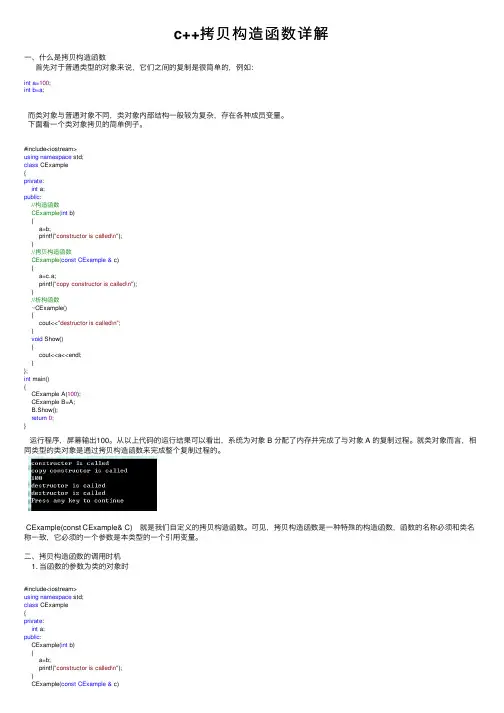
#include<iostream>using namespace std;class CExample{private:int a;public://构造函数CExample(int b){a=b;printf("constructor is called\n");}//拷贝构造函数CExample(const CExample & c){a=c.a;printf("copy constructor is called\n");}//析构函数~CExample(){cout<<"destructor is called\n";}void Show(){cout<<a<<endl;}};int main(){CExample A(100);CExample B=A;B.Show();return 0;}运⾏程序,屏幕输出100。
从以上代码的运⾏结果可以看出,系统为对象 B 分配了内存并完成了与对象 A 的复制过程。
就类对象⽽⾔,相同类型的类对象是通过拷贝构造函数来完成整个复制过程的。
CExample(const CExample& C) 就是我们⾃定义的拷贝构造函数。
可见,拷贝构造函数是⼀种特殊的构造函数,函数的名称必须和类名称⼀致,它必须的⼀个参数是本类型的⼀个引⽤变量。
⼆、拷贝构造函数的调⽤时机1. 当函数的参数为类的对象时#include<iostream>using namespace std;class CExample{private:int a;public:CExample(int b){a=b;printf("constructor is called\n");}CExample(const CExample & c){a=c.a;printf("copy constructor is called\n");}~CExample(){cout<<"destructor is called\n";}void Show(){cout<<a<<endl;}};void g_fun(CExample c){cout<<"g_func"<<endl;}int main(){CExample A(100);CExample B=A;B.Show();g_fun(A);return 0;}调⽤g_fun()时,会产⽣以下⼏个重要步骤:(1).A对象传⼊形参时,会先会产⽣⼀个临时变量,就叫 C 吧。