
独立主格结构 (2)
- 格式:pptx
- 大小:1.86 MB
- 文档页数:12

独立主格结构完整讲解(最新)
一、独立主格结构的定义与特点
1. 定义
独立主格结构是由一个名词或代词(逻辑主语)和一个非谓语动词(逻辑谓语)构成的独立结构,它在句中不担任谓语,但能够表示一种独立于主句之外的动作或状态。
2. 特点
(1)独立主格结构的逻辑主语和逻辑谓语之间没有连接词。
(2)独立主格结构的逻辑主语和逻辑谓语在语法上不与主句的谓语发生关系。
(3)独立主格结构在句中可以表示时间、原因、条件、结果等意义。
(4)独立主格结构可以转换为主句的从句,但意义略有不同。
二、独立主格结构的分类与用法 1. 现在分词的独立主格结构
现在分词的独立主格结构表示正在进行的动作或状态,其构成形式为:名词/代词 + 现在分词。
示例:
The sun rising, we set off for the mountain.(太阳升起时,我们出发去爬山。)
The students laughing, the teacher entered the
classroom.(学生们笑着,老师走进了教室。)
2. 过去分词的独立主格结构
过去分词的独立主格结构表示已经完成的动作或状态,其构成形式为:名词/代词 + 过去分词。
示例:
The lesson finished, the students left the classroom.(课程结束后,学生们离开了教室。)
The work done, we went home.(工作完成后,我们回家了。)
3. 不定式的独立主格结构 不定式的独立主格结构表示将来要发生的动作或状态,其构成形式为:名词/代词 + 不定式。
示例:
The meeting to be held next week, we need to
prepare well.(下周要开的会议,我们需要做好准备。)
The plan to be executed, we must follow the

独立主格结构完整讲解(范文)
一、独立主格结构的定义与特点
1. 定义
独立主格结构是由一个名词或代词作为逻辑主语,和一个非谓语动词(不定式、现在分词或过去分词)作为逻辑谓语构成的句子结构。这种结构在句中作为一个独立成分,与句子的其他部分在语法上没有直接关系,但在意义上有着密切的联系。
2. 特点
(1)独立主格结构的两部分在语法上没有直接关系,但意义上紧密相连。
(2)独立主格结构通常位于句首或句末,有时也可插入句中。
(3)独立主格结构中的非谓语动词与逻辑主语构成主谓关系,表示动作的主动或被动。
(4)独立主格结构可以表示原因、条件、伴随状况等意义。 二、独立主格结构的分类
1. 现在分词独立主格结构
现在分词独立主格结构表示主动关系,即逻辑主语是动作的发出者。例如:
The sun rising in the east, we began to work.
(太阳从东方升起,我们开始工作。)
2. 过去分词独立主格结构
过去分词独立主格结构表示被动关系,即逻辑主语是动作的承受者。例如:
The test finished, the students left the classroom.
(考试结束后,学生们离开了教室。)
3. 不定式独立主格结构
不定式独立主格结构表示逻辑主语与动作之间的关系,可以是主动或被动。例如:
The decision made, we set out to implement it.
(决定做出后,我们开始执行。) 三、独立主格结构的用法
1. 表示原因
独立主格结构可以表示原因,相当于从句。例如:
The boy exhausted, he sat down to rest.
(男孩累坏了,他坐下来休息。)
2. 表示条件
独立主格结构可以表示条件,相当于if从句。例如:
Weather permitting, we will go hiking.
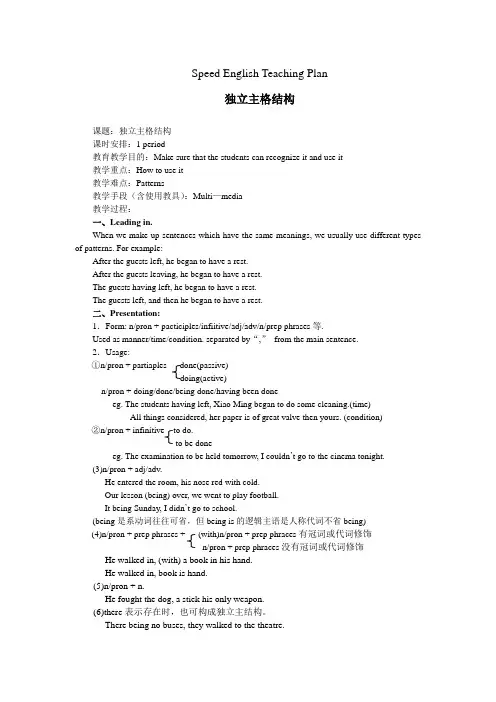
Speed English Teaching Plan
独立主格结构
课题:独立主格结构
课时安排:1 period
教育教学目的:Make sure that the students can recognize it and use it
教学重点:How to use it
教学难点:Patterns
教学手段(含使用教具):Multi—media
教学过程:
一、Leading in.
When we make up sentences which have the same meanings, we usually use different types
of patterns. For example:
After the guests left, he began to have a rest.
After the guests leaving, he began to have a rest.
The guests having left, he began to have a rest.
The guests left, and then he began to have a rest.
二、Presentation:
1.Form: n/pron + pacticiples/infiitive/adj/adv/n/prep phrases等.
Used as manner/time/condition. separated by“,” from the main sentence.
2.Usage:
①n/pron + partiaples
done(passive)
doing(active)
n/pron + doing/done/being done/having been done
eg. The students having left, Xiao Ming began to do some cleaning.(time)

高中英语复习系列之:
独立主格结构
独立主格结构:名词\代词+其它成分(不定式,分词,名词,代词,形容词,副词或介词短语)构成,在语法上是一个独立的短语,不是句子,在意思上依附于整个句子。
1.名词或代词主格+不定式:原因状语或条件状语。
(1)Lots of work to do(=Because I have lots of work to do),I have to
work extra hours.
(2)No one to wake me up(If no one wakes me up),I might be late for
the fiirst class.
2.名词或代词主格+现在分词:(时间\原因\条件\方式)状语。
(1)All the students having sat down(=After all the students had sat
down),the lecture began.(时间状语)
(2)His hand waving in the air(As his hand was waving in the air),the
little boy ran away.(原因状语)
(3)Weather permitting(It the weather permits),they will go on anouting
to the beach tomorrow.(条件状语)
(1)There being no further business to discuss, we all went home(原因)
3.名词或代词主格+过去分词(时间\原因\条件\伴随)状语。
(1)The test finished(=After the test has been finished),We’ll have our
summer vacation.(时间状语)