
Grammar 1 比较级及最高级
- 格式:pptx
- 大小:365.43 KB
- 文档页数:23

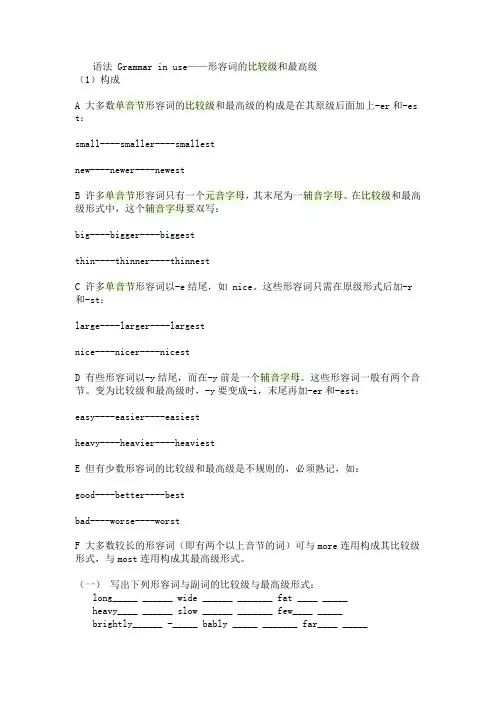
语法 Grammar in use——形容词的比较级和最高级 (1)构成
A 大多数单音节形容词的比较级和最高级的构成是在其原级后面加上-er和-est:
small----smaller----smallest new----newer----newest B 许多单音节形容词只有一个元音字母,其末尾为一辅音字母。在比较级和最高级形式中,这个辅音字母要双写:
big----bigger----biggest thin----thinner----thinnest C 许多单音节形容词以-e结尾,如 nice。这些形容词只需在原级形式后加-r和-st:
large----larger----largest nice----nicer----nicest D 有些形容词以-y结尾,而在-y前是一个辅音字母。这些形容词一般有两个音节。变为比较级和最高级时,-y要变成-i,末尾再加-er和-est:
easy----easier----easiest heavy----heavier----heaviest E 但有少数形容词的比较级和最高级是不规则的,必须熟记,如: good----better----best bad----worse----worst F 大多数较长的形容词(即有两个以上音节的词)可与more连用构成其比较级形式,与most连用构成其最高级形式。
(一) 写出下列形容词与副词的比较级与最高级形式: long_____ ______ wide ______ _______ fat ____ _____ heavy____ ______ slow ______ _______ few____ _____ brightly______ -_____ bably _____ _______ far____ _____ quickly _____ ______ happy_____ -______ unhappy________ (二)用所给词的正确形式填空: 1. Of the two girls, I find Lucy the _______ (clever). 2. Gold(黄金) is ______ (little) useful than iron(铁). 3. My sister is two years _______ (old ) than I. 4. John’s parents have four daughters, and she is the _____ (young) child. 5. The _____ (cheap) bags are the not usually the best ones. 6. The short one is by far _______ expensive of the five. 7. The boy is not so ______ (interesting) as his brother. 8. Dick sings _____ (well), she sings ______(well) than John, but Mary sings______(well) in her class. 9. She will be much ______ (happy) in her mew house. 10. This dress is ______ that.(twice, as…as…, expensive) (三)选择填空: 1. He feels _____ today than yesterday. A. tired B. more tired C. more tireder D. much tired 2. Which do you like _____, coffee, tea or milk? A. the worst B. worse C. the worse D. worst 3. Of the two toys, the child chose_____. A. the expensive one B. one most expensive C. a least expensive D. the most expensive of them 4. The line is ____ than that one. A. more longer B. not longer C. much more longer D. many more longer 5. The earth is _____ the moon. A. as 49 times big as B. 49 times as bigger as C. 49 times as big as D.as big as 49 times 6. The book is ____ of the two. A. thinner B. the thinner C. more thinner D. the thinnest 7. She looks _____ than she does. A. the more older B. very older C. much older D. more older 8. The garden is becoming ______. A. more beautiful and more B. more beautiful and beautiful C. more and more beautiful D. more beautiful and beautifuler 9. They competed(比赛) to see who could work _____. A. the fastest and best B. the faster and the better C. fastest and better D. faster and better 10.______ hurry, _______speed. A. More, less B. Much, little C. The more, the less D. The much, the little 11. This kind of coffee is different ______. A. and it is also better B. and better than the other C. but also than others D. from the other, and better


八年级上册语法点总结Unit1 Howoften doyou exercise?Grammar: 特殊疑问句:wh-questions:what, who, where,when,which,whose, why, whom等。
特殊疑问句的构成及用法:1.结构:特殊疑问词+ 一般疑问句, 即:特殊疑问词+be/助动词/情态动词+主语+谓语/表语(+其他)疑问代词:1) Who:谁。
做主语,用来指人Who is the boy under the tree?2)Whom谁,做宾语,用来指人Whom are you writing to?3)Whose 谁的,用来指所属关系,如果做定语,一般后接名词Whose pen is this?4)Which 哪个,哪些,用来指对人或物在一定范围之内进行选择Whichgrils w illinthesports meeting? Whichpen isLily’s?5)What什么,通常指物,也可指人,一般用在没有指出范围的情况下What canyou see in the picture?Whatareyou doingnow?疑问副词:1)When:何时,询问时间Whenwill shecome back?2)Where何地,询问地点, Where do youcomefrom?3)Why为什么,询问原因,Why are youlatefor school?4)How 如何,询问手段、方式、工具以及程度等How do you usuallygotoschool?5)How old多大,询问年龄,How oldis Jim’s little brother?6)Howmany/much多少,询问数量How many birdsarethere inthetree?7)How far多远,询问距离,How faris it formyourhome to school?8)Howlong多长,多久,询问时间的长度或距离How long will you stay inBeijing?9)How often多长时间按一次,询问频率Howoften do yougo to seeyour grandparents?10)How soon多久,询问时间How soon willyoucomeback?频率副词:表示动作发生的频率,never,sometimes, often,usually, always.Unit 2What’sthematter withyou?Grammar:1. 用have 来描述身体不适have/havegot a+疾病名字;得了……病2.情态动词should,情态动词should,can, may, must没有人称和时态的变化,后接动词原形Unit 3 Whatare you doing for vacation?Grammar:现在进行时表将来一般将来时表示将要做某事或计划打算做某事要用到句型“be+doing”其中be是助动词,它有人称和单复数的变化。