if引导的条件状语从句
- 格式:doc
- 大小:53.08 KB
- 文档页数:5
【同步教育信息】
一. 本周教学内容:
Module 4 New Technology
二. 重点内容:
If 引导的条件状语从句
三. 具体内容:
(一)语法知识
If引导条件状语从句。
在含有条件状语从句的主从复合句中,当主句谓语动词以某种形式表示将来时间概念时,条件状语从句中的谓语动词通常要用一般现在时代替一般将来时。
此句中主句为用祈使句表将来,if引导的状语从句用一般现在时。
If you see him , give him this letter .
如果你见到他的话,把这封信给他。
(二)知识拓展:
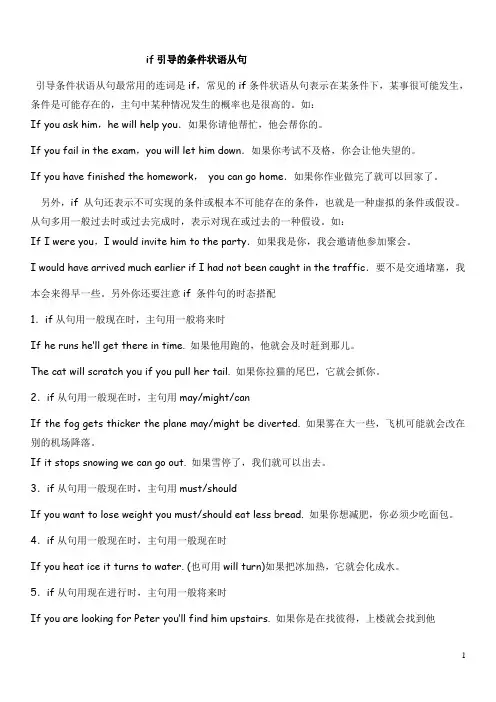
引导条件状语从句最常用的连词是if,由if引导的条件状语从句表示在某种条件下某事很可能发生。如:
If you ask him,he will help you .
如果你请他帮忙,他会帮你的。
If you fail in the exam , you will let him down .
如果你考试不及格,你会让他失望的。
另外,if从句还表示不可实现的条件或根本不可能存在的条件,也就是一种虚拟的条件或假设,从句多用一般过去时或过去完成时。如:
If I were you , I would invite him to the party .
如果我是你,我会邀请他参加聚会。
I would have arrived much earlier if I had not been caught in the traffic .
如果没有堵车,我会到的早一点儿。
四. 课文知识点详解
1. He lent me his CD recorder.
他把他的CD机借给了我。
lend将某物借给某人
(1)主语+lend+人+物
I lent a friend a pen .
(2)主语+lend+物+to+人
I lent money to a friend .
borrow 向某人借某物 主语+borrow+物+from+人
I borrowed a book from my teacher .
2. If you want to send your recording by email , connect the recorder to your computer .
如果你想通过电子邮件的方式发送你的录音,你要把录音连接到电脑上。 want的用法;
want 表示“想要”
① want+名词“想要某物”
② want to do sth …“想要干某事”
③ want sb. to do sth. “想要某人干某事”
例如:
I want a bottle of juice.
She wants to go to a movie.
I want you to go with me.
3. If you want to choose another program, press the key.
如果你想选择另一个节目,按这个键。
another表示泛指,又一,再一,另一,强调的是单数,跟单数名词连用。
例如:Can you give me another one?
(一)知识拓展:
other,another,others的辨析:
other其它的,泛指,other+复数名词,指其他的人或物
others表示泛指,相当于other+复数名词,指其他的人或物/其他的,另外的人或者事,它一般跟some连用。
the other表示特指,有限定的范围,与单数名词连用,指两者中的另一个。
例如:Hold the bottle and pull the cork out with the other hand(握住瓶子,另一只手把瓶塞拔开);
the others表示特指,相当于the other+名词复数,指其余的,剩下的(人或者事)
例如:
The other students in my class are from Italy . = The others in my class are from Italy.
我们班其余的同学都是意大利人。
one … the other 一共两个,一个……另一个……
some … others一些……其余……
one … another不只是两个,一般指两个事物以上的一个……另一个……
4. I threw it across the kitchen , and it landed in the fridge .
我沿着厨房向外扔,它落进了冰箱里。
across、over、through
在英语考题中,经常出现单词“across”,“over”和“through”,它们都有“穿过”的意思,但其用法有如下区别:
“across”介词,意为“横过”,常指从这边到另一边,即:“from this side to the other”,图形好像“十”字。
例如:
They often go to school across the street .
“over”既可用作介词又可用作副词,意为“越过、翻越过去”。
例如:
After they climbed over the hill , they found many flowers in the fields .
“through”介词,意为“从中间穿过”。
例如:The deer is going through the forest .
5. Doctors couldn’t say what was wrong because they didn’t know what kind of snake it was .
医生们因为不知道那是哪一种类的蛇而不能说出他到底有什么病。 What was wrong 与 What kind of snake it was均为what引导的宾语从句。宾语从句中,语序为陈述语序。
6. If the snake doesn’t smile for its photo , don’t worry !
不要担心给蛇拍照时它没有笑。
if引导的条件句,当主句谓语动词以某种形式表示将来时间概念时,条件状语从句中的谓语动词通常要用一般现在时代替一般将来时。否定情况亦符合。
7. What kind of food do you advise people to eat because it’s good for them?
你建议人们吃哪些对人体有益的食品?
advise sb. to do sth建议某人做某事,不定式作补语。advise等一些动词后面接不定式作补语。
8. When l got home , I found out that the plant was very dangerous .
我到家时才发现这株植物非常危险。
find out 表示“找出原因、查明真相”等意思,常接宾语或宾语从句。
例如:
I have found out that they had settled the problem .
知识拓展:
find,find out,look for
find强调“找”的结果,即“找”到还是没“找”到。如:
I look for my book everywhere,but I can’t find it . 我到处找我的书,但没找到。
find out表示“查出,努力查找”。往往是指通过努力去查明事情的真相或查找答案等。
如:
The teacher tries to find out who is not in the classroom . 老师试着查出谁没在教室。
look for强调“找”的动作和过程。如:
I’m looking for my book. 我正在找我的书。
【模拟试题】
一. 单项选择:
1. You can take a photo ______ your mobile phone.
A. for B. in C. with D. by
2. This is the surprising ________ of a British cook.
A. a advice B. an advice C. advice D. advices
3. The snake bit him ________ the hand.
A. by B. on C. in D. from
4. She asked me______ we should have a party there.
A. if B. that C. where D. /
5. If I have time I _______.
A. come B. came C. to come D will come
6. My handkerchief fell on the ground, could you please _________?
A. pick up it B. pick it up C. put it on D. put on it
7. She began _______ English at the age of eighteen.
A. knew B. know C. known D. to know
8. Doctors couldn’t say what was wrong _____ they didn’t know what kind of snake it was.
A. so B. because C. or D. but
9. The hot water ______ again, I began to take a bath.