Unit 2 Where is the post office
- 格式:doc
- 大小:60.50 KB
- 文档页数:6
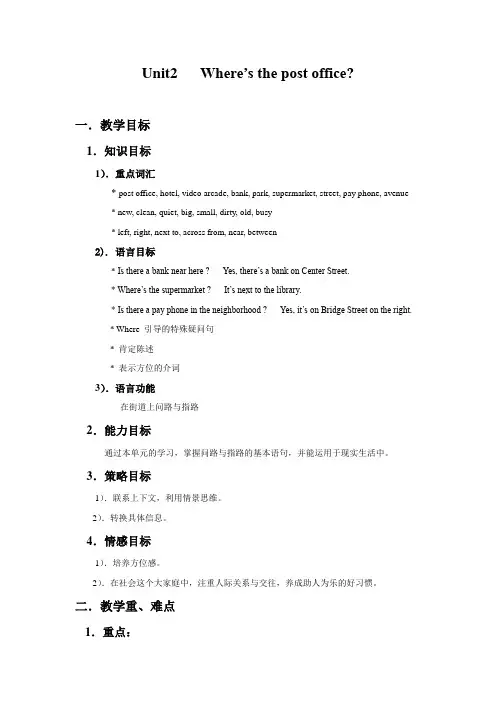
1 Unit 2 Where is the post office? 目标认知 重点词汇: 1. post 邮件 2. office 办公室 3. library 图书馆 4. restaurant 餐馆、饭店 5. supermarket 超级市场 6. bank 银行 7. pay 付钱 8. park 公园 9. street 街道 10. center 中心 11. near 在......附近 12. bridge 桥 13. across 横过 14. between 在......之间 15. behind 在......后面 16. clean 干净的 17. quiet 安静的 18. dirty 脏的 19. hungry 饥饿的 20. enjoy 欣赏 21. walk 步行 22. through 穿过 23. beginning 开始 24. tour 旅行 25. visit 参观 26. arrive 到达 27. take 乘坐 28. airport 飞机场 29. pass 通过 30. hope 希望
重点词组及句型: 1. post office 邮局 2. pay phone 投币式公用电话 3. in front of 在......前面 4. across from 在......对面 5. next to 紧挨着 6. turn left/right 向左右拐 7. a busy street 一条繁忙的街道 8. a dirty park 一个脏乱的公园 9. have fun 玩得开心 10. the way to school 到学校的路 11. -Is there a bank near here? -Yes, there is. It is on Center Street. 附近有银行吗? 是的, 有,在中央大街上。 12. -Where is the post office? -It’s across from the bank. 邮局在哪里?它在银行的对面。 13. Next to the hotel is a small house with an interesting garden. 旅馆的旁边是带有一个有趣花园的小房子。 14. Bridge Street is a good place to have fun. 大桥街道是一个娱乐的好地方。
日常用语: 1. -Excuse me. Is there a hotel in the neighborhood? 2
-Yes, there is. Just go straight and turn left. It’s ... 2. -Where is the hotel? - It’s next to the post office. 3. Welcome to our shop. 4. If you are hungry, you can buy some food in the restaurant.
精讲巧练 1. Is there a bank near here? Yes, there is. It is on Center Street. 附近有银行吗?是的,有。它在中央大街上。 (1.)这是there be的一般疑问句,把be动词放在句子的开头,句子结尾用问号,读句子的时候用升调。对于这类句子的肯定回答是:Yes, there is.或者Yes, there are.否定回答是:No, there isn’t.或者No, there aren’t. (2.)there be表示“某地有某物”;have (has)表示“某人有某物”。同学们在表达的时候不能相混,一定要分清楚。例如: There is a book on the desk. 桌子上有一本书。 I have a book on the desk. 我有一本书在桌子上。 (3.)on Center Street 在中央大街上。on是介词表示“在......上”的意思,本单元学习一些介词构成的短语表示具体的地点。例如:in front of the library,on the street,on the road。在街道上,英国人用in,美国人用on。例如: Our teacher lives in/on XinHua Street. 我们的老师住在新华街道上。 随时练 【考例1】 ______ there a book in your school bag? Yes, there is. A. Are B. Is C. Have D. Has 【答案与解析】答案是B。本句子是考查there be的一般疑问句的用法,构成一般疑问句直接把be动词放在句子的开头,因为本句子的主语a book是单数,所以be要用is,在句子开头要大写。不能用have (has)表示某人有。 【考例2】There is going to _____ a sports meeting in our school tomorrow. A. is B. are C. have D. be 【答案与解析】答案是D。本句子是考查there be的一般将来时的用法,is going to表示将来时,there be表示“某地有某物”,不能用动词have,否则就成为there have结构,这是错误的。
2.The pay phone is between the post office and the library. 投币式电话在邮局和图书馆之间。 (1.)between是介词,它的意思是“在两者之间”,如果between的后面用代词应该用代词的宾格形式作宾语。表示“在多者之间”要用介词among。例如: Our school is between the bank and post office. 我们的学校在银行和邮局 3
之间。 My house is among the trees. 我的房子在许多树之间。 (2.)pay是“付款”的意思,经常和介词for连用表示“为......付款”。例如: I paid 200 Yuan for that new bike.那辆新自行车花了我200元。 随时练 【考例】 The shop in our school opens _______ 8 a.m. and 5 p.m. A. from B. between C. among D. at 【答案与解析】答案是B。本句子是考查介词的用法,在两者之间用介词between。本句子的意思是“商店在早上8点到下午5点之间营业”。among是表示在多者之间,介词from经常和to搭配构成介词短语from to 表示“从......到......”的意思。介词at用在整点钟,例如:at six o’clock 在6点钟。
3.The pay phone is in front of the library. 投币式电话在图书馆的前面。 (1.)in front of是介词短语表示“在......前面”,of的后面经常用名词或者代词表示地点。例如:My brother sits in front of me in our classroom. 在我们的教室里我弟弟坐在我的前面。 (2.)介词短语in front of强调一个物体在另一个物体的前面。in the front of强调一个物体在另一个物体内部的前面。例如: There is a big desk in the front of our classroom.在我们教室里前面有一个大课桌。 at the head of是强调在一列队伍的前面。例如: I stand at the head of the queue.我排在队伍的最前面。 随时练 【考例】 There is a pay phone ______ of the hospital. A. at front B. in front C. in the front D. at the front 【答案与解析】答案是B。本句子是考查介词的用法,在表示一个物体在另一个物体的前面用介词短语in front of,而介词短语in the front of表示一个物体在另一个物体内部的前面。
4. Just go straight and turn left. 一直向前走然后向左拐。 (1.)这是一个祈使句,用来表示命令或者请求,一般情况下祈使句的主语you要省略,谓语动词直接用动词原形。例如: Open the door, please. 请开门。(表示请求) Go out quickly.快出去。(表示命令) 4
(2.)祈使句的否定形式是在句子的动词前面加助动词don’t。例如: Don’t close the door, please.请不要关门。 随时练 【考例】 ______ to school on foot, please. A. Don’t go B. Not go C. Going D. To go 【答案与解析】答案是A。本句子是考查祈使句的否定形式,在动词原形的前面直接加助动词don’t。不能用not go。
5. Excuse me. Is there a hotel in the neighborhood? 劳驾。请问这附近有旅馆吗? (1.)Excuse me的意思是“对不起、请原谅、打扰一下”。这是英语中经常用到的表示客气的礼貌用语,用于向对方提出请求、询问情况、打扰或者麻烦别人等情景中。 拓展 Excuse me 具体用于以下几种情况: 1.向别人问路的时候。例如:Excuse me, where is the bank? 劳驾,请问银行在哪里? 2.客气地向别人提出请求(允许)。例如: Excuse me, may I use your bike? 对不起,我可以用一用你的自行车吗? 3.向别人打听或者询问情况的时候。例如: Excuse me, is this your bike? 麻烦一下,这是你的自行车吗? 4. 和别人谈话的时候需要中断或者做别的事情。例如: Excuse me, just a moment. 对不起,请稍等一下。 Excuse me主要用于问路、插话、打扰或者麻烦别人的情景中;而sorry. I am sorry. 表示“道歉”,经常用于: 1. 自己有过失,做错了事情表示道歉。例如: I am sorry. I lost your book. 对不起,我把你的书丢失了。 2. 听到别人的痛苦或者不幸的消息表示同情。例如: -My mother was ill.我妈妈病了。 -I am sorry to hear that.听到这个消息我很难过。 3. 表示委婉拒绝或者不同意。例如: Sorry. You can’t sit here. 对不起。你不能坐在这里。 4. 因失约、失礼而表示歉意。例如: -Can you come to my party? 你能来参加我的聚会吗? -Sorry. I can’t. 对不起,我不能。 回答I am sorry可以用:It doesn’t matter. That’s all right/OK. That’s nothing. Never mind.