(完整版)Unit9HowIFoundMyVoice课文翻译综合教程四
- 格式:doc
- 大小:78.51 KB
- 文档页数:6
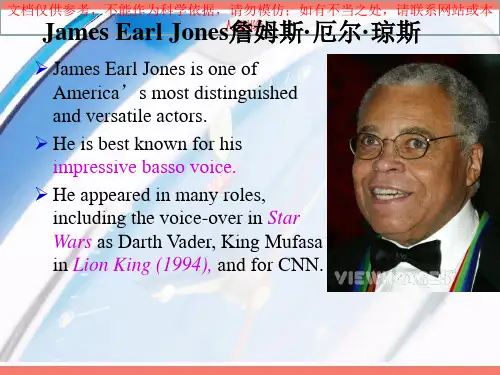
Unit 9How I Found My VoiceJames Earl Jones1 Today I am known for my voice as much as for my acting. It has been my goodfortune to receive jobs such as the speaking role of Darth Vader in George Lucas’s Star Wars trilogy and the voice-over announcer for CNN cable television. I also narrated Aaron Copland’s Lincoln Portrait on a compact disc I recorded with the Seattle Symphony. Perhaps my greatest honor came when I was asked to read the New Testament on tape.2 But it took a long time to believe such good things could happen to me. When Iwas a youngster I stuttered so badly I was completely unable to speak in public.3 Since I was eight I’d had trouble speaking. It was so bad that whenever I stoodup in class to read, the other kids snickered and laughed. I always sat down, my face burning with shame.4 I’m not sure what caused my stuttering. Perhaps it was an emotional problem. Iwas born in Arkabutla, Mississippi, and when I was about five, I moved to live with my grandparents on their farm near Dublin in northern Michigan. It was traumatic moving from the warm, easy ways of catfish country to the harsh climate of the north, where people seemed so different.5 Fortunately, my granddaddy was a gentleman, a farmer who taught me to lovethe land. He was short and he had a prodigious amount of energy. He even built a church to please grandmother, a fervent worshiper of the Lord. All sorts of people were invited to our little church; white, black and American Indian came together ina nondenominational fellowship. Granddad’s Irish heritage came out in his love forlanguage; during the week he used “everyday talk”, but on Sunday he spoke only the finest English.6 As much as I admired his fluency, I couldn’t come close to it. I finally quitSunday school and church, not wanting to be humiliated any more. All through my grade school years, the only way the teacher could assess my progress was for me to write down everything I had learned.7 Oh, I could talk, all right. Our farm animals knew that. I found it easy to call thepigs, tell the dogs to round up the cows, and vent my feelings to Fanny, the horse whose big brown eyes and lifted ears seemed to express interest in all I said. But when visitors came and I was asked to say hello, I could only stand, pound my feet,and grit my teeth. That awful feeling of my voice being trapped got worse as I grew older.8 Then when I was 14, Professor Donald Crouch came to our school. He was aretired college professor who had settled in nearby Brethren, a Mennonite community. When he heard that our agricultural high was teaching Chaucer, Shakespeare and other classics, he couldn’t stand not being a part of our school. So he left his retreat to teach us English, history and Latin.9 Donald Crouch was a tall, lean man with gray hair; English was his favoritesubject, poetry was his deepest love. He’s been an associate of Robert Frost. He helda book of poems as if it were a diamond necklace, turning pages as if uncoveringtreasures. He memorized a poem every day, explaining that if he ever lost his eyesight he would still be able to savor all that beauty.10 When he learned that I not only loved poetry but was writing it, we found akinship. There was, however, one difficulty between us. Professor Crouch (we always called him that) could not stand the fact I refused to read my poems to the class.11 “Jim, poetry is meant to be read aloud, just like sermons,” he pressed. “Youshould be able to speak those beautiful w ords.”12 I shook my head and turned away.13 Then he tricked me. I labored long and hard on a poem, and after handing it in Iwaited expectantly for his critique. It didn’t come. Instead, one day as the students assembled, he challenged me. “Jim, I don’t think you wrote this.”14 I stared at him in disbelief. “Why,” I started, anger flooding me, “of course Idid!”15 “Well, then,” he said, “you’ve got to prove it by getting up and reciting it frommemory.”16 By then the other students had settled at their desks. He looked at memeaningfully and nodded. With knees shaking, I walked up before my peers.17 “Jim will recite his latest poem,” announced Professor Crouch.18 For a moment I stood breathless. I could see smirks and wry smiles on somefaces. Then I began. And kept going. I recited my poem all the way through without hesitation or fault! I stood amazed and floated back to my desk in a daze, amid wild applause.19 Afterward, Professor Crouch congratulated me. “Aha,” he said. “Now we havesomething here. Not only will you have to write more poetry and read it aloud to know how good it feels, but I’m sure that you will want to read other writers’ poetrybefore the class.”20 I was dubious about that, but said I’d try.21 Soon I began to discover something other stutterers know. Most have noproblem singing because the lyrics’ rhythmic pattern flows by itself. I found the same cadences in poetry, and before long my fellow students actually looked forward to hearing me recite. I loved the rolling beat of The Song of Hiawatha, especially since I had Indian blood in my veins.22 I discovered I did have a voice, a strong one. Under Professor Crouch’s tutelage,I entered oratorical contests and debates. He never pushed anything at me again; hejust wanted all his students to wake up.23 As my stuttering disappeared, I began dreaming of becoming an actor, like myfather, who was then performing in New York City. No one in my family had ever gone to college. But encouraged by Professor Crouch, I took exams and won a scholarship to the University of Michigan.24 There I entered the drama department and after graduation fulfilled my ROTCresponsibility by serving with the Army’s Cold Weather Training Com mand on mountain maneuvers in Colorado.25 Later, on the GI Bill, I signed up with the American Theater Wing in New Yorkand supported myself between roles by sweeping floors of off-Broadway stages. In 1962 I earned an Obie for my role in an off-Broadway production of Othello, and have been an actor ever since.26 Meanwhile, I always kept in touch with my old professor, by letter andtelephone. Every time we talked it was always, “Hi, Jim. Read any good poetry lately?” He was losing his sight and I remembered his early explanation of why he had memorized poetry. In later years when I was doing Shakespeare’s Timon of Athens at the Yale Repertory Theater in New Haven, Connecticut, I phoned him.“Can I fly you in from Michigan to see it?”27 “Jim,” he sighed, “I’m blind now. I’d hate not to be able to see you acting. Itwould hurt too much.”28 “I understand, Professor,” I said, helped in part by the realization that thoughmy mentor could no longer see, he was still living in a world vibrant with all of the beautiful treasures he had stored.29 About two years later I learned Donald Crouch had passed on. When I wasasked to record the New Testament, I really did it for a tall, lean man with gray hair who had not only helped to guide me to the author of the Scriptures, but as thefather of my resurrected voice, had also helped me find abundant life.找回声音詹姆斯·厄尔·琼斯1 今天我在声音方面的名气一点都不逊色于我的表演。