
大学英语写作-第一讲
- 格式:ppt
- 大小:282.00 KB
- 文档页数:21
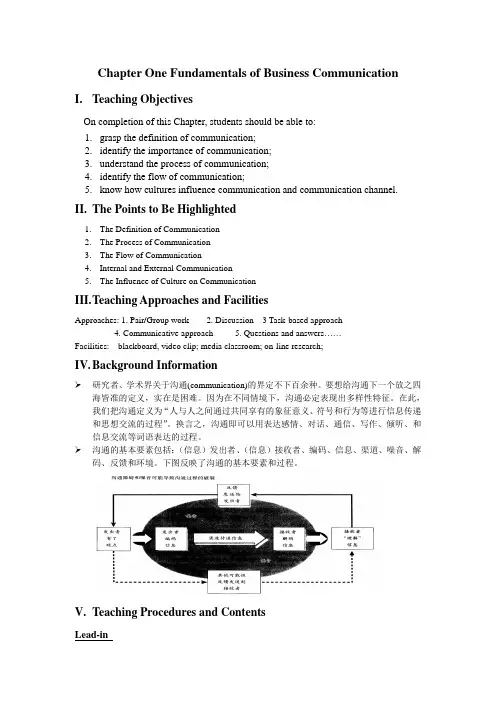
Chapter One Fundamentals of Business Communication
I. Teaching Objectives
On completion of this Chapter, students should be able to:
1. grasp the definition of communication;
2. identify the importance of communication;
3. understand the process of communication;
4. identify the flow of communication;
5. know how cultures influence communication and communication channel.
II. The Points to Be Highlighted
1. The Definition of Communication
2. The Process of Communication
3. The Flow of Communication
4. Internal and External Communication
5. The Influence of Culture on Communication
III. Teaching Approaches and Facilities
Approaches: 1. Pair/Group work 2. Discussion 3 Task-based approach
4. Communicative approach 5. Questions and answers……
Facilities: blackboard, video clip; media classroom; on-line research;

英语写作教程1
Writing is an important aspect of learning English as a
second language. It is an activity that helps learners to
develop their language skills, including grammar, vocabulary,
and syntax. Writing also helps learners to express their
thoughts and ideas in a cohesive and logical manner, and to
communicate effectively with others. In this writing tutorial,
we will discuss some techniques that can help learners
improve their English writing skills.
1. Start with a Plan
Effective writing begins with a plan. Before you start
writing, it is important to outline your ideas and organize
them in a systematic manner. This will help you to avoid
rambling and losing the coherence of your writing. When
planning, consider the purpose of your writing, your audience,
and what information you need to include. This will help you

语法部分
第一讲 虚拟语气
I. 考点分析:
虚拟语气是动词的特殊形式,用来表达说话人的意愿、建议、请求、意图、惊奇、设想等未能或不可能成为事实的情况,以及在说话人看来实现的可能性很小的情况。
虚拟语气是非常重要的语法考点。考察历届四级试题,我们发现与虚拟语气有关的考题每次至少2题,有时甚至3-4题。虚拟语气的考查要点有:
1. 虚拟语气的形式:分清虚拟时间和主句、从句所使用的动词形式十分重要,因此我们把所有虚拟语气的不同类型列表归纳并进行对比,以便于同学们记忆掌握。
动词形式
类型 虚拟时间 从句动词 主句动词
if条件句 现在 过去式 would/should/might/could+动词原形
过去 had+过去分词 would/should/might/could+
have +过去分词
将来 should/were to/
过去式 would/should/might/could+
动词原形
wish引导的宾从 现在 过去式
过去 had+过去分词/
could have done
将来 would/could/
might+动词原形
as if/though方式状语从句 同wish
其它动词引导的宾从 (should)+动词原形
主语从句 (should)+动词原形
表语从句 (should)+动词原形
同位语从句 (should)+动词原形
if only 同if条件句
lest, for fear that, in
case should+动词原形
would rather
/sooner that 现在/将来 过去式
过去 had+过去分词
It is high/about
time that 过去式
2. 要注意从句中第一/三人称的过去式was用were代替。
例如:If I were invited, I would come.
.. ..
..
参考材料 Section A
Text A Toward a brighter future for all
1. Good afternoon! As president of the university, I am proud to welcome you to this
university. Your achievement is the triumph of years of hard work, both of your own and of your
parents and teachers. Here at the university, we pledge to make your educational experience as
rewarding as possible.
下午好!作为校长,我非常自豪地欢迎你们来到这所大学。你们所取得的成就是你们自己多年努力的结果,也是你们的父母和老师们多年努力的结果。在这所大学里,我们承诺将使你们学有所成。
Words and phrase
1. achievement n something very good and difficult that you have succeeded in doing:
e.g. An Olympic silver medal is a remarkable achievement for one so young.
2. triumph n being successful or victorious 成功,胜利
shouts of triumph