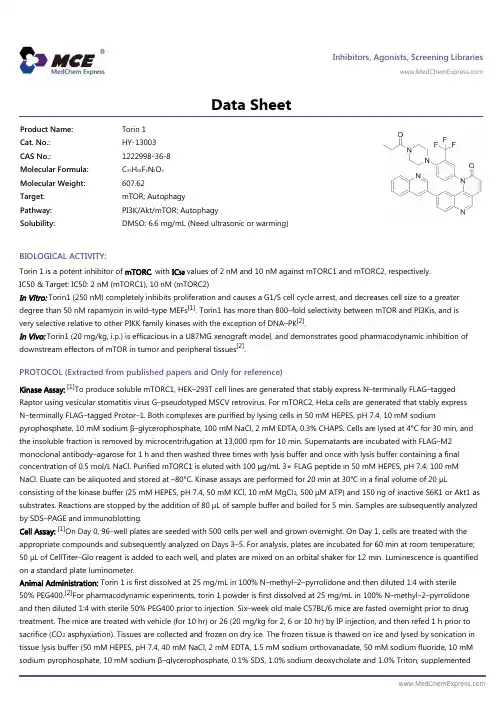
Inhibitors, Agonists, Screening Libraries Data SheetBIOLOGICAL ACTIVITY:Torin 1 is a potent inhibitor of mTORC , with IC 50 values of 2 nM and 10 nM against mTORC1 and mTORC2, respectively.IC50 & Target: IC50: 2 nM (mTORC1), 10 nM (mTORC2)In Vitro: Torin1 (250 nM) completely inhibits proliferation and causes a G1/S cell cycle arrest, and decreases cell size to a greater degree than 50 nM rapamycin in wild–type MEFs [1]. Torin1 has more than 800–fold selectivity between mTOR and PI3Kis, and is very selective relative to other PIKK family kinases with the exception of DNA–PK [2].In Vivo: Torin1 (20 mg/kg, i.p.) is efficacious in a U87MG xenograft model, and demonstrates good pharmacodynamic inhibition ofdownstream effectors of mTOR in tumor and peripheral tissues [2].PROTOCOL (Extracted from published papers and Only for reference)Kinase Assay:[1]To produce soluble mTORC1, HEK–293T cell lines are generated that stably express N–terminally FLAG–tagged Raptor using vesicular stomatitis virus G–pseudotyped MSCV retrovirus. For mTORC2, HeLa cells are generated that stably express N–terminally FLAG–tagged Protor–1. Both complexes are purified by lysing cells in 50 mM HEPES, pH 7.4, 10 mM sodiumpyrophosphate, 10 mM sodium β–glycerophosphate, 100 mM NaCl, 2 mM EDTA, 0.3% CHAPS. Cells are lysed at 4°C for 30 min, and the insoluble fraction is removed by microcentrifugation at 13,000 rpm for 10 min. Supernatants are incubated with FLAG–M2monoclonal antibody–agarose for 1 h and then washed three times with lysis buffer and once with lysis buffer containing a final concentration of 0.5 mol/L NaCl. Purified mTORC1 is eluted with 100 μg/mL 3× FLAG peptide in 50 mM HEPES, pH 7.4, 100 mM NaCl. Eluate can be aliquoted and stored at –80°C. Kinase assays are performed for 20 min at 30°C in a final volume of 20 μL consisting of the kinase buffer (25 mM HEPES, pH 7.4, 50 mM KCl, 10 mM MgCl 2, 500 μM ATP) and 150 ng of inactive S6K1 or Akt1 as substrates. Reactions are stopped by the addition of 80 μL of sample buffer and boiled for 5 min. Samples are subsequently analyzed by SDS–PAGE and immunoblotting.Cell Assay:[1]On Day 0, 96–well plates are seeded with 500 cells per well and grown overnight. On Day 1, cells are treated with the appropriate compounds and subsequently analyzed on Days 3–5. For analysis, plates are incubated for 60 min at room temperature;50 μL of CellTiter–Glo reagent is added to each well, and plates are mixed on an orbital shaker for 12 min. Luminescence is quantified on a standard plate luminometer.Animal Administration: Torin 1 is first dissolved at 25 mg/mL in 100% N–methyl–2–pyrrolidone and then diluted 1:4 with sterile 50% PEG400.[2]For pharmacodynamic experiments, torin 1 powder is first dissolved at 25 mg/mL in 100% N–methyl–2–pyrrolidone and then diluted 1:4 with sterile 50% PEG400 prior to injection. Six–week old male C57BL/6 mice are fasted overnight prior to drug treatment. The mice are treated with vehicle (for 10 hr) or 26 (20 mg/kg for 2, 6 or 10 hr) by IP injection, and then refed 1 h prior to sacrifice (CO 2 asphyxiation). Tissues are collected and frozen on dry ice. The frozen tissue is thawed on ice and lysed by sonication in tissue lysis buffer (50 mM HEPES, pH 7.4, 40 mM NaCl, 2 mM EDTA, 1.5 mM sodium orthovanadate, 50 mM sodium fluoride, 10 mM sodium pyrophosphate, 10 mM sodium β–glycerophosphate, 0.1% SDS, 1.0% sodium deoxycholate and 1.0% Triton, supplementedProduct Name:Torin 1Cat. No.:HY-13003CAS No.:1222998-36-8Molecular Formula:C 35H 28F 3N 5O 2Molecular Weight:607.62Target:mTOR; Autophagy Pathway:PI3K/Akt/mTOR; Autophagy Solubility:DMSO: 6.6 mg/mL (Need ultrasonic or warming)with protease inhibitor cocktail tablets). The concentration of clear lysate is measured using the Bradford assay and samples are subsequently normalized by protein content and analyzed by SDS–PAGE and immunoblotting.References:[1]. Thoreen CC, et al, An ATP–competitive mammalian target of rapamycin inhibitor reveals rapamycin–resistant functions of mTORC1. J Biol Chem, 2009, 284(12), 8023–8032.[2]. Liu Q, et al. Discovery of 1–(4–(4–propionylpiperazin–1–yl)–3–(trifluoromethyl)phenyl)–9–(quinolin–3–yl)benzo[h][1,6]naphthyridin–2(1H)–one as a highly potent, selective mammalian target of rapamycin (mTOR) inhibitor for the treatment of cancer. J Med CheCaution: Product has not been fully validated for medical applications. For research use only.Tel: 609-228-6898 Fax: 609-228-5909 E-mail: tech@Address: 1 Deer Park Dr, Suite Q, Monmouth Junction, NJ 08852, USA。