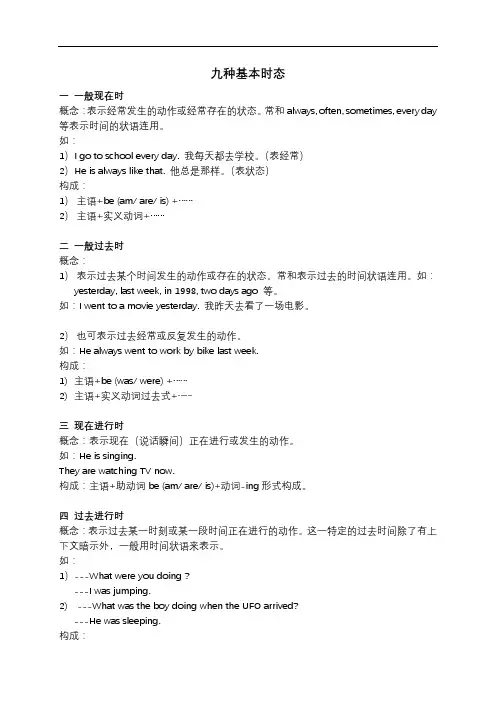
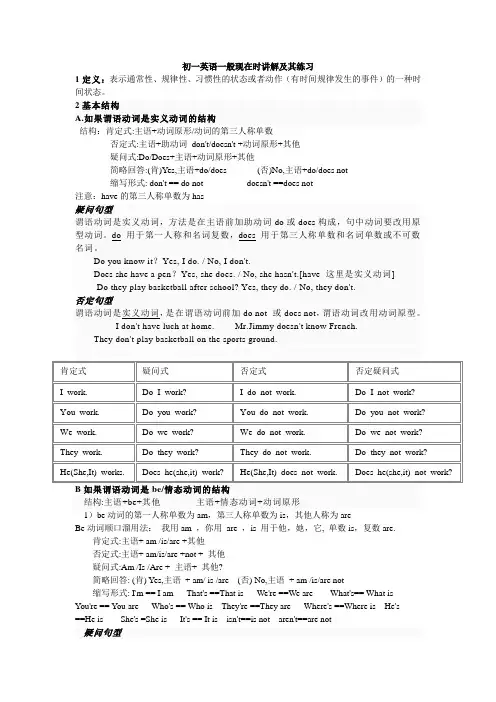
(完整word版)初中一般现在时与现在进行时语法详解及习题
- 格式:doc
- 大小:29.86 KB
- 文档页数:10
一般现在时
一、概述
一般现在时表示习惯性、经常性、反复性的动作或存在的状态。“习惯性、经常性、反复性”是一般现在时的三大特性,它不表示特定时间内发生的事。
用法:
1)经常性、习惯性的动作或存在的状态。
e.g. I go to school on foot.
He is very busy now.
2)表示主语的特征、性格、能力、爱好等。
e.g. He can swim.
I work hard.
I like watching TV.
3)表示客观真理
e.g. There are seven days in a week.
The moon moves round the earth.
二、一般现在时的结构
时态的结构指的是动词的变化形式。一般现在时间有两种结构,一种是动词原形,用于主语为非第三人称时的情况;另一种为动词的第三人称单数形式,用于主语为第三人称时的情况。Eg1.We often get up early in the morning.
Eg2.My father often gets up early in the morning.
三、谈谈“主语为三单,其后动词s添”
在一般现在时中,当主语为第三人称单数时,谓语动词要用第三人称单数形式。可以简单叙述为“主语为三单,其后动词s添”。何谓第三人称单数?用一句话概括就是“非你、非我、非复数”,如he, she, it, my father, my mother, my sister, our English teacher, Tom, Mike, Liu Jia,
China, my book, etc.
Eg3.He sometimes goes to school by bike.
Eg4.My father works in the hospital as a doctor.
四、动词第三人称单数变化规则
动词第三人称变化的规则与可数名词复数变化的规则相同。
规则一、一般在词尾加-s。
如:looks, puts. reads, sees, skis等。
规则二、以-o, -s, -x, -sh, -ch结尾的加-es。
如:goes, does, misses, passes, mixes, fixes, pushes, wishes, watches, teaches,等。
规则三、以辅音字母加y结尾的,变y为i,再加-es。注意一定是辅音字母加y才变,若是元音字母加y,则直接加-s。
如:fly → flies, try → tries, fry → fries, copy → copies
buy → buys, enjoy → enjoys, play → plays, say → says, pay → pays五、
一般现在时的句子转换
(1)当句子中有be动词或情态动词时,则把be动词或情态动词(can,could等等)提到主语的前面变成一般疑问句;在be动词或情态动词后面加not变成否定句.例:
①陈述句:She is a student.
一般疑问句→ Is she a student?
否定句→ She is not a student.
②陈述句:I can swim.
一般疑问句→ Can you swim?
否定句→ I can not swim.
(2)当句子中即没有be动词,也没有情态动词时,则在主语前加助动词do (you,以及复数),
does(单数she,he,it)变成一般疑问句;在主语后谓语动词前加助动词don’t(I,you,以及复数), doesn’t(单数she,he,it)变成否定句,助动词后的动词要变成动词原形。例:
①陈述句:We get up at 7:00 every morning.一般疑问句→Do you get up at 7:00 every morning?否定句→We don’t get up at 7:00 every morning.
②陈述句:She has a little brother.
一般疑问句→ Does she have a little brother?否定句→ She doesn’t have a little brother.
标志:其时间状语为often、 usually、 always、 sometimes等频率副词,on Saturdays、 in
the morning(afternoon evening) 、every day 等。
特殊用法:下列动词come, go, arrive, leave, start, begin, return的一般现在时可以表示将来,主要用来表示在时间上已确定或安排好的事情。例如:
The train leaves at six tomorrow morning. 火车明天上午六点开。
When does the bus star? It stars in ten minutes. 汽车什么时候开?十分钟后
六、练习巩固
1.写出下列动词的三单形式
go__________ catch_________
brush(刷)_____ wash___________
do________ like________
have___________ watch________
drink ___________ fly___________
say_______ learn ___________
eat___________ read___________ sing___________ buy__________
study_______ stay __________
make __________ look ____
pass__________ carry ____
come__________plant(种植)______
teach_______ buy__________
2.用括号内动词的适当形式填空。 1. We often___________(play) in the playground.
2. He _________(get) up at six o’clock.
3.__________you_________(brush) your teeth every morning.
4. What________ (do) he usually______ (do) after school?
5.Danny_______(study)English,Chinese,Maths,
Science and Art at school.
6. Mike sometimes __________(go) to the park with his sister.
7. At eight at night, she often__________(watch) TV with his parents.
8. ________ Mike________(read) English every day?
9.How many lessons_________your classmate________(have) on Monday?
10. What time_________his mother_________(do) the housework?
3.选择题
( )1. I ________to school at 7:00 in the morning.
A. go B. going C. goes
( )2. They _______books every day in the library.
A.reads B. read C. reading
( )3. The monkey________ eating bananas very much.
A.like B. likes C. liking
( )4. My father ________to read newspaper after supper every day.
A.like B. likes C. liking
( )5. I like watching TV, but my mother _________like it.
A. don’t B. doesn’t C. does
( )6. ____________ your father drink milk every day?
A.do B. are C. does
( )7. We will go shopping if it____ tomorrow.
A. don't rain B. didn't rain
C.doesn't rain D. isn't rain
( )8. He said the sun ____in the east and ____in the west.
A rose; set B rises; sets
C rises, set D rise; sets
( )9.Wang Mei ____ music and often ____ to music.
A like; listen B likes; listens
C like; are listening D liking ; listen
( )10. Jenny____ English every evening.
A has study B studies
C study D studied
4.改错(划出错误的地方,将正确的写在横线上)
1. Is your brother speak English? __________________
2. Does he likes going fishing? __________________
3. He likes play games after class. __________________
4. Mr. Wu teachs us English. __________________