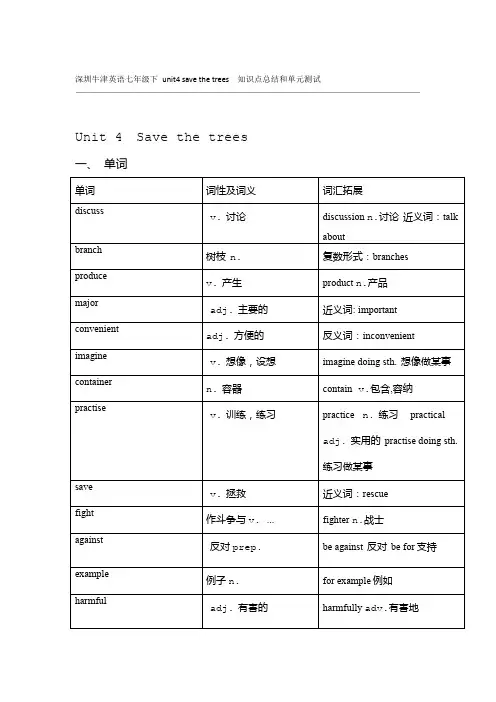
七年级英语下册Unit4 Save the trees期末知识点汇总
- 格式:docx
- 大小:22.24 KB
- 文档页数:9
七年级英语下册Unit4 Save the trees期末知识点汇总七年级英语下册Unit4 Sav期末知识点汇总1.save vt. 拯救;解救Eg. Let’s dg to save the animals in dangThe police savedld【拓展】save “节省、储蓄” Eg. savav 【变形】safe adj. sa2.discuss vt “讨论” 后接名词(短语)或wh-从句及wh-短语discug. We discussedblWe will discuss who should dWe will discuss what to teach nexleaf n. “树叶” 复数:leavg. The fallleaugh to tellg of autumn. 一叶知秋。
The leaves turn gg. 变绿lp+do = help + to do “帮忙做……”lp+名词+(to)do “帮(某人)做……” Eg. I helped (to) waaI helped him (to) l【拓展】help+with...或help+名词+with... “在某方面帮忙”Eg.Can I help you with your work?Can you help me wwork, Mary?g“为……而战” fight过去式:fougght against “与……作斗争”Eg. He is fighting agaThey figdvide sb. wvidb. 提供给某人……,为某人提供……Egvide us with woolvide wool for uany ways “在许多方面”【短语】 by the way 顺便说一下 in a way 在某种程度上way of sb. 妨碍某人way to...在去……的途中way 用这种方法“使维持(某种状态)”+名词+形容词 Eg. Tawa+名词+副词/介词短语Eg. Don’boy outside/+名词+doing Egwaiting for half an houa“接受……,吸收……”Eg. The kind man would labFish take in oxygen througgills. 鱼用腮吸氧气10.breathe[i:] v. breath[e]ake 普通用词,指任何东西的制造或制造过程 Eg.He made the dlduce 正式用词,除表示大量生产制造外,还表示创造Eg. Twill produblxt yea2.in fact 实际上,事实上。
用作状语,用于强调或订正前句。
Eg. He doesn’t mind. In faleasedlook around = look round “四下环顾” vt./vg. Look around you bg 朝各方向看看Don’t look around when you study. 学习时,别东张西望urniture 不可数名词(集合用法)表示件数时用g. We don’t have much furniture. 有多少家具They bought a fewurnituday. 买了几件家具bemade of “由……制成” 制成品能看出原材料be made from 制成品看不出原材料Eg. Tade of silPaade from woodagine vt. “设想;想象” 不可用于进行时;不可跟动词不定式agine +名词/动名词/宾语从句Eg. Can you imaglife without el?I can’t imagine what he looks lut down “把……砍到” Eg. Ight to cut dowll“无数的,成千上万的”/doing 停止某事/做某事 (停止做正在做的事情) Eg.Didwork/working late last night?He can’g aboudo 表示中断现在的行动或活动去做另一件事。
不定式to do表示目的Egd reading and closed the bI stopped to read the newspa20.pay a注意……Eg. You must pay ablasked the boy to pay alling.21.uake = uakingEg. We use wood to make a table.=We use wood for making a table.用木材制作桌子22.be good for “对……有好处,对……有益处” Egwill be goodal23.【短语】as a result 结果,因此 according to 根据abit of drinking tea 喝茶的习惯 the Tang Dynasty唐朝Key grammar现在进行时态一、现在进行时的用法1、表示说话时正在进行或发生的动作。
如:I’m babysitting my younger b我在照看我弟弟。
It’s raining outside. 外面正在下雨。
2、表示现阶段一直在进行或不断重复的动作,但说话时该动作并不一定在进行。
如:He’s watching ag TV plada近来,他在看一部很有趣的电视剧。
Are you teaching English in a school? 你在学校教英语吗?3、表示最近的确定安排,即根据计划或安排在近期内将要发生的动作。
这是表示眼前打算最普通的说法,但一般要与表示将来的时间连用,以避免现在进行时和一般将来时的含义上的混淆。
例如:I’g you at the avening. 今晚,我会到机场接你。
What are you having for dinner? 晚饭吃什么?4、表示从一个地方到另一个地方位置移动的动词(如gdrive, fly, travel, arrive, leave, start, visit,run,return等),以及动词do等的现在进行时形式,可以用来表示没有确定安排的决定或计划。
He’s leaving for Beijingw. 他明天动身去北京。
What are you doing next Sunday? 下星期天你要干什么?5、现在进行时和always,usually,all等连用时,表示一种经常、反复的动作,且说话人往往带有某种感情色彩(如赞扬、欣赏、厌烦、批评、惊讶、不理解等)。
例如:’s always helping她总是乐于助人。
(表示赞赏)You are always talking in class. 你上课老是说话。
(表示批评)二、现在进行时的谓语部分构成现在进行时在句式的变化上,都应在助动词be上做文章。
1、肯定式:be(am, is, are)+ Ving(现在分词) 如: They are having an English class. 他们在上英语课。
2、否定式:be(am, is, are) + not + Ving(现在分词) 如:They aren’t having an English class. 他们不在上英语课。
3、疑问式:将be的具体形式(即am, is或are)提前到句首。
如:Aaving an English class?他们在上英语课吗?助动词变化口诀:变疑问,往前提,句后问号莫丢弃;变否定,更容易,be后not 莫忘记。
三、现在分词的变化规则1、一般在词尾加-ing(一般-ing)。
例如: going,playing,knowing2、以不发音的字母e结尾,先去e再加-ing(去哑e)。
例如:making,arriving,coming3、以重读闭音节结尾,且词尾只有一个辅音字母时,先双写这个辅音字母,再加-ing(重闭单辅先双写)。
例如:running,stopping,g4、以-ie结尾,先将-ie改成y,再加-ing。
例如:tying,dying, lying口诀:现在进行ing,以e 结尾要去e,除去几个特殊词,系住tie-tying死去die-dying要躺下lie-lying,直接ie变成y。
四、现在进行时态的常见提示语1、在汉语中,通常有“在,正在”等提示词。
如:我在做作业。
I am doingw2、在英语中,最常见的提示词有now,look,listen以及a(此时此刻)等。
如: Look,they are playing football. 瞧!他们在踢足球。
五、运用现在进行时常见的几个错误1、把动词变成现在分词形式易出错。
例:(1)误:They are swiming (swim) .正:They are swimming (swim).(2)误:laiing (play) football.正:laying (play) football.解析:A、动词变现在分词可有如下口诀:一般-ing;哑e先去e;重闭单辅先双写;-ie结尾y来替。
B、动词现在分词的变化规则要与名词变复数、动词变现单三等规则区分开来。
2、谓语部分的构成不完整:丢掉be动词,或忘记把动词变成现在分词。
例:(1)误:Look! Two children flying (fly) aa正:Look!Two children are flying (fly) aa(2)误:Li Ming isn’t read ( not read) a book in bed now.正:Li Ming isn’t reading ( not read) a book in bed now.解析:现在进行时的谓语部分的构成是“be+现在分词”,二者缺一不可,这一点必须要牢记。
3、对动词或动词词组提问时,丢掉代动词doing。
例:The students are singing(对划线部分提问)→误:What aud?→正:What audents doing?解析:现在进行时态中对动作提问可记住此句式“What +be +主语+doing+其它?”或简写为“What......doing......? ”句式。
4、现在进行时态的谓语部分是并列结构时,容易忽视第二个以及第二个以后的动词用现在分词形式。
例:孩子们在跑还是在跳?误:Aldren running or jump?正:Aldren running or jumping?解析: or连接的是两个并列成分,动词形式须一致。
Pra(一)单项选择填空:1、 Look! He _____dusewA. is helping B. are hellp D. is helpping2 、_____are the boys doing ? They are singingA. Who B. How C. What D. W、Don’t tal_____ .A. is sleepingB. are sleepingC. sleepingD. sl、Danny ______. Don’t callA. is writeing B. is writing C. writing D. w、---- When_____ he_____back?----Sorry, I don’t know.A. dB. agDg(二)用括号中动词的适当形式填空1、It’s ten o’cl_____ (lie) in bed.2、 What____he _____(mend)?3、 We _____(play) games now.4、 What ____you____ (do) these days?5、 ____he ___ (clean) the classroom?6、 Who____ (sing)xt room?7 、The girl____ (like) wearing a sweater. Look! She ____ (wear) a red sweater today.存在,所有,感官,认识,情感:(状态)存在:ay , remain , b(由……组成), contain 所有: have ,belong to(属于)wn , hold知觉: sound(听起来),hear , look /seem /appear (看起来), smell(闻起来), taste(尝起来),feel (摸起来) ,认识: understand, know, suber, adget, believ情感:like, love, ha。