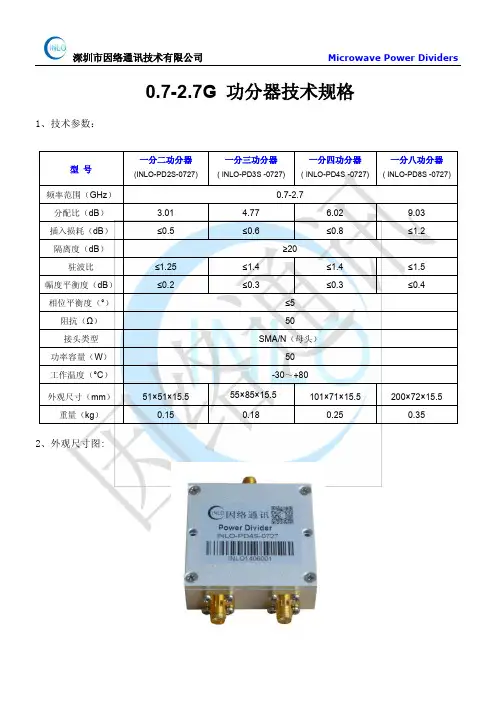
具有高隔离度和任意功分比的平行带状功分器中英文对照翻译
- 格式:doc
- 大小:4.71 MB
- 文档页数:39
A Parallel-Strip Ring Power Divider With
High Isolation and Arbitrary
Power-Dividing Ratio
Abstract—In this paper, a new power divider concept, which provides high
flexibility of transmission line characteristic impedance and port impedance, is
proposed. This power divider is implemented on a parallel-strip line, which is a
balanced transmission line. By implementing the advantages and uniqueness of
the parallel-strip line, the divider outperforms the conventional divider in terms of
isolation bandwidths. A swap structure of the two lines of the parallel-strip line is
employed in this design, which is critical for the isolation enhancements. A lumped-circuit model of the parallel-strip swap including all parasitic effects has been
analyzed. An equal power divider with center frequency of 2 GHz was designed to
demonstrate the idea. The experimental results show that the equal power divider has
96.5%—10-dB impedance bandwidth with more than 25-dB isolation and less than
0.7-dB insertion loss. In order to generalize the concept with an arbitrary power ratio,
we also realize unequal power dividers with the same isolation characteristics. The
impedance bandwidth of the proposed power divider will increase with the dividing
ratio, which is opposite to the conventional Wilkinson power divider. Unequal
dividers with dividing ratios of 1 : 2 and 1 : 12 are designed and measured.
Additionally, a frequency independent 1800 power divider has been realized with less
than 20 phase errors.
Index Terms—Arbitrary power-dividing ratio, parallel-strip line,
ring structure, unequal power divider.
I. INTRODUCTION
THE WIKINSON power divider is one of the conventional and fundamental
components in microwave engineering and exists in many microwave circuits. Both
distributed and lumped Wilkinson power dividers have been applied in microwave
integrated circuits and monolithic microwave integrated circuits [1]. Recently,
extensive studies have been made to enhance the performances of the Wilkinson
power divider, including size reductions by capacitive loading [2], folded circuitry [3]
and resonating structure [4], [5], multiband operation [6], [7], unequal power
dividing/combining [8], and active device [9] and waveguide implementations [10].
The power dividers discussed in this paper are focused on the isolation enhancement.
The proposed divider is realized in the parallel-strip transmission line. Some parallel-strip circuits were reported with performance enhancement [11], [12]. The parallel-strip line provides more design flexibility than a micro-strip line, especially in
realization of a high-impedance line and transitions.
Many balanced circuits such as push–pull amplifiers, balanced mixers, frequency
multipliers, and antenna arrays employ the Wilkinson power divider because of its
simple design with high port-to-port isolation. Isolation is one of the important issues in the design of the power divider and directional coupler. High isolation implies the
minimization of unwanted coupling between active devices, as well as the elimination
of unexpected distortions and oscillations. It is because it may provide a positive
feedback path for other frequencies, e.g., in Fig. 1, as unwanted oscillation at f1 may
be set up outside of the operation frequency f0. Therefore, a wideband isolation
operation is always preferred to suppress the coupling in other frequency bands.
Fig. 1. Balanced circuit at frequency f0 and unwanted feedback at f1.
The parallel-strip line belongs to a family of balanced transmission line. The
conventional printed circuit board (PCB) fabrication technique is able to easily realize
parallel-strip lines. It is a simple structure of a dielectric substrate sandwiched
between two strip conductors. The signals flowing on the upper and lower strip
conductors are always equal in magnitude and 1800 out-of-phase. The quasi-TEM
mode electric and magnetic fields distributions are closed to the micro-strip line. In
this paper, a parallel-strip swap is employed to enhance isolation performance of the
power divider. The swap is a passive microwave component. It forms a compact
realization of 1800 phase shift by interchanging the connection of two conductors in
the balanced transmission line. Various swaps were proposed for performance
enhancement in a 1800 hybrid coupler [13]–[15].
A new equal power divider, which is realized on a parallel-strip line with a ring-like
structure, was first demonstrated in [16]. The four arms and two shunt resistors in the
divider provide a high degree of freedom for choosing the circuit parameters. In this