英语中的十六种时态
- 格式:docx
- 大小:18.92 KB
- 文档页数:6
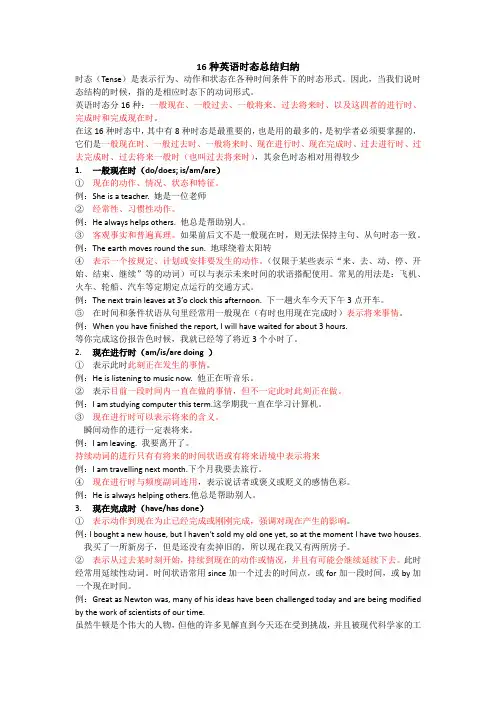
英语中的十六种时态 Company Document number:WUUT-WUUY-WBBGB-BWYTT-1982GT 英语中的十六种时态 一般时态 进行时态 完成时态 完成进行时态 现在 do/does am/is/are doing have/has done have/has been doing 过去 did was/were doing had done had been doing 将来 shall/will do shall/will be doing shall/will have done shall/will have been doing 过去将来 should/would do should/would be doing should/would have done should/would
have been doing
一、一般现在时 1.概念:表示经常发生的情况;有规律出现的情况;总是发生的;和事实真理2.时间状语: always, usually, often, sometimes, everyweek (day,year, month…·), once a week(day,year, month…), on Sundays( on Mondays…·), 3.基本结构:动词原形(如主语为第三人称单数,动词上要改为第三人称单数形式) 4.否定形式:主语+am/is/are+not+其他;此时态的谓语动词若为行为动词,则在其前加don’t,如主语为第三人称单数,则用 doesn’t,同时还原行为动词。 5.一般疑问句:把be动词放于句首;用助动词do提问,如主语为第三人称单数,则用does,同时,还原行为动词。 6.例句: It seldom snows here.这里很少下雪。 He is always ready to help others.他总是乐于帮助别人 Action speaks louder than words.事实胜于雄辩
二、一般过去时 1.概念:过去某个时间里发生的动作或状态;过去习惯性、经常性的动作、行为。 2.时间状语:ago, yesterday, the day before yesterday, last week , last year , night , month . ) , in 1 9 8 9 , just now at the age of 5 , one day , long long ago , once upon a time 3.基本结构:主语+动词的过去式或be的过去式+名词 4.否定形式:主语+was/were+not+其他;在行为动词前加didn’'t,同时还原行为动词。 5.一般疑问句:was或were放于句首;用助动词do的过去式did提问,同时还原行为动词。 6.例句: She often came to help us in those days.那些天她经常来帮助我们。 i didn' t know you were so busy.我不知道你是这么忙
三、一般将来时 1.概念:表示将要发生的动作或存在的状态及打算、计划或准备做某事。 2时间状语: Tomorrow, next day(week, month,year…·) soon , in a few minutes , by , the day after tomorrow , etc . 3.基本结构:主语+am/is/are+ going to+do+其它;主语+wi1l/ shall+do+其它 4.否定形式:主语+am/is/ are not going to do;主语+will/ shall not do+其它 5.一般疑问句:be放于句首;wi1l/sha1l提到句首。{首字母大写 6 .例句 : they are going to have a competition with us in studies It is going to rain.天要下雨了
四、一般过去将 1.概念:立足于过去某一时刻,从过去看将来,常用于宾语从句中。 2.时间状语: The next day( morning \,year……),the following month(week…·),etc 3.基本结构:主语+Was/were+ going to+do+其它;主语+ would/ should+do+其它 4.否定形式:主语+was/were+not+ going to+do;主语+ would/ should 5.一般疑问句:was或were放于句首; would/ should提到句首 6.例句: He said he would go to beijing the next day.他说他第二天要去北京。 asked who was going there.我问,谁要去那里。
五、现在进行时 1.概念:表示现阶段或说话时正在进行的动作及行为。 2时间状语:Now, at this time,days,, listen 3.基本结构:主语+be+ doing+其它 4.否定形式:主语+be+ not + doing+其它 5.一般疑问句:把be动词放于句首。6.例句: How are you feeling today你今天感觉如何 He is doing well in his lessons.在课上他表现得很好。
六、过去进行时 1.概念:表示过去某段时间或某一时刻正在发生或进行的行为或动作。 2时间状语: at this time yesterday, at that time或以when引导的谓语动词是一般过去时的时间状语等。 3.基本结构主语+was/ were + doing+其它 4.否定形式:主语+Was/were+not+ doing+其它 5.一般疑问句:把was或were放于句首。(第一个字母大写) 6.例句: At that time she was working in a pla unit.那段时间她在人民解放军部队工作。 When he came in, i was reading a newspaper.他进来时,我正在读报纸。
七、将来进行时 1.概念:表示将来某一时间正在进行的动作,或表示要在将来某一时间开始,并继续下去的动作。常用来表示询问、请求等。 2时间状语:Soon, tomorrow, this evening, on Sunday, by this time , in two days , tomorrow evening 3.基本结构:主语+ shall/will+be+现在分词+其它 4否定形式:主语+ shall/wi1l+not+be+现在分词+其它5.例句: This time next day they will be sitting in the cinema.下一天的这个时间,他们正坐在电影院。 He won’ t be coming to the party.他不去参加聚会了。
八、过去将来进 1.概念:表示就过去某一时间而言,将来某一时刻或某一段时间正在进行的动作,主要用于宾语从句中,尤其多用于间接引语中 2.基本结构: should/ would+be+现在分词 3.例句: They said they would be coming他们说了他们将要来。 He said he could not come because he would be having a meeting .他说他不能来因为要开会
九、现在完成时 1.概念:过去发生或已经完成的动作对现在造成的影响或结果,或从过去已经开始,持续到现在的动作或状态。 2.时间状语:yet, already,just, never,ever, so far, by now,S1nce+时间点,for+时间段, recently, lately,ln the past few years , etc .3.基本结构:主语+have/has+(过去分词)+其它 4.否定形式:主语+have/has+not+(过去分词)+其它 5.一般疑问句:have或has放句首。 6.例句: I've written an article.我已经写了一篇论文。 The countryside has changed a lot in the past few years在过去的几年,农村发生了巨大的变化
十、过去完成时 1.概念:以过去某个时间为标准,在此以前发生的动作或行为,或在过去某动作之前完成的行为,即“过去的过去”。 2时间状语: Before, by the end of last year(term, month…·),etc. 3.基本结构:主语+had+pp(过去分词)+其它4.否定形式:主语+had+not+(过去分词)+其它 5.一般疑问句:had放于句首。 6.例句: As soon as we got to the station, the train had left.当我们到车站的时候,火车已经开走了。 By the end of last month , we had reviewed four books .到上个月底,我们已经复习了四本书。 7.基本结构:主语+had+(过去分词)+其它 ①肯定句:主语+had+(过去分词)+其它②否定句:主语+had+not+(过去分词)+其
它 ③一般疑问句:Had+主语+(过去分词)+其它 ④特殊疑问句:特殊疑问词+一般疑问句
十一、将来完成时 1.概念:在将来某一时刻之前开始的动作或状态 2.时间状语: by the time of; by the end of+时间短语(将来); by the time+从句(将来) 3.基本结构:主语+ be going to/will/ shall+have+(过去分词)+其它 4.例句:by the time you get back , great changes will have taken place in this area .到你回来的时候,就将发生巨大的变化。
十二、过去将来完成时