
5formation
- 格式:ppt
- 大小:365.50 KB
- 文档页数:39
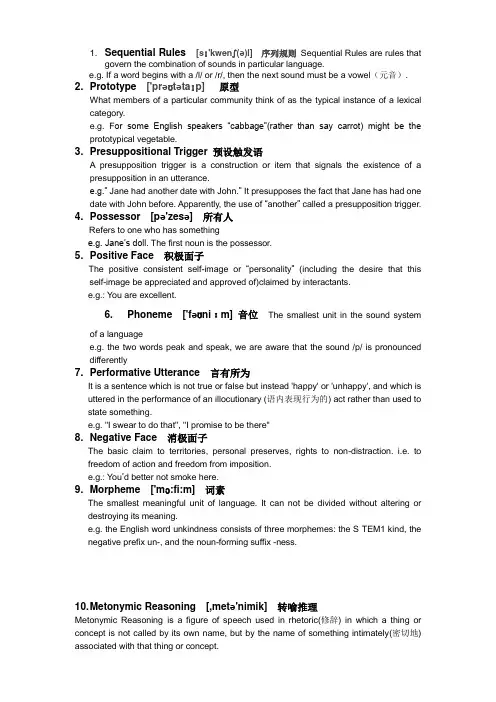
1. Sequential Rules [sɪ'kwenʃ(ə)l] 序列规则 Sequential Rules are rules that
govern the combination of sounds in particular language.
e.g. If a word begins with a /l/ or /r/, then the next sound must be a vowel(元音).
2. Prototype ['prəʊtətaɪp] 原型
What members of a particular community think of as the typical instance of a lexical
category.
e.g. For some English speakers “cabbage”(rather than say carrot) might be the
prototypical vegetable.
3. Presuppositional Trigger 预设触发语
A presupposition trigger is a construction or item that signals the existence of a
presupposition in an utterance.
e.g.” Jane had another date with John.” It presupposes the fact that Jane has had one
date with John before. Apparently, the use of “another” called a presupposition trigger.
4. Possessor [pə'zesə] 所有人
Refers to one who has something

《英语词汇学 》 复习资料1
Ⅰ. Fill in the blanks.
Directions: Complete the following statements with proper words.
1. The 1 is the smallest functioning unit in the composition of words.
2. 2 are words borrowed early in the past and now are well assimilated into
the English language.
3. The problem of interrelation of the various meanings of the same word can be
dealt with from two different angles: 3 approach and synchronic
approach.
4. “Mal-” in “maltreat” is a 4 prefix, while “inter-” in “ interstate” is a 5
prefix.
5. Old English is described as a language of full endings, Middle English language
of 6 endings, and a language of 7 endings.
6. In modern English, one may find some 8 words whose sounds suggest
their meaning, for these words were created by imitating the natural sounds or

5XFAD转基因小鼠介绍
展开全文
系统命名:B6SJL-Tg(APPSwFlLon,PSEN1*M146L*L286V)6799Vas/Mmjax
普通命名:5XFAD, Tg6799
品系来源:该品系由Northwestern University的Robert Vassar捐赠。 原始参考文献为Oakley H; Cole SL; Logan S; Maus E; Shao
P; Craft J; Guillozet-Bongaarts A; Ohno M; Disterhoft J; Van Eldik
L; Berry R; Vassar R. 2006. Intraneuronal beta-amyloid aggregates,
neurodegeneration, and neuron loss in transgenic mice with five
familial Alzheimer's disease mutations: potential factors in
amyloid plaque formation. J Neurosci 26(40):10129-40 PubMed:
17021169 MGI: J:112949
品系描述:这些 5XFAD 转基因小鼠过表达突变的人 APP(695) 以及瑞典型(K670N、M671L)、佛罗里达型 (I716V) 和伦敦型 (V717I)
家族性阿尔兹海默症 (FAD) 突变并携带两个 FAD 突变(M146L 和
L286V)的人 PS1。这两个转基因的表达都由小鼠的神经特异性调控元件 Thy1 启动子调控,以驱动转基因在大脑中的过表达。这一品系的小鼠具有高 APP 表达,与 42 个氨基酸长度的 β-淀粉样蛋白 (Aβ-42)
种类的高负荷和加速积累相关。5XFAD 小鼠几乎只产生 Aβ-42,并快速在大脑中积累。在 C57BL/6 和 SJL 的混合遗传背景下(见 MMRRC

添加词缀是最常见的创造新词的方法,叫做派生。除了派生,还有许多创造新词
的方法。 1. Backformation 反向构词 反向构词就是把添加词缀过程“颠倒过来”,不是通过给词干添加词缀构成新词,
而是先假定词干的一部分属于词缀,然后把这部分去掉。 2. Compounding 复合
复合就是把两个或两个以上的词放在一起,构成新的单词,新词具有不同于起组
成成分的特性。也就是说,虽然可以大致猜测合成词的意义,但不能从构成复合词的成分来推断其确切的词义和词性。 e.g. greenhouse, blackboard
3. Conversion 转类构词
转类构词就是改变一个词的语法功能,但不对词形作任何添加或删减。使原本具
有一种词性的词兼有另一种词性。 e.g. a walk--- to walk
content (n.)--- content (adj.)
contract (n.) --- contract (v.)
4. Borrowing 外来语构词
外来语构词就是直接借用外语词汇。也叫借词或翻译借词,仿造词。英语从其他语言借用了许多词汇,保留其原来的发音形式,甚至也保留拼写形式。 e.g. bungalow (印地语)
veranda(葡萄牙语)
spaghetti (意大利语)
lychee / litchi commence (法语)
5. Clipping 缩略构词
把多音节词缩短,构成的新词通常用于非正式的口语。 e.g. ad --- advertisement
lab --- laboratory flu --- influenza
math --- mathematics
6. Blending混合构词
不是把完整的两个词连在一起,而是把前一个词的开头和后一个词的末尾拼起
来。 e.g. smog
brunch
7. Acronym 首字母缩合词
把一个短语中各个词的首字母串起来,形成新词。 e.g. radar --- radio detecting and ranging AIDS --- acquired immune deficiency syndrome