
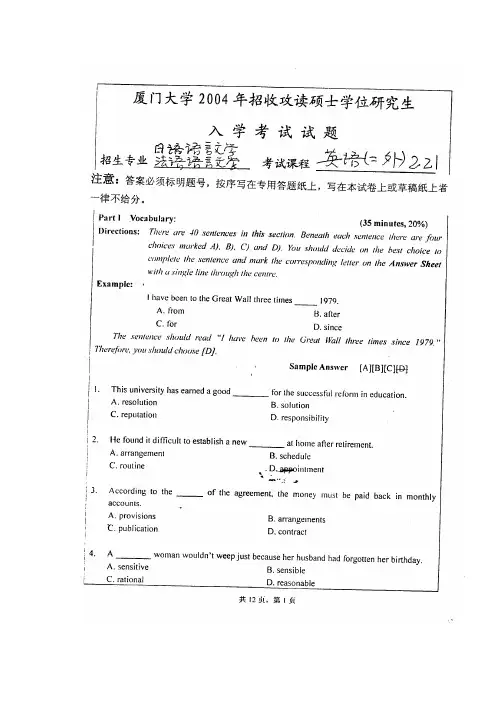
厦门大学2004年研究生入学考试《英语(二外)》试题
- 格式:doc
- 大小:774.50 KB
- 文档页数:12
厦门大学研究生入学考试历年真题及答案点击蓝色字体查看原文温馨提示:内容较多,(Ctrl+H)搜索所需内容2015年厦门大学701语言文学基础全套资料本专业课考试科目的全套资料主要包括:1.历年考研真题及详解(即考研拥有的本专业课考试科目的全部考研真题,部分可能由于官方未公布而无法取得,但是我们在不断更新,如有会第一时间补发给学员);2.本科生、研究生课堂笔记;3.本科生、研究生课堂作业;4.教师授课讲义及课件;5.期中期末考试试题;6.指定教材(参考教材)配套资料(课后习题答案、模拟试题等)。
2015年厦门大学802文学理论与文学评论写作全套资料本专业课考试科目的全套资料主要包括:1.历年考研真题及详解(即考研拥有的本专业课考试科目的全部考研真题,部分可能由于官方未公布而无法取得,但是我们在不断更新,如有会第一时间补发给学员);2.本科生、研究生课堂笔记;3.本科生、研究生课堂作业;4.教师授课讲义及课件;5.期中期末考试试题;6.指定教材(参考教材)配套资料(课后习题答案、模拟试题等)。
2015年厦门大学861语言学全套资料本专业课考试科目的全套资料主要包括:1.历年考研真题及详解(即考研拥有的本专业课考试科目的全部考研真题,部分可能由于官方未公布而无法取得,但是我们在不断更新,如有会第一时间补发给学员);2.本科生、研究生课堂笔记;3.本科生、研究生课堂作业;4.教师授课讲义及课件;5.期中期末考试试题;6.指定教材(参考教材)配套资料(课后习题答案、模拟试题等)。
2015年厦门大学313历史学基础全套资料本专业课考试科目的全套资料主要包括:1.历年考研真题及详解(即考研拥有的本专业课考试科目的全部考研真题,部分可能由于官方未公布而无法取得,但是我们在不断更新,如有会第一时间补发给学员);2.本科生、研究生课堂笔记;3.本科生、研究生课堂作业;4.教师授课讲义及课件;5.期中期末考试试题;6.指定教材(参考教材)配套资料(课后习题答案、模拟试题等)。
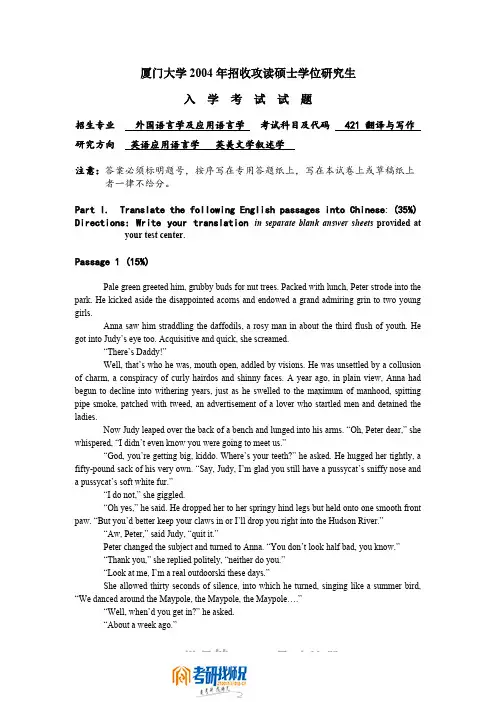
厦门大学2004年招收攻读硕士学位研究生入学考试试题招生专业外国语言学及应用语言学考试科目及代码 421 翻译与写作研究方向英语应用语言学英美文学叙述学注意:答案必须标明题号,按序写在专用答题纸上,写在本试卷上或草稿纸上者一律不给分。
Part I. Translate the following English passages into Chinese: (35%) Directions: Write your translation in separate blank answer sheets provided at your test center.Passage 1 (15%)Pale green greeted him, grubby buds for nut trees. Packed with lunch, Peter strode into the park. He kicked aside the disappointed acorns and endowed a grand admiring grin to two young girls.Anna saw him straddling the daffodils, a rosy man in about the third flush of youth. He got into Judy’s eye too. Acquisitive and quick, she screamed.“There’s Daddy!”Well, that’s who he was, mouth open, addled by visions. He was unsettled by a collusion of charm, a conspiracy of curly hairdos and shinny faces. A year ago, in plain view, Anna had begun to decline into withering years, just as he swelled to the maximum of manhood, spitting pipe smoke, patched with tweed, an advertisement of a lover who startled men and detained the ladies.Now Judy leaped over the back of a bench and lunged into his arms. “Oh, Peter dear,” she whispered, “I didn’t even know you were going to meet us.”“God, you’re getting big, kiddo. Where’s your teeth?” he asked. He hugged her tightly, a fifty-pound sack of his very own. “Say, Judy, I’m glad you still have a pussycat’s sniffy nose and a pussycat’s soft white fur.”“I do not,” she giggled.“Oh yes,” he said. He dropped her to her springy hind legs but held onto one smooth front paw. “But you’d better keep your claws in or I’ll drop you right into the Hudson River.”“Aw, Peter,” said Judy, “quit it.”Peter changed the subject and turned to Anna. “You don’t look half bad, you know.”“Thank you,” she replied politely, “neither do you.”“Look at me, I’m a real outdoorski these days.”She allowed thirty seconds of silence, into which he turned, singing like a summer bird, “We danced around the Maypole, the Maypole, the Maypole….”“Well, when’d you get in?” he asked.“About a week ago.”1。

Section Ⅰ Listening Comprehension Part A(每题1分,共20分)Directions: This section is designed to test your ability to understand spoken English. You will hear a selection of recorded materials and you must answer the questions that accompany them. There are three parts in this section, Part A, Part B, and Part C. Remember, you should first put down your answers in your test booklet. At the end of the listening comprehension section, you will have five minutes to transfer all your answers from your test booklet to ANSWER SHEET I. Now look at Part A in your test booklet. Part A Directions: For Quesstions1-5,you will hear a talk about Boston Museum of Fine Art. While you listen, fill out the table with the information you have heard. Some of the information has been given to you in the table. Write only 1 word or number in each numbered box. You will hear the recording twice. You now have 25 seconds to read the table below.(5 points) 1、Geography of BelgiumThree main regions coastal plaincentral plateau Highest 1 (本题分值:1分) 【正确答案】 highlands 2、altitude of the coastal plain 2 m (本题分值:1分) 【正确答案】 20 3、Climate near the sea 3 humid (本题分值:1分) 【正确答案】 mild 4、Particularly rainy months of the years 4 April (本题分值:1分) 【正确答案】 November 5、Average temperatures in July in Brussels low 13℃ high 5 ℃ (本题分值:1分) 【正确答案】 22 Section Ⅰ Part B(每题1分,共5分)Directions: For Questions 6-10,you will hear an interview with Mr. Saffo from the Institute for the Future. While you listen, complete the sentences or answer the questions. Use not more than 3 words for each answer. You will hear the recording twice. You now have 25 seconds to read the sentences and questions below. ( 5 points ) 6、What is Saffo according to himself? (本题分值:1分) 【正确答案】 A (technology)forecaster 7、The Institute for the Future provides services to private companies and (本题分值:1分) 【正确答案】 government agencies 8、The Institute believes that to think systematically about the long-range future is (本题分值:1分) 【正确答案】 (a)meaningful(exercise) 9、To succeed in anything, one should be flexible, curious and (本题分值:1分) 【正确答案】 open to change 10、What does Saffo consider to be essential to the work of a team? (本题分值:1分) Section Ⅰ Part C(共三节,满分10分) Directions: You will hear three pieces of recorded material. Before listening to each one, you will have time to read the questions related to it. While listening, answer each question by choosing A,B,C or D . After listening, you will have time to check your answers. You will hear each piece once only. ( 10 points ) Questions 11-13 are based on the following talk about naming newborns. You now have 15 seconds to read questions 11-13. 11、What do we often do with the things we love? (本题分值:1分) 【正确答案】 D A.Ask for their names. babies after them. C.Put down their names. D.Choose names for them. 12、 The unpleasant meaning of an old family name is often overlooked if (本题分值:1分) 【正确答案】 B A. the family tree is fairly limited. B. the family tie is strong enough. C.the name is commonly used. D.nobody in the family complains. 13、 Several months after a baby's birth, its name will (本题分值:1分) 【正确答案】 C A.show the beauty of its own. B.develop more associations. C.lose the original meaning. D.help form the baby's personality. Questions 14-16 are based on the biography of Bobby Moore, an English soccer player. You now have 15 seconds to read Questions 14-16. 14. How many matches did Moore play during his professional career? (本题分值:1分) 【正确答案】 D A. 90. B .108. C.180. D. 668. 15、In 1964, Bobby Moore was made (本题分值:1分) 【正确答案】 A A.England's footballer of the year. B.a soccer coach in West Germany. C.a medalist for his sportsmanship. D.a number of the Order of the British Empire. 16、After Moore retired from playing, the first thing he did was (本题分值:1分) 【正确答案】 C A.editing Sunday Sport. B.working for Capital Radio. C.managing professional soccer teams. D.developing a sports marketing company. Questions 17-20 are based on the on the city of Belfast. You now have 20 seconds to read Questions 17-20. 17. Belfast has long been famous for its (本题分值:1分) 【正确答案】 B A. oil refinery. B. linen textiles. C.food products. D. deepwater port. 18、Which of the following does Belfast chiefly export? (本题分值:1分) 【正确答案】 A A. Soap. B. Grain. C.Steel. D.Tobacco. 19、When was Belfast founded? (本题分值:1分) 【正确答案】 A A. In 1177. B. In 1315. C.In the 16th century. D. In the 17th century. 20、 What happened in Belfast in the late 18th century? (本题分值:1分) 【正确答案】 C A. French refugees arrived. B. The harbor was destroyed. C.Shipbuilding began to flourish. D.The city was taken by the English. Section II Use of English(满分10分) Directions: Read the following text. Choose the best word(s) for each numbered blank and mark A,B,C or D on ANSWER SHEET 1. (10 points) Many theories concerning the causes of juvenile delinquency (crimes committed by young people) focus either on the individual or on society as the major contributing influence. Theories (21)[] on the individual suggest that children engage in criminal behavior (22)[] they were not sufficiently penalized for previous misdeeds or that they have learned criminal behavior through (23)[] with others. Theories focusing on the role of society that children commit crimes in (24)[] to their failure to rise above their socioeconomic status (25)[] as a rejection of middle-class values. Most theories of juvenile delinquency have focused on children from disadvantaged families, (26)[] the fact that children from wealthy homes also commit crimes. The latter may commit crimes (27)[] lack of adequate parental control. All theories, however, are tentative and are (28)[] to criticism. Changes in the social structure may indirectly (29)[] juvenile crime rates. For example, changes in the economy that (30) [] to fewer job opportunities for youth and rising unemployment (31)[] make gainful employment increasingly difficult to obtain. The resulting discontent may in (32)[] lead more youths into criminal behavior. Families have also(33)[] changes these years. More families consist of one parent households or two working parents;(34)[], children are likely to have less supervision at home (35)[] was common in the traditional family (36)[]. This lack of parental supervision is thought to be an influence on juvenile crime rates. Other (37)[] causes of offensive acts include frustration or failure in school, the increased (38)[] of drugs and alcohol, and the growing (39)[] of child abuse and child neglect. All these conditions tend to increase the probability of a child committing a criminal act, (40)[] a direct causal relationship has not yet been established. 21、 (本题分值:0.5分) 【正确答案】 C [注释]"很多有关少年犯罪原因的理论,要么把个⼈当成主要的影响因素,要么把社会当成主要的影响因素。

可编辑修改精选全文完整版外国语学院二外德语历年考研真题及详解(总5页)--本页仅作为文档封面,使用时请直接删除即可--全国名校外国语学院二外德语历年考研真题及详解(第3版)益星学习网可免费下载题库目录第1章全国名校外语学院二外德语考研真题分析二外德语考研真题分析重点院校二外德语考研真题比较第2章全国名校外语学院二外德语考研真题详解1.北京外国语大学二外德语考研真题及参考答案(2012~2014)2.中国人民大学二外德语考研真题及参考答案(2007)3.对外经济贸易大学二外德语考研真题及参考答案(2013~2014)4.北京第二外国语学院二外德语考研真题及参考答案(2012~2013)5.北京航空航天大学二外德语考研真题及参考答案(2012~2014)6.上海外国语大学二外德语考研真题及参考答案(2006)7.浙江大学二外德语考研真题及参考答案(2008-2009)8.武汉大学二外德语考研真题及参考答案(2008-2011)9.南京大学二外德语考研真题及参考答案(2008-2009)10.中山大学二外德语考研真题及参考答案(2012~2014)11.厦门大学二外德语考研真题及参考答案(2011~2013)12.四川外语学院二外德语考研真题及参考答案(2008-2009)13.南开大学二外德语考研真题及参考答案(2011~2012)第1章全国名校外语学院二外德语考研真题分析“二外德语”是全国各院校英语、日语、法语、俄语等外国语专业研究生入学考试科目,考生第二外语为德语。
一般来说,“二外德语”总分为100分,考试时间为3小时。
二外德语考研真题分析“二外德语”为全国各大院校自主命题,而非全国统考,没有统一的考试大纲,考生在备考“二外德语”时往往目标不明确,定位不准确,所以对各大院校的二外德语历年真题分析则显得尤为重要。
分析各大院校的二外德语试题能够为考生准确定位自己的德语水平提供很好的参照,也使考生对“二外德语”考试有一个全面的了解,更加清晰的了解出题者的思路,从而正确地制定出复习方法和学习步骤,使复习具有针对性,使复习的效果更上一层楼。