
Conflicts in the Colonial Era
- 格式:pptx
- 大小:12.33 MB
- 文档页数:25
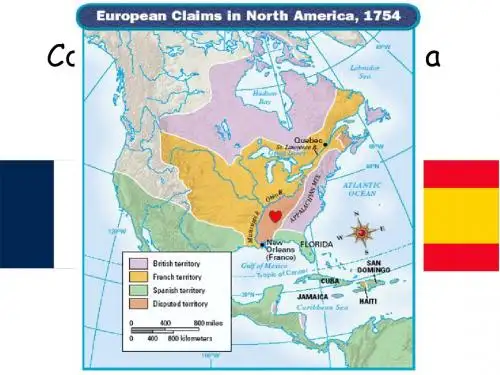


Chapter 9 HistoryI.America in the Colonial Era1、The first Americans:traditionally believed that were Indians,descendants of theMongoloid people in Asia.2、In 1492,Christopher Columbus is believed to have discovered America.<1>found the island of the Caribbean,and called the natives Indians.<2>Italian navigator,Amerigo Vespucci,discovered the continent of SouthAmerica3、The first successful English colony in North America<1>Found at Jamestown Virginia in 1607.<2>In 1620,the Pilgrim Fathers landed in Plymouth,Massachusetts byMayflower.<3>By 1733,English settlers had occupied 13 colonies along the Atlanticcoast.<4>the French and controlled Canada and Louisiana.<5>After the Seven Years’War,England gained control of Canada and all of NorthAmerica east of the Mississippi in 1763.4、The conflict in England and its colonies<1>England imposed new taxes partly<2>the colonies resented the taxes and resisted the quartering of soldiers.II.The War of Independence1、On April19,1775,some British were sent to Concord to search for weaponsand “rebelling” colonists.2、The first shots in the American War of Independence were fired.<1>In May 1775,the Second Continental Congress was held inPhiladelphia,acted as a provisional governmentof the 13 colony-states.<2>Established the Continental Army and Navy.<3>Thomas Jefferson drafted the Declaration of Independence.Odopted on July4,1776.◆Presented a public defense of the American War of Independence.◆Explained the philosophy behind the war,”Life,Liberty and the pursuitof happiness”.◆“the consent of the governed”.3、In October 1777,the Americans won a great victory at Saratoga – the turningpoint of the war.4、In 1781,the Americans won a decisive victory at Yorktown,and the Britishsoliders were forced to surrender.5、In 1783,the Birtish and the Americans signed the Treaty of Paris,Unitedstates of America won its independence.III.The Civil War1、The reason of slavery existed<1>In the South,the land was abundant and suitable for farming<2>In the North,there was a growing demand for labor to work in factories. 2、The reason of the abolition of slavery<1>Some Northerners wanted to get slavery from the South.<2>Northerners demanded a law to protect tariffs and asked to finance thebuilding of railways and roads.3、On January1,1863, Lincoln issued the Emancipation Proclamation to grantfreedom to all slaves.IV.America in the 20th Century1、At the start of World War I<1>President Wailson: Neutrality on behalf of the people of US<2>In 1917,the US entered the war.①That submarines to England greatly injured American trade.②Germany promised the Mexicans to regain its lost territory by going towar against the US.③Both sides grew weary,it’s a chance to successfully influence the result ofthe war.<3>In 1918,President Wilson proposed his Fourteen Points as the basis forpeace negotiation.<4>On June28,1919,the Versailles Treaty was signed.2、After World War I<1>the Great Depress Broke out.<2>Franklin D.Roosevelt was elected President and introduced “New Deal”in 19333、In the early days of World War II<1>Adopted a sit-on –the-fence policy.<2>①In 1940,Japan had openly announced its “New Order”.②On December7,1941,Japanese planes showered bombs at PearlHarbor,Hawaii,America into the war.③In June 1944,landed on the beaches of Normandy.④In May 1945,Germany surrdendered.On August 6 and 9,American airplanesdroped two atomic bombs in Japan,on 14th,Japan surrendered and WorldWar II ended.4、The Cold War<1>dissgreements between the Soviet Union and the United States5<2>In the spring of 1947, t he “Truman Doctrine”-the beginning of the ColdWar.<3>In April 1949,forming the North Atlsntic Treaty Organization.<4>The Vietnam War①Was started by Eisenhower and continued by John F.Kennedy.②In 1973,Richard M.Nixon announce Vietnam War ended.③Nixon achieved two diplomatic breakthroughs.5、The policy of Ronald Reagan<1> called for reductions in income taxes and business taxes.<2>Inflation: Under control and by 1983,was underway.<3>social welfare: drastically curtailed.6、George H.Bush: followed Reagan’s economic program and contrated onsolving social and economic problems.7、Clinton: <1>approved the North American Free Trade Agreement.<2>In 1998,had an affair with a young intern ,lead to a period of turmoil.V. America in the 21st Century1、In 2000, George W.Bush became the President of US.2、Deal with an economy that was beginning to silp from its peak of the late 1990s.3、On September11,2001,suffered the most devasting foreign attack ever against its mainland.<1>destroyed the twin towers of the World Trade Center.<2>Crashed into the Pentagoni4、In 2002,”axis of the evil”5、On March20,2003,the troops began an invasion of Iraq and Baghdad fell onApril 9.。


全面侵华战争英语The Sino-Japanese War: A Tragic Clash of Nationalism and ImperialismThe early 20th century was a tumultuous period in East Asia, marked by the rise of aggressive nationalism and competing imperial ambitions. At the heart of this turbulent era was the Sino-Japanese War, a conflict that would have far-reaching consequences for the region and the world. This war, which lasted from 1937 to 1945, was a complex and multifaceted event that cannot be reduced to a simple narrative of aggression and resistance.The roots of the Sino-Japanese War can be traced back to the late 19th century, when Japan emerged as a formidable military power following the Meiji Restoration. Driven by a desire to emulate the success of Western colonial powers, Japan sought to expand its sphere of influence in Asia. This led to a series of conflicts with China, culminating in the First Sino-Japanese War of 1894-1895, in which Japan emerged victorious and gained control of Taiwan and the Liaodong Peninsula.The aftermath of the First Sino-Japanese War sowed the seeds of thelater conflict. China's humiliating defeat at the hands of a smaller and less-developed nation fueled a growing sense of nationalism and a determination to regain its rightful place in the regional order. Meanwhile, Japan's success emboldened its military leaders, who increasingly saw China as a threat to their ambitions of regional hegemony.The immediate trigger for the Sino-Japanese War was the Marco Polo Bridge Incident of 1937, in which a skirmish between Chinese and Japanese troops near Beijing escalated into a full-scale military confrontation. Japan, seizing the opportunity, launched a massive invasion of China, quickly capturing major cities and establishing a puppet government in Nanjing.The Japanese military's conduct during the war was marked by extreme brutality and disregard for civilian lives. The Nanjing Massacre, in which Japanese troops systematically killed an estimated 300,000 Chinese civilians, stands as one of the most horrific atrocities of the 20th century. The widespread use of chemical weapons, the forced conscription of laborers, and the systematic exploitation of the occupied territories all contributed to the immense suffering of the Chinese people.China's resistance to the Japanese invasion was no less remarkable. Led by the Nationalist government of Chiang Kai-shek and theCommunist forces of Mao Zedong, the Chinese people fought with a tenacity and courage that surprised their Japanese adversaries. The long and arduous guerrilla campaign, combined with the logistical challenges of the vast Chinese landscape, ultimately proved too much for the Japanese military to overcome.The Sino-Japanese War also had significant international implications. The conflict drew the attention of the global community, with the United States and the Soviet Union providing varying degrees of support to the Chinese forces. The war also contributed to the growing tensions between the Axis and Allied powers, ultimately leading to Japan's involvement in the broader conflict of World War II.The legacy of the Sino-Japanese War continues to shape the geopolitical landscape of East Asia. The deep-seated animosity and mistrust between China and Japan, fueled by the atrocities committed during the war, have persisted to this day, influencing bilateral relations and regional dynamics. The war also played a crucial role in the rise of Chinese nationalism and the eventual triumph of the Communist Party, which would go on to transform China into a global superpower.In the end, the Sino-Japanese War was a tragedy of epic proportions, a conflict that laid bare the destructive potential of nationalism,imperialism, and the quest for regional dominance. The lessons of this war continue to resonate, reminding us of the importance of diplomacy, mutual understanding, and the protection of human rights in the pursuit of lasting peace and stability.。