新概念英语103-104
- 格式:ppt
- 大小:2.89 MB
- 文档页数:55

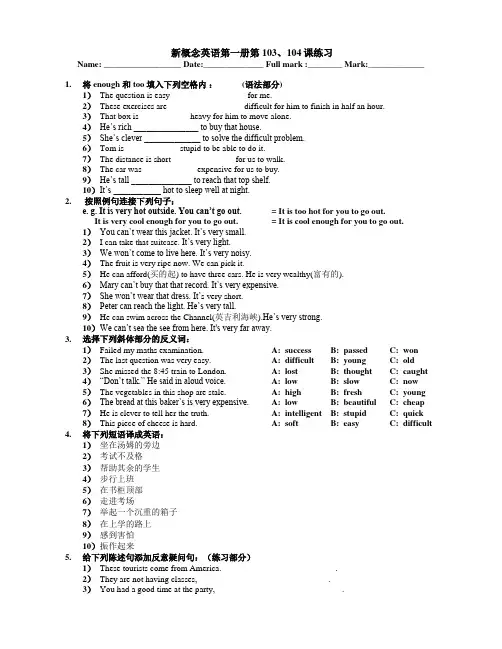
新概念英语第一册第103、104课练习Name: __________________ Date:______________ Full mark :________ Mark:_____________ 1.将enough 和too填入下列空格内:(语法部分)1)The question is easy _________________ for me.2)These exercises are _________________ difficult for him to finish in half an hour.3)That box is ___________ heavy for him to move alone.4)He’s rich _______________ to buy that house.5)She’s clever _____________ to solve the difficult problem.6)Tom is ____________ stupid to be able to do it.7)The distance is short ______________ for us to walk.8)The car was ____________ expensive for us to buy.9)He’s tall ______________ to reach that top shelf.10)I t’s ___________ hot to sleep well at night.2.按照例句连接下列句子:e. g. It is very hot outside. You can’t go out.= It is too hot for you to go out.It is very cool enough for you to go out. = It is cool enough for you to go out.1)You can’t wear this jacket. It’s very small.2)I can take that suitcase. It’s very light.3)We won’t come to live here. It’s very noisy.4)The fruit is very ripe now. We can pick it.5)He can afford(买的起) to have three cars. He is very wealthy(富有的).6)Mary can’t buy that that record. It’s very expensive.7)She won’t wear that dress. It’s very short.8)Peter can reach the light. He’s very tall.9)He can swim across the Channel(英吉利海峡).He’s very strong.10)W e can’t sea the see from here. It's very far away.3.选择下列斜体部分的反义词:1)Failed my maths examination. A: success B: passed C: won 2)The last question was very easy. A: difficult B: young C: old 3)She missed the 8:45 train to London. A: lost B: thought C: caught 4)“Don’t talk.” He said in aloud voice.A: low B: slow C: now 5)The vegetables in this shop are stale. A: high B: fresh C: young 6)The bread at this baker’s is very expensive.A: low B: beautiful C: cheap 7)He is clever to tell her the truth. A: intelligent B: stupid C: quick 8)This piece of cheese is hard. A: soft B: easy C: difficult 4.将下列短语译成英语:1)坐在汤姆的旁边________________________________________________________ 2)考试不及格________________________________________________________ 3)帮助其余的学生________________________________________________________ 4)步行上班________________________________________________________ 5)在书柜顶部________________________________________________________ 6)走进考场________________________________________________________ 7)举起一个沉重的箱子________________________________________________________ 8)在上学的路上________________________________________________________ 9)感到害怕________________________________________________________ 10)振作起来________________________________________________________ 5.给下列陈述句添加反意疑问句:(练习部分)1)These tourists come from America. __________________________.2)They are not having classes, ______________________________.3)You had a good time at the party, _____________________________.4)These people won’t agree with you, _______________________________.5)Peter teaches English in your college, _______________________________.6)Your grandfather was a soldier (军人、士兵)________________________________.6.将下列句子中的汉语译成英语:1)_____________________________________ (你刚洗过澡), haven’t you?2)He doesn’t help you with your English, ____________________ (是不是), _____________ (不,他帮我).3)______________________________________ (我明天不必来得很早), need I? ___________ _________________ (是的,你不必)4)There aren’t many people in the classroom, ___________________________(是不是)________ ________________ (不,有很多).5)They went to the garden, __________________________ (是不是),_____________________ ( 是的,他们去了)7.根据回答标出反意疑问句的语调:1)You enjoy listening to the radio, don’t you?Yes, I do.2)Mary often goes swimming in summer, doesn't she?Yes, she does. /No, she doesn’t.3)John isn't a student, is he? No, he isn't.4)You can't say it in English, can you? Yes, I can. /No, I can’t.8.将括号中的汉语译成英语:1)They are sure that _____________________________________ (他们的英语及格了).2)Tom hopes that ____________________________________ (他数学没有不及格).3)The English paper ______________________________ (对Dike 来说很容易),but ________________________________ (对Harry 来说太难了).4)None of the questions is _____________________________________________ (容易,Dick 边上的那个人都不会答)5)Have you got _________________________________________________(智商高还是智商低) 6)The teacher told us ____________________________________(别灰心)7)_____________________________ (智力测试) are not easy for them.8)The girl nest to me _______________________________________ (在那儿坐了三个小时)9.介词填空:1)I have passed ______________ Chinese, but failed the test _______________ Mathematics.2)The Intelligence Test was too difficult __________ tom. He could answer only half __________ all the questions.3)I an sure the fellow next_____________ dick did not pass the test. I am sure __________ it.4)I waited for him ____________ the bottom of the hill ____________ two hours yesterday.5)We had our lunch ____________ the restaurant next ___________ our factory.6)The examiner told him to write his name _____________ the top of the paper, but he wrote it _______________ the bottom of it.7)The box is too heavy _____________ for you to lift. Just leave it ______________ the floor.8)The smiths live next ____________ us. they have got a big garden ________ front of their house.10.仿照例句改写下列句子:Example: The car is very cheap. Mr. Smith can buy it.The car is cheap enough for Mr. Smith to buy.1)That house is too expensive. We can not buy it. ______________________________________ 2)The pear is very soft. My grandmother can eat it. _____________________________________ 3)It was too dark. I could not go out. _________________________________________________ 4)The wall is very low. You can jump off it. ___________________________________________ 5)Sue is clever. She can answer the questions. __________________________________________ 6)Billy is stupid. He can not answer the questions. _______________________________________。

新概念103-104课重点语法知识本课学习的是副词too、very和enough的用法,但其实要学习的是动词不定式to do的用法。
(一)副词too、very和enoughtoo表示“太”,一般后接贬义词汇,如:too bad, too heavy, too fast。
very表示“很;非常”,是个中性词,既可以修饰褒义词,也可以修饰贬义词,如:very good, very bad, very slowly, very quickly。
enough作为副词,表示“足够”,要放在所修饰的形容词或副词后面,如:good enough, well enough。
【注意】enough也可以用作形容词,表示“足够的”,放在名词前面,用来修饰名词,如:enough books, enough water。
(二)不定式to do的用法1、too...to...该句型表示“太...,而不能...”。
too后面接的是形容词或副词,to后面接的是动词原形。
且to do前面有的时候需要加上for sb.。
如:She is too young to attend the party.她太小了,不能参加这个聚会。
The box is too heavy for me to carry.这个盒子太重了,我搬不动。
2、enough to doenough也常与to do连用,且to do前面有时也需要加上for sb.。
如:She is old enough to attend the party.她年龄够大了,可以参加这个聚会。
The box is light enough for me to carry.这个盒子够轻,我可以搬得动。