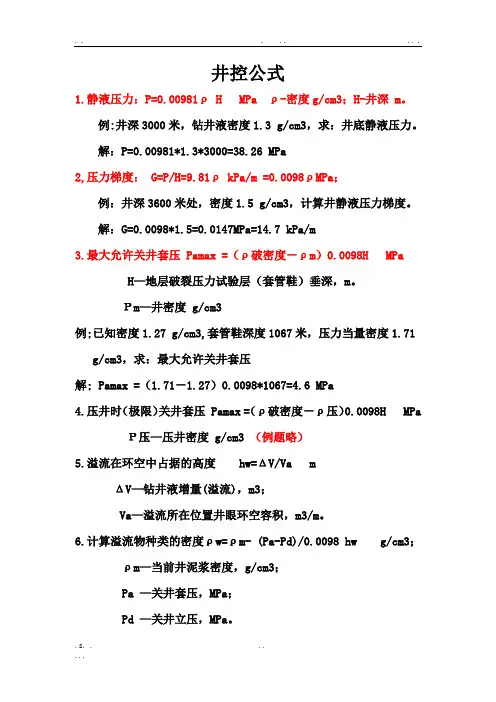
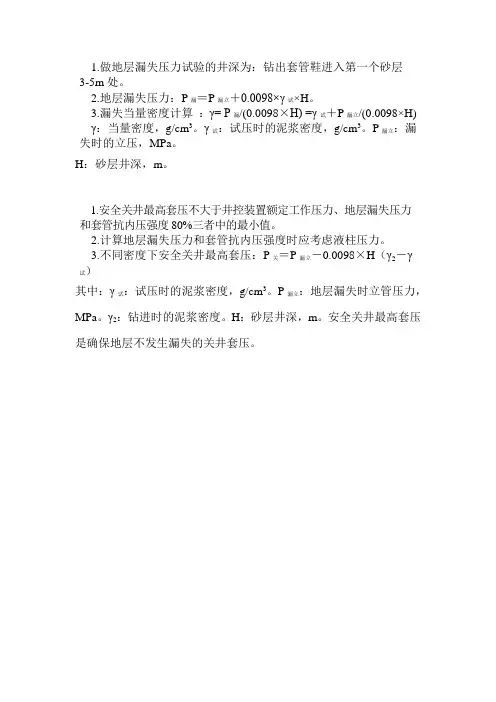
井控计算公式-英进制(英文)WELL CONTROLEquationsCharts & Tables1.Pressure (psi)Force (lb) Area (in)= psi22.Pressure Gradient (psi/ft)P.G.(psift) 0.052 Mud Weight (ppg)=?3.Hydrostatic Pressure (psi)a.H.P.(psi) =0.052 Mud Weight (ppg) True Vertical Depth, TVD (ft)b. Mud Weight (ppg) =Hydrostatic Pressure (psi)0.052 True Vertical Depth, TVD (ft)c.True Vertical Depth, TVD (ft) =Hydrostatic Pressure (psi)0.052 Mud Weight (ppg)4.Equivalent Density (ppg)Eq. Density (ppg) =Pressure (psi) 0.052 TVD (ft)5.Formation Pressure (psi)Formation Pressure (psi) = Hydrostatic Pressure in Drill Pipe(psi) + SIDPP (psi) assuming shut-in well with BHP equalized with formation pressure6.Density to Balance Formation (ppg)Kill Mud Weight, KMW (ppg) =SIDPP (psi) 0.052 TVD (ft)+ Original Mud Weight (ppg)7.Equivalent Mud Weight, EMW (ppg)EMW(ppg) =Leak-Off Pressure (psi)0.052 Casing Shoe TVD (ft)+ Leak-Off Mud Wt (ppg) ?8.Maximum Allowable Surface Pressure, MASP (psi) Based on Casing Burst.MASP(psi) = Casing Internal Yield (psi) .80 (safety factor)9.Maximum Initial Shut-In Casing Pressure, MISICP (psi) Upon initial closure only--Based on***************************IWCF, written as initial MAASP.[]MISICP(psi) =EMW (ppg) - Present Mud Wt (ppg)0.052 Shoe TVD (ft)10.Initial Circulating Pressure (psi) ENGINEER'S & DRILLER'S METHODS.ICP (psi) = SIDPP(psi) + Slow Pump Rate Pressure, SPRP (psi)11.Final Circulating Pressure (psi) ENGINEER'S METHOD.FCP(psi) = SPRP (psi)Kill Mud Wt (ppg)Original Mud Wt (ppg)?12.Equivalent Circulating Density, ECD (ppg)ECD(psi) =Annular Pressure Loss (psi)0.052 TVD Bit (ft)+ Mud Wt (ppg) ?13.Gas Pressure and Volume Relationship -- Boyle's LawP V= P V1122The P ressure (psi) of a gas bubble times its V olume (bbl) in onepart of the hole equals its P ressure times its V olume in another.Disregards effects of Temperature (T) and gas compressibility (z)P=P V V2112or V=P VP211214. Pump Output (bbl/min)Pump Output(bbl /min) =bbl stroke strokesmin15. 100% Triplex Pump Output (bbl/stroke)[]Pump Output(bbl /stk) =Liner ID (in)1029Stroke Length (in)123 216. Surface To Bit Strokes (strokes)Strokes =Drill String Internal Volume (bbl)bbl /stroke17. Circulating Time (min)Min = Volume (bbl)Pump Output (bbl /min)18. Open Hole Capacity Factor (bbl/ft)[]Capacity(bbl /ft) =Open Hole Diameter (in)1029219. Pipe Capacity Factor (bbl/ft) []Capacity(bbl /ft) = Pipe Inside Diameter 2()in 102920. Annulus Capacity Factor, ACF (bbl/ft)[][][][]Capacity(bbl /ft) =Open Hole Diameter (in) - Pipe Outside Diameter (in) Capacity(bbl /ft) =Casing Inside Diameter (in) - Pipe Outside Diameter (in) 2 22210291029or21. Pipe Displacement (bbl/ft)Disregarding tool joints.[][]Displacement(bbl /ft) =Pipe Outside Diameter (in) - Pipe Inside Diameter (in)22102922. Total Pipe Displacement Including Capacity (bbl/ft) Disregarding tool joints.[]Displacement(bbl /ft) =Pipe Outside Diameter (in) 2102923. Height of Influx (ft)Height(ft) =Pit Gain (bbl)Annulus Capacity Factor (bbl /ft)24. Pressure Gradient of Influx (psi/ft) Bit on bottom.25.Influx Gradient(psi /ft) = Pressure Gradient of Mud (psi /ft) - SICP (psi) - SIDPP (psi)Height of Influx (ft)26. Rate of Kick Rise (ft/hr) Well Shut-In.R.O.R.(ft /hr) =Change in SICP (psi)0.052 Mud Wt (ppg) Elapsed Time for Change in SICP (hr)27. Weight per Foot of Drill Collars (lb/ft)[][]()lbs /ft = 2.67 OD (in) ID (in) 22-28. Force (lb)Force(lbs) = Pressure (psi) Area (in ) 2?29. Area (in 2) []Area(in )Diameter (in)4, 3.14222=?≈ππ30. Degrees API (@ 60o F)OAPI = 141.5Specific Gravity- 131.531. Specific Gravity (@ 60o F)Sp ecific G rav ity =141.5API + 131.5O32. Mud Weight from Specific Gravity (ppg)Mud Weight(ppg)Specific Gravity ppg =?833. (Fresh Water weighs 8.33 ppg)33. Hang Off Weight (lb)Weight of Block + Kelly Weight+ Weight of Compensator+ Air Weight of Drill Pipe (KB to Hang-Off Ram)+ 10,000 lbs Weight on Indicator after hangoff (lb)34. Barite Requirement For Weight-up (100 lb sxs)Barite (sxs) = Volume to weight up (bbls) Increase in MW 35.0 - KWM1535. Cutting Back or Weighting Up One Fluid with Another to Obtain Desired Fluid DensityVolume of Mixing Fluid to Add (bbls) Vol of Starting Fluid (bbls)Starting Fluid Wt (ppg)Desired Fluid Wt (ppg)Desired Fluid Wt (ppg)Mixing Fluid Wt (ppg)=--36. Final Density of a Mixture of Fluids, (ppg)[][]Final Fluid Wt (ppg)Fluid Wt 1 (ppg)Volume Fluid 1 (gals)Fluid Wt 2 (ppg)Volume Fluid 2 (gals)Volume Fluid 1 (gals)Volume Fluid 2 (gals) =+?+37. Final Density of a Mixture of a Fluid and a Solid, (ppg)[]Final Fluid Density (ppg)Fluid Density (ppg)Volume Fluid (gals)Weight of Solid Added (lb)Volume Fluid (gals)Weight of Solid Added (lb)True Density of Solid (ppg)=++38. Weight of Solid to Add to a Fluid to Obtain Desired Fluid Weight, (lb)Weight of Solid to Add (lb)Volume of Starting Fluid (gals)True Density of Solid (ppg)Desired Fluid Wt (ppg)Starting Fluid Wt (ppg)True Density of Solid (ppg)Desired Fluid Wt (ppg)=--VOLUMETRIC CONTROL EQUATIONS 39.Pressure Increment,PI (psi)PI =Safety Factor (psi)= psi340.Fluid Increment, MI (bbl)MI =PI (psi) Annulus Capacity Factor (bbl/ft)0.052 Mud Wt (ppg)= bbl ?41.Rate of Bubble Rise, ROR (ft/hr) See Equation 25 above.ROR =Change in Casing Pressure (psi)0.052 Mud Wt (ppg) Elapsed Time for Change (hr)=fthr ??42.Time to Bubble Penetration, BPT (hr)BPT =Depth of Bubble (ft) - Depth of Bit (ft)ROR (ft/hr) + Stripping Speed (ft/hr)= hrLUBRICATE AND BLEED43.Pressure that can be bled off after lubricating in a given volume of fluid, (psi)Volume Lubricated (bbl)0.052 Fluid Wt (ppg)Capacity Factor (bbl/ft)= psi ?STRIPPING AND SNUBBING EQUATIONSSTRIPPING44. Pressure-Area Force, F p (lb) []F p =πOD (in)Well Head Pressure (psi)2445. Buoyed Weight of Tubulars, W (lb) W W AIR =?-(lb)Mud Wt (ppg)654654..46. Barrels to Bleed per Stand, (bbls/stand)[]BBL /Stand OD (in)1029Stand Length (ft)2=?47. Volumetric Control ConsiderationsPressure Increment, PI (psi) See Equation 37 above.Fluid Increment, MI (bbl) See Equation 38 above.Surface Pressure Increase due to Penetration of the Bubble, SP INCR (psi) ()()L L PG PG psi K DP OH K OH MUD GAS ()()?-?-=Open Hole Kick Length, L K(OH) (ft)L K OH ()=Kick Volume at penetration (bbl)ACF (bbl /ft)OHDP by Hole Kick Length, L K(DP ?OH) (ft)L K DP OH ()??=Kick Volume at penetration (bbl)ACF (bbl /ft)DP OHRate of Bubble Rise, ROR (ft/hr) See Equation 40 above.Time of Bubble Penetration, BPT (hrs)See Equation 41 above.SNUBBING48. Snub Force, SF (lb)SF F p =+-Friction Force W49. Neutral PointSF F p ==0;W50. Effective String Weight, W E (lb/ft)W W (lb)L (ft)E (lb /ft)=51. Calculating Effective String Weight and Change in Effective String Weight after Filling a) Effective String Weight with no fluid in the workstring:[]W E (Effective String Wt, lb /ft)Air Wt (lb /ft)OD (in)Fluid Wt (ppg)WELL =-2245.Note that W E and Air Wt both have units of lb/ft . For example, the air weight of 2-7/8” tubing normally would be 6.5 lb/ft.b) Increase in the Effective String Weight after the pipe is filled with the same Fluid Weight that is in the well:[]?W ID in E (lb /ft)Fluid Wt (ppg)WELL =().2245c) Increase in the Effective String Weight after the pipe is filled with a different Fluid Weight than the Fluid Weight that is in the well:[]?W ID in E (lb /ft)Fluid Wt (ppg)FILL =().2245d) After filling the pipe, the Effective String Weight will be:[][]W W W E EE (AFTER FILLING)WELL FILL (lb /ft)Air Wt (lb /ft)OD (in)Fluid Wt (ppg)24.5ID (in)Fluid Wt (ppg)24.5=+=-+22In this case, note that Fluid Wt FILL in the last term above will be Fluid Wt WELL if filled with the same fluid.NOTE: This the GENERAL EQUATION for the Effective Buoyed Weight of the String. It works regardless of the fluid that is inside or outside the pipe. If the fluid is gas at fairly low pressure, use 0 lbs/gal for the fluid wt.52. Predicting the Neutral PointCombining Equations 47 and 48 above gives an equation for the length L (ft) of pipe that must be run into the well to reach the Neutral Point:F W (lb)L (ft)L (ft)F W p E p E (lb)W (lb)andW (lb /ft)(lb) (lb /ft)===a)The Neutral Point occurs in unfilled pipe when the length of pipe run into the well is:[]L F OD in lui p (ft) (lb)AIR Wt (lb /ft)F d Wt (ppg)WELL =-().2245b)The Neutral Point occurs in filled pipe when the length of pipe run into the well is:[][]L F p (ft) (lb)AIR Wt (lb /ft)OD (in)Fluid Wt (ppg)+ID (in)Fluid Wt (ppg)WELL FILL =-22245245..Accumulator Sizing52.Bottle Capacity Required(gals)Bottle Volume (gals)Volume Fluid Required(gals)Precharge PressureMinimum Operating Pressure-Precharge PressureMaximum Operating Pressure =53.Volume Useable Fluid Available (gals)Volume Useable Fluid (gals)=Bottle Volume (gals)Precharge Pressure Minimum Operating Pressure -Precharge Pressure Maximum Operating Pressure ?。