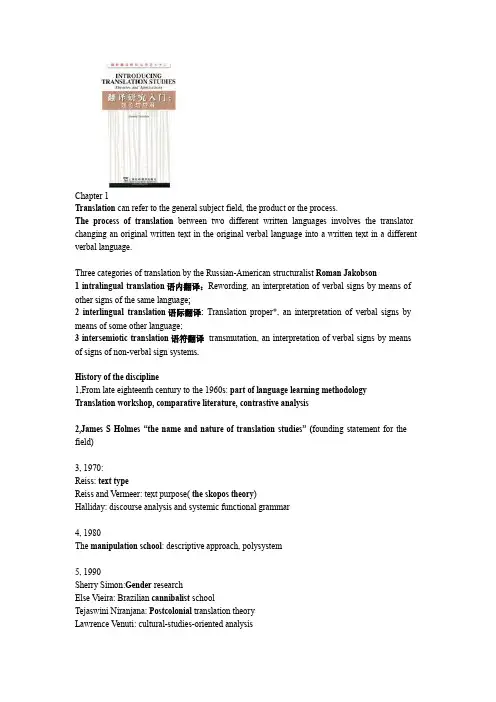
Chapter1Translation can refer to the general subject field,the product or the process.The process of translation between two different written languages involves the translator changing an original written text in the original verbal language into a written text in a different verbal language.Three categories of translation by the Russian-American structuralist Roman Jakobson1intralingual translation语内翻译:Rewording,an interpretation of verbal signs by means of other signs of the same language;2interlingual translation语际翻译:Translation proper*,an interpretation of verbal signs by means of some other language;3intersemiotic translation语符翻译transmutation,an interpretation of verbal signs by means of signs of non-verbal sign systems.History of the discipline1,From late eighteenth century to the1960s:part of language learning methodology Translation workshop,comparative literature,contrastive analysis2,James S Holmes“the name and nature of translation studies”(founding statement for the field)3,1970:Reiss:text typeReiss and Vermeer:text purpose(the skopos theory)Halliday:discourse analysis and systemic functional grammar4,1980The manipulation school:descriptive approach,polysystem5,1990Sherry Simon:Gender researchElse Vieira:Brazilian cannibalist schoolTejaswini Niranjana:Postcolonial translation theoryLawrence Venuti:cultural-studies-oriented analysisHolmes’s map of translation studiesThe objectives of the pure areas of research:1,descriptive translation theory:the description of the phenomena of translation2,translation theory:the establishment of general principles to explain and predict such phenomenaPure:theoretical and descriptiveDTS:descriptive translation studies1,product-oriented DTS:existing translations,text(diachronic or synchronic)2,function-oriented DTS:the function of translations in the recipient sociocultural situation (socio-translation studies or cultural-studies-oriented translation)3,process-oriented DTS:the psychology of translation(later think-aloud protocols)Relation between Theoretical and descriptiveThe results of DTS research can be fed into the theoretical branch to evolve either a general theory of translation or,more likely,partial theories of translation.Partial theories1,Medium-restricted theories:translation by machine and humans2,Area-restricted theories:3,Rank-restricted theories:the level of word,sentence or text4,Text-type restricted theories:discourse types or genres5,Time-restricted theories:6,Problem-restricted theories:Applied branch of Holmes’s framework:translator training,translation aids and translation criticism.Translation policy:the translation scholar advising on the place of translation in societyChapter2translation theory before the twentieth centuryLiteral vs.free debateCicero(first century BCE):I did not hold it necessary to render word for word,but I preserved the general style and force of the language.Horace:producing an aesthetically pleasing and creative text in the TL.St Jerome:I render not word for word,but sense for sense.Martin Luther:1,non-literal or non-accepted translation came to be seen and used as a weapon against the Church.2,his infusion of the Bible with the language of ordinary people and his consideration of translation in terms focusing on the TL and the TT reader were crucial.“Louis Kelly:Fidelity: to both the words and the perceived senseSpirit:1, creative energy or inspiration of a text or language, proper to literature; 2, the Holy Spirit.Truth: content17 century:Early attempts at systematic translation theoryCowley: imitationCounter the inevitable loss of beauty in translation by using our wit or invention to create new beauty;he has ‘taken, left out and added what I please’John Dryden reduces all translation to three categories: the triadic model(约翰 德莱顿的三分法:“直译”、意译”与“仿译”) 1, metaphrase: word for word translation2, paraphrase : sense for sense translation3, imitation : forsake both words and senseEtienne Dolet: a French humanist, burned at the stake for his addition to his translation of one of Plato’s dialogues.Five principles:① The translator must perfectly understand the sense and material of the original author,although he should feel free to clarify obscurities.②The translator should have a perfect knowledge of both SL and TL , so as not to lessen the majesty of the language.③The translator should avoid word-for-word renderings.④The translator should avoid Latinate and unusual forma .⑤The translator should assemble and liaise words eloquently to avoid clumsiness.Alexander Fraser TytlerTL-reader-oriented definition of a good translation: That, in which the merit of the original work is so completely transfused into another language, as to be as distinctly apprehended, and as strongly felt, by a native of the country to which that language belongs, as it is by those who speak the language of the original work.Three general rules:I. That the Translation should give a complete transcript of the ideas of the original work.II. That the style and manner of writing should be of t he same character with that of the original.III. That the Translation should have all the ease of original composition.—— A. F. Tytler: Essay on the Principles of TranslationTytler ranks his three laws in order of comparative importance:Ease of composition would be sacrificed if necessary for manner,and a departure would be made from manner in the interests of sense.Friedrich Schleiermacher:the founder of modern Protestant theology and of modern hermeneuticsHermeneutics:a Romantic approach to interpretation based not on absolute truth but on the individual’s inner feeling and understanding.2types of translators:1,Dolmetscher:who translates commercial texts;2,Ubersetzer:who works on scholarly and artistic texts.2translation methods:1,translator leaves the reader in peace,as much as possible,and moves the author towards him. Alienating method2,translator leaves the writer alone,as much as possible,and moves the reader towards the writer. Naturalizing methodThe status of the ST and the form of the TLFrancis Newman:emphasize the foreignness of the workMatthew Arnold:a transparent translation method(led to the devaluation of translation and marginalization of translation)Chapter3Equivalence and equivalent effectRoman Jakobson:the nature of linguistic meaningSaussure:the signifier(能指)the spoken and written signalThe signified(所指)the concept signifiedThe signifier and signified form the linguistic sign,but that sign is arbitrary or unmotivated.1,There is ordinarily no full equivalence between code-units.Interlingual translation involves substituting messages in one language not for separate code-units but for entire messages in some other language.2,for the message to be equivalent in ST and TT,the code-unit will be different since they belong to two different sign systems which partition reality differently.3,the problem of meaning and equivalence thus focuses on differences in the structure and terminology of languages rather than on any inability of one language to render a message that has been written in another verbal language.4,cross-linguistic differences center around obligatory grammatical and lexical forms.They occur at the level of gender,aspect and semantic fields.Eugene Nida1,an orthographic word has a fixed meaning and towards a functional definition of meaning in which a word acquires meaning through its context and can produce varying responses accordingto culture.2,meaning is broke down into a,linguistic meaning,b,referential meaning(the denotative ‘dictionary’meaning指称,字面)and c,emotive meaning(connotative隐含).3,techniques to determine the meaning of different linguistic itemsA,analyze the structure of wordsB,differentiate similar words in relaxed lexical fields3techniques to determine the meaning of different linguistic items1,Hierarchical structuring,differentiates series of words according to their level,2,Techniques of componential analysis(成分分析法)identify and discriminate specific features of a range of related words.3,Semantic structure analysis:Discriminate the sense of a complex semantic termChomsky:Generative-transformational model:analyze sentences into a series of related levels governed by rules.3features1,phrase-structure rules短语结构规则generate an underlying or deep structure which is2,transformed by transformational rules转换规则relating one underlying structure to another, to produce3,a final surface structure,which itself is subject to形态音位规则phonological and morphemic rules.The most basic of such structures are kernel sentences,which are simple,active,declarative sentences that require the minimum of transformation.Three-stage system of translationAnalysis:the surface structure of the ST is analyzed into the basic elements of the deep structure Transfer:these are transferred in the translation processRestructuring:these are transferred in the translation process and then restructured semantically and stylistically into the surface structure of the TT.Back-transformation回归转换(Kernels are to be obtained from the ST structure by a reductive process)Four types of functional class:events,objects,abstracts and relationals.Kernels are the level at which the message is transferred into the receptor language before being transformed into the surface structure in three stages:literal transfer,minimal transfer最小单位转换and literary transfer.Formal equivalence:focuses attention on the message itself,in both form and content,the message in the receptor language should match as closely as possible the different elements in the source language.Gloss translations释译Dynamic equivalence is based on what Nida calls the principle of equivalent effect,where the relationship between receptor and message should be substantially the same as that which existed between the original receptors and the message.Four basic requirements of a translation1,making sense2,conveying the spirit and manner of the original3,having a natural and easy form of expression4,producing a similar response.NewmarkCommunicative translation attempts to produce on its reader an effect as close as possible to that obtained on the readers of the original.Semantic translation attempts to render,as closely as the semantic and syntactic structures of the second language allow,the exact contextual meaning of the original.Literal translation is held to be the best approach in both communicative translation and semantic translation.One of the difficulties encountered by translation studies in systematically following up advances in theory may indeed be partly attributable to the overabundance of terminology.Werner KollerCorrespondence:contrastive linguistics,compares two language systems and describes contrastively differences and similarities.Saussure’s langue(competence in foreign language) Equivalence:equivalent items in specific ST-TT pairs and contexts.Saussure’s parole (competence in translation)Five types of equivalenceDenotative equivalenceConnotative equivalenceText-normative equivalencePragmatic equivalence(communicative equivalence)Formal equivalence(expressive equivalence,the form and aesthetics of the text)A checklist for translationally relevant text analysis:Language functionContent characteristicsLanguage-stylistic characteristicsFormal-aesthetic characteristicsPragmatic characteristicsTertium comparationi in the comparison of an ST and a TTChapter5functional theories of translationKatharina Reiss:Text TypeBuilds on the concept of equivalence but views the text,rather than the word or sentence as the level at which communication is achieved and at which equivalence must be sought.Four-way categorization of the functions of language(Karl Buhler,three)1,plain communication of facts,transmit information and content,informative text2,creative composition,expressive text3,inducing behavioral responses,operative text4,audiomedial text,supplement the other three functions with visual images,music,etc.Different translation methods for different texts1,transmit the full referentical or conceptual content of the ST in plain prose without redundancy and with the use of explicitation when required.2,transmit the aesthetic and artistic form of the ST,using the identifying method,with the translator adopting the standpoint of the ST author.3,produce the desired response in the TT receiver,employing the adaptive method,creating an equivalent effect among TT readers.4,supplementing written words with visual images and music.Intralinguistic and extralinguistic instruction criteria1,intralinguistic criteria:semantic,lexical,grammatical and stylistic features2,extralinguistic criteria:situation,subject field,time,place,receiver,sender and affective implications(humor,irony,emotion,etc.)Holz-Manttari:Translational actionTakes up concepts from communication theory and action theoryTranslation action views translation as purpose-driven,outcome oriented human interaction and focuses on the process of translation as message-transmitter compounds involving intercultural transfer.Interlingual translation is described as translational action from a source text and as a communicative process involving a series of roles and players.The initiatorThe commissionerThe ST producerThe TT producerThe TT userThe TT receiverContent,structured by what are called tectonics,is divided into a)factual information and b) overall communicative strategy.Form,structured by texture,is divided into a)terminology and b)cohesive elements.Value:place of translation,at least the professional non-literary translation within its sociocultural context,including the interplay between the translator and the initiating institution.Vermeer:Skopos theorySkopos theory focuses above all on the purpose of the translation,which determines the translation methods and strategies that are to be employed in order to produce a functionally adequate result(TT,translatum).Basic rules of the theory:1,a translatum is determined by its skopos;2,a TT is an offer of information in a target culture and TL concerning an offer of information in a source culture and SL.3,a TT does not initiate an offer of information in a clearly reversible way4a TT must be internally coherent5a TT must be coherent with the ST6the five rules above stand in hierarchical order,with the skopos rule predominating.The coherence rule,internally coherent,the TT must be interpretable as coherent with the TT receiver’s situation.The fidelity rule,coherent with the ST,there must be coherence between the translatum and the ST.1,the ST information received by the translator;2,the interpretation the translator makes of this information;3,the information that is encoded for the TT receivers.Intratextual coherence intertextual coherenceAdequacy comes to override equivalence as the measure of the translational action. Adequacy:the relations between ST and TT as a consequence of observing a skopos during the translation process.In other words,if the TT fulfills the skopos outlined by the commission,it is functionally and communicatively adequate.Criticisms:1,valid for non-literary texts2,Reiss’s text type approach and Vermeer’s skopos theory are considering different functional phenomena3,insufficient attention to the linguistic nature of the ST nor to the reproduction of microlevel features in the TT.Christiane Nord:translation-oriented text analysisExamine text organization at or above sentence level.2basic types of translation product:1,documentary translation:serves as a document of a source culture communication between the author and the ST recipient.2,instrumental translation:the TT receiver read the TT as though it were an ST written in their own language.Aim:provide a model of ST analysis which is applicable to all text types and translation situations.Three aspects of functionalist approaches that are particularly useful in translator training1,the importance of the translation commission(translation brief)2,the role of ST analysis3,the functional hierarchy of translation problems.1,compare ST and TT profiles defined in the commission to see where the two texts may diverge Translation brief should include:The intended text functions;The addressees(sender and recipient)The time and place of text receptionThe medium(speech and writing)The motive(why the ST was written and why it is being translated)2,intratextual factors for the ST analysisSubject matterContent:including connotation and cohesionPresuppositions:real-world factors of the communicative situation presumed to be known to the participants;Composition:microstructure and macrostructure;Non-verbal elements:illustrations,italics,etc.;Lexic:including dialect,register and specific terminology;Sentence structure;Suprasegemtal features:stress,rhythm and stylistic punctuationIt does not matter which text-linguistic model is used3,the intended function of the translation should be decided(documentary or instrumental) Those functional elements that will need to be adapted to the TT addressee’s situation have to be determinedThe translation type decides the translation style(source-culture or target culture oriented)The problems of the text can then be tackled at a lower linguistic levelChapter6discourse and register analysis approachesText analysis:concentrate on describing the way in which texts are organized(sentence structure,cohesion,etc.)Discourse analysis looks at the way language communicates meaning and social and power relations.Halliday’s model of discourse analysis,based on systemic functional grammarStudy of language as communication,seeing meaning in the writer’s linguistic choices and systematically relating these choices to a wider sociocultural framework.Relation of genre and register to languageGenre:the conventional text type that is associated with a specific communicative function Variables of Register:1,field:what is being written about,e.g.a delivery2,tenor:who is communicating and to whom,e.g.a sales representative to a customer3,mode:the form of communication,e.g.written.Each is associated with a strand of meaning:Metafunctions:概念功能(ideational function)、人际功能(interpersonal function)和语篇功能(textual function)Realized by the lexicogrammar:the choices of wording and syntactic structureField--ideational meaning—transitivity patternsTenor—interpersonal meaning—patterns of modalityMode—textual meaning—thematic and information structures and cohesion及物性系统(transitivity)情态系统(modality)、主位结构(theme structure)和信息结构(information structure)。