五年级下册英语试题 一二单元练习题 人教
- 格式:doc
- 大小:39.00 KB
- 文档页数:3
第1页/共3页 五年级英语一二单元练习题 姓名:
Unit 1
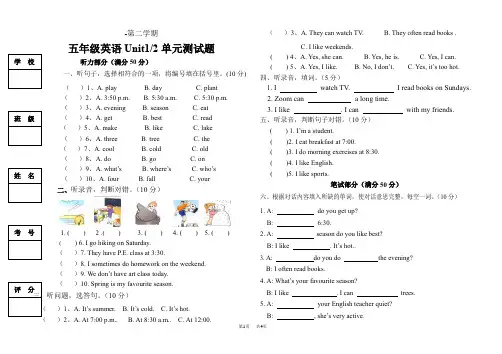
一、判断下列画线部分发音是(T)否(F)一致。(10分)
( )1. old robot ( )2. shy baby
( )3. windy sunny ( )4. young party
( )5. happy sorry
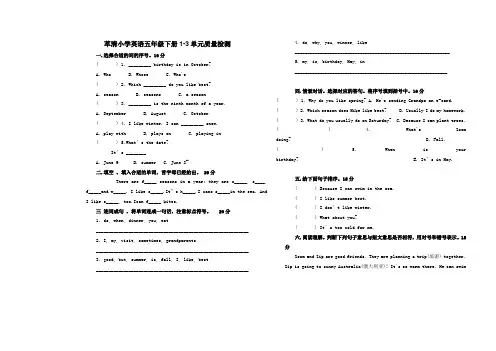
二、根据句意及首字母提示补全单词。(10分)
1. Our Chinese teacher is clever and f_______. We all like him.
2. —Is your mother strict?
—No, she isn’t. She is k________.
3. Our head teacher isn’t old. She is very y_________.
4. Chen Jie helps her mother clean the room at home. She is h________.
5.Wang Lin doesn’t play at home. He likes reading and writing. He is
h________.
三、单项选择。(15分)
( )1. They _________ hard-working.
A. is B. am C. are
( )2. —What’s he _________?
—He’s tall and thin.
A. like B. Doing C. is like
( )3. —Is she strict? —No, she’s _________.
A. kind B. shy C. very quiet
( )4. —Who’s she? —She’s _________. A. Miss Yang B. Mr Yang C. Miss yang
( )5. —Is your mother strict? — _________.
A. No, she is B. Yes, he is C. No, she isn’t
四、读一读,从B栏中选出A栏问题的答语。(10分)
A
( )1. Who’s your maths teacher?
( )2. Is she helpful?
( )3. Do you know who is our new teacher?
( )4. What’s she like?
( )5. What’s Mr Wang like?
B
A. She’s tall and thin.
B. He’s tall and strong.
C. Yes, she is.
D. Mr Zhang.
E. Yes, Miss White is our new teacher.
五、给下列句子排序,使之组成一段完整的对话。(10分)
( )Really? What’s she like?
( )I have a new art teacher.
( 6 )Cool!
( )Is she strict?
( )No, she isn’t. She’s very kind.
( )She’s young and funny.
六、阅读短文,根据短文内容选出合适的选项。(15分)
My name is Wang Lin. I’m shy but polite. I’m tall and strong. I like
sports. I have a friend. His name is Bob. He is young and clever. He can 第2页/共3页 speak Chinese. He is hard-working, too. He is helpful at home. He’s
strict. He often(经常)helps me. He makes me finish my homework. I
like him.
( )1. Wang Lin is _________ . A. polite B. short
( )2. Wang Lin is _________.
A. tall and thin B. tall and strong
( )3. Bob can speak_________ . A. Chinese B. English
( )4. Bob is_________ . A. kind B. strict
( )5. _________ helps me. A. Wang Lin B. Bob
Unit 2
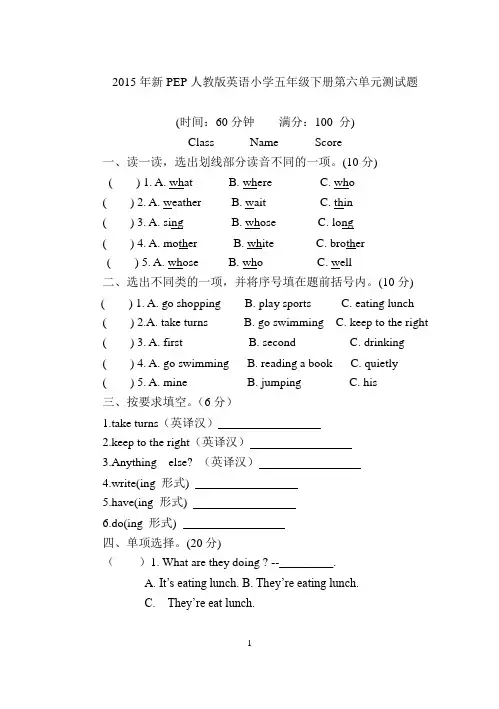
一、判断下列每组单词画线部分读音是(T)否(F)相同。(10分)
( )1. feet meet ( )2. see read
( )3. beef feed ( )4. eat tea
( )5. head speak
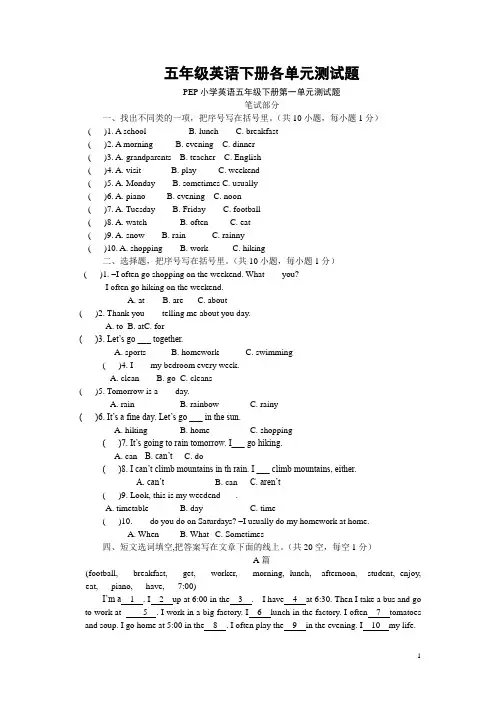
二、单项选择。(20分)
( )1. We have art class__________ .
A. on Thursdays B. at Thursday C. for Thursdays
( )2. — __________you often play the pipa?
—No, I don’t.
A. Do B. Are C. Can
( )3. —__________do you have on Fridays?
—We have English and music.
A. Where B. Who C. What
( )4. —What do you do on Sundays?—__________
A. I often play sports. B. I can play computer games.
C. I have Chinese and English. ( )5. —What do you do on the weekend?
—__________
A. I play sports. What about you? B. I listen to music, too.
C. What do you do on Saturdays?
三、给下列句子排序。(10分)
( )It’s a picture book.
( )No, I don’t. Do you often play sports here?
( )Me too.
( 1 )Hi, Sarah. What’s that?
( )Do you often read books in the park?
( )Yes, I do. I like this park very much.
四、阅读理解, 根据短文内容填空。(20分)
Elephant: What do you do on Saturdays?
Monkey: I often play football and watch TV. Sometimes I go to the park.
Panda: I often play sports and do my homework.
Elephant: What do you do on Sundays?
Monkey: I play ping-pong and play computer games.
Elephant: What about you, Panda?
Panda: I often play the pipa and read books. I eat two meals(餐)every
day.
Elephant: Why?
Panda: Mom and Dad say I’m too big.
课本、报刊杂志中的成语、名言警句等俯首皆是,但学生写作文运用到文章中的甚少,即使运用也很难做到恰如其分。为什么?还是没有彻底“记死”的缘故。要解决这个问题,方法很简单,每天花3-5分钟左右的时间记一条成语、一则名言警句即可。可以写在后黑板的“积第3页/共3页 累专栏”上每日一换,可以在每天课前的3分钟让学生轮流讲解,也可让学生个人搜集,每天往笔记本上抄写,教师定期检查等等。这样,一年就可记300多条成语、300多则名言警句,日积月累,终究会成为一笔不小的财富。这些成语典故“贮藏”在学生脑中,自然会出口成章,写作时便会随心所欲地“提取”出来,使文章增色添辉。1.
Monkey often _______________________________on Saturdays.
2. Panda often _______________________________on Saturdays
我国古代的读书人,从上学之日起,就日诵不辍,一般在几年内就能识记几千个汉字,熟记几百篇文章,写出的诗文也是字斟句酌,琅琅上口,成为满腹经纶的文人。为什么在现代化教学的今天,我们念了十几年书的高中毕业生甚至大学生,竟提起作文就头疼,写不出像样的文章呢?吕叔湘先生早在1978年就尖锐地提出:“中小学语文教学效果差,中学语文毕业生语文水平低,……十几年上课总时数是9160课时,语文是2749课时,恰好是30%,十年的时间,二千七百多课时,用来学本国语文,却是大多数不过关,岂非咄咄怪事!”寻根究底,其主要原因就是腹中无物。特别是写议论文,初中水平以上的学生都知道议论文的“三要素”是论点、论据、论证,也通晓议论文的基本结构:提出问题――分析问题――解决问题,但真正动起笔来就犯难了。知道“是这样”,就是讲不出“为什么”。根本原因还是无“米”下“锅”。于是便翻开作文集锦之类的书大段抄起来,抄人家的名言警句,抄人家的事例,不参考作文书就很难写出像样的文章。所以,词汇贫乏、内容空洞、千篇一律便成了中学生作文的通病。要解决这个问题,不能单在布局谋篇等写作技方面下功夫,必须认识到“死记硬背”的重要性,让学生积累足够的“米”。3.Monkey
______________________________________on Sundays.
“师”之概念,大体是从先秦时期的“师长、师傅、先生”而来。其中“师傅”更早则意指春秋时国君的老师。《说文解字》中有注曰:“师教人以道者之称也”。“师”之含义,现在泛指从事教育工作或是传授知识技术也或是某方面有特长值得学习者。“老师”的原意并非由“老”而形容“师”。“老”在旧语义中也是一种尊称,隐喻年长且学识渊博者。“老”“师”连用最初见于《史记》,有“荀卿最为老师”之说法。慢慢“老师”之说也不再有年龄的限制,老少皆可适用。只是司马迁笔下的“老师”当然不是今日意义上的“教师”,其只是“老”和“师”的复合构词,所表达的含义多指对知识渊博者的一种尊称,虽能从其身上学以“道”,但其不一定是知识的传播者。今天看来,“教师”的必要条件不光是拥有知识,更重于传播知识。4. Panda