韩顺平Spring笔记说课材料
- 格式:doc
- 大小:232.50 KB
- 文档页数:15
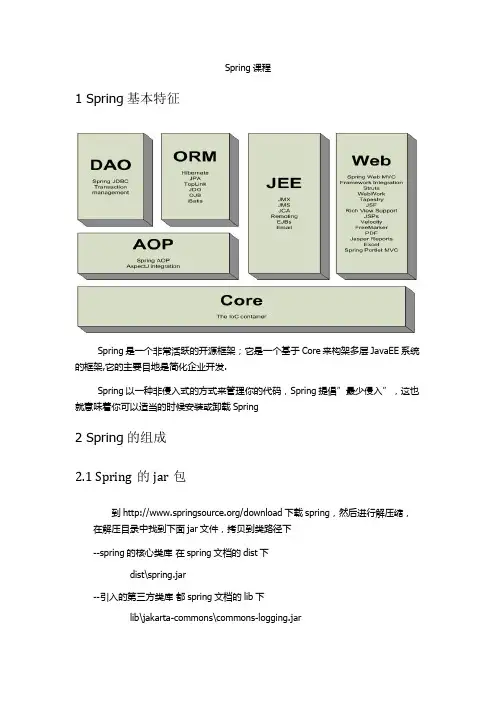
◆spring的快速入门案例①spring是什么?struts 是web 框架(jsp/action/actionfrom)hibernate 是orm框架,处于持久层.spring 是容器框架,用于配置bean,并维护bean之间关系的框架☞spring中有一个非常概念: bean (是java中的任何一种对象javabean/service/action/数据源./dao, ioc(控制反转inverse of control) di( dependency injection 依赖注入)☞画一个框架图◆快速入门开发一个spring项目.1.引入spring的开发包(最小配置spring.jar 该包把常用的jar都包括, 还要写日志包common-logging.jar2.创建spring的一个核心文件applicationContext.xml, [hibernate有核心hibernate.cfg.xmlstruts核心文件struts-config.xml], 该文件一般放在src目录下,该文件中引入xsd文件:可以从给出的案例中拷贝一份.3.配置bean<!-- 在容器文件中配置bean(service/dao/domain/action/数据源) --><!-- bean元素的作用是,当我们的spring框架加载时候,spring就会自动的创建一个bean 对象,并放入内存UserService userSerivce=new UserService();userSerivce.setName("韩顺平");--><bean id="userService" class="erService"><!-- 这里就体现出注入的概念. --><property name="name"><value>韩顺平</value></property></bean>4.在Test.java中,我们怎么使用//我们现在使用spring来完成上面的任务//1.得到spring 的applicationContext对象(容器对象)ApplicationContext ac=new ClassPathXmlApplicationContext("applicationContext.xml");UserService us=(UserService) ac.getBean("userService");us.sayHello();5.细节讨论?传统的方法和使用spring的方法5.1使用spring ,没有new 对象,我们把创建对象的任务交给spring框架5.2spring的运行原理图:5.3我们再看spring对上面案例总结:spring实际上是一个容器框架,可以配置各种bean(action/service/domain/dao),并且可以维护bean与bean的关系,当我们需要使用某个bean的时候,我们可以getBean(id),使用即可.ioc是什么?答:ioc(inverse of controll ) 控制反转: 所谓控制反转就是把创建对象(bean),和维护对象(bean)的关系的权利从程序中转移到spring的容器(applicationContext.xml),而程序本身不再维护.DI是什么?答: di(dependency injection) 依赖注入: 实际上di和ioc是同一个概念,spring设计者认为di 更准确表示spring核心技术☞学习框架,最重要的就是学习各个配置.把Applicationcontext做成一个单例的.上机练习: 把我写的代码走一遍.spring开发提倡接口编程,配合di技术可以层与层的解耦举例说明:现在我们体验一下spring的di配合接口编程的,完成一个字母大小写转换的案例:思路:1.创建一个接口ChangeLetter2.两个类实现接口3.把对象配置到spring容器中4.使用通过上面的案例,我们可以初步体会到di配合接口编程,的确可以减少层(web层) 和业务层的耦合度.思考题:接口ValidateUser有一个方法:check(??)有两个类CheckUser1 implements ValidateUser{check// 安装xml验证}CheckUser2 implements VallidateUser{check()// 到数据库去验证}◆从ApplicationContex 应用上下文容器中获取bean和从bean工厂容器中获取bean具体案例://从ApplicationContext中取beanApplicationContext ac=newClassPathXmlApplicationContext("com/hsp/ioc/beans.xml");//当我们去实例化beans.xml,该文件中配置的bean被实例(该bean scope是singleton)从bean中取出student//如果我们使用beanfactory去获取bean,当你只是实例化该容器,那么//容器的bean不被实例化,只有当你去使用getBean某个bean时,才会实时的创建.BeanFactory factory = new XmlBeanFactory(new ClassPathResource("com/hsp/ioc/beans.xml"));factory.getBean("student");结论:1.如果使用ApplicationContext ,则配置的bean如果是singlton不管你用不用,都被实例化.(好处就是可以预先加载,缺点就是耗内存)2.如果是BeanFactory ,则当你获取beanfacotry时候,配置的bean不会被马上实例化,当你使用的时候,才被实例(好处节约内存,缺点就是速度)3.规定: 一般没有特殊要求,应当使用ApplicatioContext完成(90%)◆bean 的scope的细节入门案例://获取两个studentStudent s1=(Student) ac.getBean("student");Student s2=(Student) ac.getBean("student");System.out.println(s1+" "+s2);●request●session●global-session是在web开发中才有意义.◆三种获取ApplicationContext 对象引用的方法1.ClassPathXmlApplicationContext -> 通过类路径2.FileSystemXmlApplicationContext -> 通过文件路径举例:ApplicationContext ac=new FileSystemXmlApplicationContext("文件路径beans.xml / applicationContext.xml");3.XmlWebApplicationContext◆bean的生命周期为什么总是一个生命周期当做一个重点?Servlet -> servlet生命周期init() destory()java对象生命周期.往往笔试,面试总喜欢问生命周期的问题①实例化(当我们的程序加载beans.xml文件),把我们的bean(前提是scope=singleton)实例化到内存②调用set方法设置属性③如果你实现了bean名字关注接口(BeanNameAware) 则,可以通过setBeanName获取id号④如果你实现了bean工厂关注接口,(BeanFactoryAware),则可以获取BeanFactory⑤如果你实现了ApplicationContextAware接口,则调用方法//该方法传递ApplicationContextpublic void setApplicationContext(ApplicationContext arg0)throws BeansException {// TODO Auto-generated method stubSystem.out.println("setApplicationContext"+arg0);}⑥如果bean 和一个后置处理器关联,则会自动去调用ObjectpostProcessBeforeInitialization方法⑦如果你实现InitializingBean 接口,则会调用afterPropertiesSet⑧如果自己在<bean init-method=”init” /> 则可以在bean定义自己的初始化方法.⑨如果bean 和一个后置处理器关联,则会自动去调用Object postProcessAfterInitialization方法⑩使用我们的bean11. 容器关闭12. 可以通过实现DisposableBean 接口来调用方法destory13. 可以在<bean destory-method=”fun1”/> 调用定制的销毁方法小结: 我们实际开发中往往,没有用的这么的过程,常见的是:1->2->6->10->9->11上机练习: 把使用每个 bean的时间记录到一个recoder.txt文件,内容是xxbean. 使用时间是: 1999-11-11 11:11:11问题:通过BeanFactory来获取bean对象,bean的生命周期是否和Applicationcontext 是一样吗?不是一样的,bean是工厂中创建的生命周期会简单一些:配置bean的细节①scope 的说明:☞尽量使用scope=”singleton” ,不要使用prototype,因为这样对我们的性能影响较大.②如何给集合类型注入值.java中主要的集合有几种: map set list / 数组Department类:package com.hsp.collection;import java.util.List;import java.util.Map;import java.util.Set;public class Department {private String name;private String [] empName;private List<Employee> empList;private Set<Employee> empsets;private Map<String,Employee> empMaps;public Set<Employee> getEmpsets() {return empsets;}public void setEmpsets(Set<Employee> empsets) {this.empsets = empsets;}public String[] getEmpName() {return empName;}public void setEmpName(String[] empName) {this.empName = empName;}public String getName() {return name;}public void setName(String name) { = name;}public List<Employee> getEmpList() {return empList;}public void setEmpList(List<Employee> empList) {this.empList = empList;}public Map<String, Employee> getEmpMaps() {return empMaps;}public void setEmpMaps(Map<String, Employee> empMaps) { this.empMaps = empMaps;}}//Employeel类package com.hsp.collection;public class Employee {private String name;private int id;public int getId() {return id;}public void setId(int id) {this.id = id;}public String getName() {return name;}public void setName(String name) { = name;}}beans.xml配置文件:<?xml version="1.0" encoding="utf-8"?><beans xmlns="/schema/beans"xmlns:xsi="/2001/XMLSchema-instance"xmlns:context="/schema/context"xmlns:tx="/schema/tx"xsi:schemaLocation="/schema/beans /schema/beans/spring-beans-2.5.xsd/schema/context/schema/context/spring-context-2.5.xsd/schema/tx/schema/tx/spring-tx-2.5.xsd"><bean id="department" class="com.hsp.collection.Department"><property name="name" value="财务部"/><!-- 给数组注入值--><property name="empName"><list><value>小明</value><value>小明小明</value><value>小明小明小明小明</value></list></property><!-- 给list注入值list 中可以有相当的对象--><property name="empList"><list><ref bean="emp2" /><ref bean="emp1"/><ref bean="emp1"/><ref bean="emp1"/><ref bean="emp1"/><ref bean="emp1"/><ref bean="emp1"/></list></property><!-- 给set注入值set不能有相同的对象--><property name="empsets"><set><ref bean="emp1" /><ref bean="emp2"/><ref bean="emp2"/><ref bean="emp2"/><ref bean="emp2"/></set></property><!-- 给map注入值map只有key不一样,就可以装配value --> <property name="empMaps"><map><entry key="11" value-ref="emp1" /><entry key="22" value-ref="emp2"/><entry key="33" value-ref="emp1"/></map></property><!-- 给属性集合配置-->【点http协议referer】<property name="pp"><props><prop key="pp1">abcd</prop><prop key="pp2">hello</prop></props></property></bean><bean id="emp1" class="com.hsp.collection.Employee"><property name="name" value="北京"/><property name="id" value="1"/></bean><bean id="emp2" class="com.hsp.collection.Employee"><property name="name" value="天津"/><property name="id" value="2"/></bean></beans>③内部bean<bean id=”foo” class=”....Foo”><property name=”属性”><!—第一方法引用--><ref bean=’bean对象名’/><!—内部bean--><bean><properyt></property></bean></property></bean>④继承配置public class Studentpublic class Gradate extends Student在beans.xml文件中体现配置<!-- 配置一个学生对象--><bean id="student" class="com.hsp.inherit.Student"><property name="name" value="顺平" /><property name="age" value="30"/></bean><!-- 配置Grdate对象--><bean id="grdate" parent="student" class="com.hsp.inherit.Gradate"><!-- 如果自己配置属性name,age,则会替换从父对象继承的数据--><property name="name" value="小明"/><property name="degree" value="学士"/></bean>思考: 目前我们都是通过set方式给bean注入值,spring还提供其它的方式注入值,比如通过构造函数注入值!◆通过构造函数注入值beans.xml 关键代码:<!-- 配置一个雇员对象--><bean id="employee" class="com.hsp.constructor.Employee"><!-- 通过构造函数来注入属性值--><constructor-arg index="0" type="ng.String" value="大明" /></bean>◆自动装配bean的属性值(1)byName的用法:<!-- 配置一个master对象--><bean id="master" class="com.hsp.autowire.Master" autowire="byName"><property name="name"><value>顺平</value></property></bean><!-- 配置dog对象--><bean id="dog" class="com.hsp.autowire.Dog"><property name="name" value="小黄"/><property name="age" value="3"/></bean>原理图:(2)byType: byType:寻找和属性类型相同的bean,找不到,装不上,找到多个抛异常。