
英文跨文化交际
- 格式:ppt
- 大小:271.00 KB
- 文档页数:17


跨文化交际与翻译
翻译与跨文化交际的关系由来已久。从跨文化的角度来说,翻译实质上就是一种语码化了的跨文化交际。作为一个译者,在翻译过程中如果能充分考虑原语文化背景,准确而忠实地将原语文化信息传达给读者,这不仅能帮助读者开阔视野、扩大知识面,同时还使自己成为一个文化交流使者,促进了两种文化间的交流。本文将围绕翻译中风俗习惯问题的处理展开讨论,从跨文化交际、文化和翻译的概念及其关系入手,讨论翻译风俗习惯应遵循的原则及一些处理方法。
关键字:communication;culture;translation
1. General introduction about several main concepts and the connection among
them: intercultural communication, culture and translation, which are involved in the
late parts of the paper.
1.1 Introduction
There is such a story in Genesis in the Bible:
The offspring of Noah was building a tower, which must be high enough to reach
the heaven so that all the people could live in it together instead of scattering on the
earth. God came and saw everything. He considered that if the human beings
continued to speak the same language, they would become very powerful not very

外语翻译与跨文化交际
随着全球化的发展,外语翻译和跨文化交际的重要性越来越强。人们不断地面对各种语言和文化的交错,而外语翻译就是在此背景下应运而生的。这篇文章将从三个方面来探讨外语翻译与跨文化交际的关系。
一、外语翻译的重要性
外语翻译是在巨大的社会需求和现实背景下发展起来的一门技术性较强的学科,也是跨文化交际中的一种重要手段。在国际化时代,企业扩张、市场拓展、文化传播等方面都需要外语翻译的支持。同时,随着知识经济的发展,各个领域的知识交流和技术创新也需要专业的翻译人员进行辅助。
外语翻译所代表的不仅是语言的沟通,更是文化的交流,具有很高的认知价值。国与国之间的经济、文化交流,人们对各种语言和文化的学习,也不断地推动着外语翻译的发展。因此,我们有理由相信,外语翻译在现代社会中的地位和作用会越来越重要。
二、翻译与跨文化交际的关系
跨文化交际是指在不同文化背景下进行交际的活动。这种交际涉及审美、信仰、习惯、价值观等多个方面,不同文化之间的差异巨大,因此需要专业翻译人员进行沟通。外语翻译在跨文化交际中起着重要的作用,它不仅仅是在不同语言间进行转译,还需要在不同文化间进行转化。
在跨文化交际中,外语翻译不仅仅是语言工具,还要扮演文化沟通的桥梁,遵循文化的规范和符号,以达到最佳沟通的效果。在面对不同的文化时,要注意文化之间的差异和传达文化的含义,避免因为文化背景不同而产生误解。这就需要翻译人员有一定的文化素养和跨文化交际能力,也需要有足够的专业知识和翻译技巧。
三、翻译人员的素质要求
外语翻译工作不仅仅需要掌握多门语言,还需要具备广博的知识和文化背景,才能更好地进行语言转换和文化转化。同时,翻译人员还需要有较强的表达能力和在翻译业界不断发展的技能,例如熟练使用计算机软件、辅助翻译工具、语料库等。
跨文化交际中,翻译人员还应该具备一些自我条件,例如跨文化沟通的能力、较好的人际交往能力、灵活的思维能力等。翻译人员要适应各种语言和文化环境,同时要保持沟通习惯和礼貌,以避免因不慎言语而产生误解或者犯错。
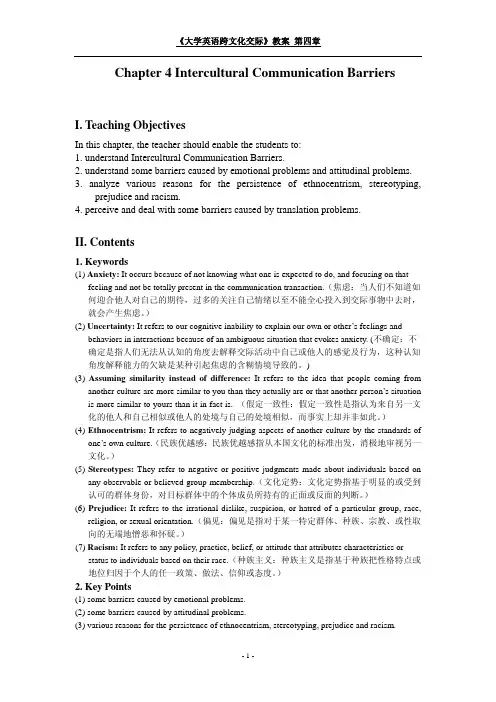
《大学英语跨文化交际》教案 第四章
Chapter 4 Intercultural Communication Barriers
I. Teaching Objectives
In this chapter, the teacher should enable the students to:
1. understand Intercultural Communication Barriers.
2. understand some barriers caused by emotional problems and attitudinal problems.
3. analyze various reasons for the persistence of ethnocentrism, stereotyping,
prejudice and racism.
4. perceive and deal with some barriers caused by translation problems.
II. Contents
1. Keywords
(1) Anxiety: It occurs because of not knowing what one is expected to do, and focusing on that
feeling and not be totally present in the communication transaction.(焦虑:当人们不知道如
何迎合他人对自己的期待,过多的关注自己情绪以至不能全心投入到交际事物中去时,
就会产生焦虑。)
(2) Uncertainty: It refers to our cognitive inability to explain our own or other’s feelings and
behaviors in interactions because of an ambiguous situation that evokes anxiety. (不确定:不

1 / 17
跨文化交际英语论文
篇一:跨文化交际(英文论文)
Cultural differences in everyday conversations
Cultural differences on politeness between western and Chinese can be
found in many aspects of daily communication, including addressing,
greeting and parting, compliments, apologies, thanks, etc.
1. Greeting and Parting
When people meet acquaintances or friends, people usually greet each
other. The purpose of greeting is to establish or maintain social contact.
So formulaic expressions are often used, but such formulaic expressions
often causes conflict because of the great cultural differences between
Chinese and native English speakers. In English, people often employ the
following expressions to greet each other “Good
morning/evening/afternoon. “Fine day, isn’t it? ” “How’s everything
going?” “Have you eaten yet?” What are you going to do?” “Where have