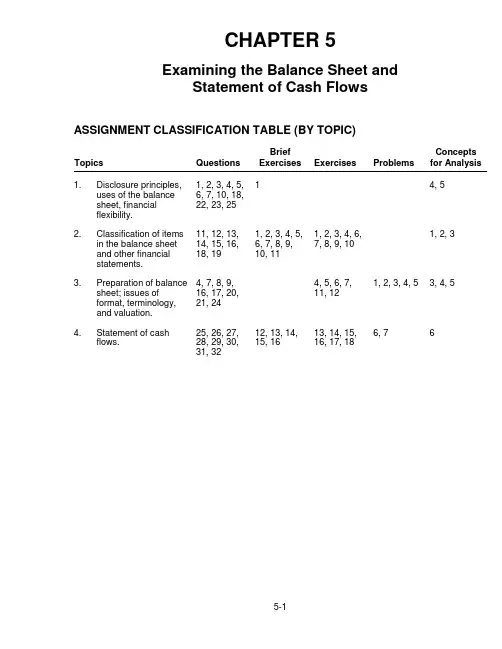
CHAPTER 5Examining the Balance Sheet andStatement of Cash Flows ASSIGNMENT CLASSIFICATION TABLE (BY TOPIC)Topics QuestionsBriefExercises Exercises ProblemsConceptsfor Analysis1. Disclosure principles,uses of the balancesheet, financialflexibility. 1, 2, 3, 4, 5,6, 7, 10, 18,22, 23, 251 4, 52. Classification of itemsin the balance sheetand other financialstatements. 11, 12, 13,14, 15, 16,18, 191, 2, 3, 4, 5,6, 7, 8, 9,10, 111, 2, 3, 4, 6,7, 8, 9, 101, 2, 33. Preparation of balancesheet; issues offormat, terminology,and valuation. 4, 7, 8, 9,16, 17, 20,21, 244, 5, 6, 7,11, 121, 2, 3, 4, 5 3, 4, 54. Statement of cashflows. 25, 26, 27,28, 29, 30,31, 3212, 13, 14,15, 1613, 14, 15,16, 17, 186, 7 6ASSIGNMENT CLASSIFICATION TABLE (BY LEARNING OBJECTIVE)Learning Objectives BriefExercises Exercises Problems1. Explain the uses and limitationsof a balance sheet.72. Identify the major classificationsof the balance sheet. 1, 2, 3, 4, 6, 8, 93. Prepare a classified balance sheet usingthe report and account formats. 1, 2, 3, 4, 5,6, 7, 8, 9,10, 111, 2, 3, 4, 5,6, 7, 9, 10,11, 12, 171, 2, 3, 4,5, 6, 74. Determine which balance sheet informationrequires supplemental disclosure.10 45. Describe the major disclosure techniquesfor the balance sheet.6. Indicate the purpose of the statementof cash flows.7. Identify the content of the statementof cash flows.138. Prepare a statement of cash flows. 12, 13, 14, 15 14, 15, 16,17, 186, 79. Understand the usefulness of the statementof cash flows.16 15, 16, 18 6, 7ASSIGNMENT CHARACTERISTICS TABLEItem Description Level ofDifficultyTime(minutes)E5-1 Balance sheet classifications. Simple 15–20 E5-2 Classification of balance sheet accounts. Simple 15–20 E5-3 Classification of balance sheet accounts. Simple 15–20 E5-4 Preparation of a classified balance sheet. Simple 30–35 E5-5 Preparation of a corrected balance sheet. Simple 30–35 E5-6 Corrections of a balance sheet. Complex 30–35 E5-7 Current assets section of the balance sheet. Moderate 15–20 E5-8 Current vs. long-term liabilities. Moderate 10–15 E5-9 Current assets and current liabilities. Complex 30–35 E5-10 Current liabilities. Moderate 15–20 E5-11 Balance sheet preparation. Moderate 25–30 E5-12 Preparation of a balance sheet. Moderate 30–35 E5-13 Statement of cash flows—classifications. Moderate 15–20 E5-14 Preparation of a statement of cash flows. Moderate 25–35 E5-15 Preparation of a statement of cash flows. Moderate 25–35 E5-16 Preparation of a statement of cash flows. Moderate 25–35 E5-17 Preparation of a statement of cash flows and a balancesheet.Moderate 30–35E5-18 Preparation of a statement of cash flows, analysis. Moderate 25–35P5-1 Preparation of a classified balance sheet, periodicinventory.Moderate 30–35 P5-2 Balance sheet preparation. Moderate 35–40 P5-3 Balance sheet adjustment and preparation. Moderate 40–45 P5-4 Preparation of a corrected balance sheet. Complex 40–45 P5-5 Balance sheet adjustment and preparation. Complex 40–50 P5-6 Preparation of a statement of cash flows anda balance sheet. Complex 35–45 P5-7 Preparation of a statement of cash flows anda balance sheet. Complex 40–50CA5-1 Reporting for financial effects of varied transactions. Moderate 25–30 CA5-2 Current asset and liability classification. Moderate 30–35 CA5-3 Identifying balance sheet deficiencies. Moderate 20–25 CA5-4 Critique of balance sheet format and content. Simple 25–30 CA5-5 Presentation of property, plant, and equipment. Simple 20–25 CA5-6 Cash flow analysis. Complex 40–50ANSWERS TO QUESTIONS1. The balance sheet provides information about the nature and amounts of investments in enterpriseresources, obligations to enterprise creditors, and the owners’equity in net enterprise resources.That information not only complements information about the components of income, but also contributes to financial reporting by providing a basis for (1) computing rates of return, (2) evaluating the capital structure of the enterprise, and (3) assessing the liquidity and financial flexibility of the enterprise.2. Solvency refers to the ability of an enterprise to pay its debts as they mature. For example, when acompany carries a high level of long-term debt relative to assets, it has lower solvency. Information on long-term obligations, such as long-term debt and notes payable, in comparison to total assets can be used to assess resources that will be needed to meet these fixed obligations (such as interest and principal payments).3. Financial flexibility is the ability of an enterprise to take effective actions to alter the amounts andtiming of cash flows so it can respond to unexpected needs and opportunities. An enterprise with a high degree of financial flexibility is better able to survive bad times, to recover from unexpected setbacks, and to take advantage of profitable and unexpected investment opportunities. Generally, the greater the financial flexibility, the lower the risk of enterprise failure.4. Some situations in which estimates affect amounts reported in the balance sheet include:a)allowance for doubtful accounts.b)depreciable lives and estimated salvage values for plant and equipment.c)warranty returns.d)determining the amount of revenues that should be recorded as unearned.When estimates are required, there is subjectivity in determining the amounts. Such subjectivity can impact the usefulness of the information by reducing the reliability of the measures, either because of bias or lack of verifiability.5. An increase in inventories increases current assets, which is in the numerator of the current ratio.Therefore, inventory increases will increase the current ratio. In general, an increase in the current ratio indicates a company has better liquidity, since there are more current assets relative to current liabilities.Note to instructors—When inventories increase faster than sales, this may not be a good signal about liquidity. That is, inventory can only be used to meet current obligations when it is sold (and converted to cash). That is why some analysts use a liquidity ratio—the acid test ratio—that excludes inventories from current assets in the numerator.6. Liquidity describes the amount of time that is expected to elapse until an asset is converted intocash or until a liability has to be paid. The ranking of the assets given in order of liquidity is:(1) (d) Short-term investments.(2) (e) Accounts receivable.(3) (b) Inventories.(4) (c) Buildings.(5) (a) Goodwill.7. The major limitations of the balance sheet are:(1) The values stated are generally historical and not at fair value.(2) Estimates have to be used in many instances, such as in the determination of collectibility ofreceivables or finding the approximate useful life of long-term tangible and intangible assets.(3) Many items, even though they have financial value to the business, presently are notrecorded. One example is the value of a company’s human resources.Questions Chapter 5 (Continued)8. Some items of value to technology companies such as Intel or IBM are the value of research anddevelopment (new products that are being developed but which are not yet marketable), the value of the “intellectual capital” of its workforce (the ability of the companies’ employees to come up with new ideas and products in the fast changing technology industry), and the value of the company reputation or name brand (e.g., the “Intel Inside” logo). In most cases, the reasons why the value of these items are not recorded in the balance sheet concern the lack of reliability of the estimates of the future cash flows that will be generated by these “assets” (for all three types) and the ability to control the use of the asset (in the case of employees). Being able to reliably measure the expected future benefits and to control the use of an item are essential elements of the definition of an asset, according to the Conceptual Framework.9. Classification in financial statements helps users by grouping items with similar characteristics andseparating items with different characteristics. Current assets are expected to be converted to cash within one year or one operating cycle, whichever is longer—property, plant and equipment will provide cash inflows over a longer period of time. Thus, separating long-term assets from current assets facilitates computation of useful ratios such as the current ratio.10. Separate amounts should be reported for accounts receivable and notes receivable. The amountsshould be reported gross, and an amount for the allowance for doubtful accounts should be deducted. The amount and nature of any nontrade receivables, and any amounts designated or pledged as collateral, should be clearly identified.11.Available-for-sale securities should be reported as a current asset only if management expects toconvert them into cash as needed within one year or the operating cycle, whichever is longer. If available-for-sale securities are not held with this expectation, they should be reported as long-term investments.12. The relationship between current assets and current liabilities is that current liabilities are thoseobligations that are reasonably expected to be liquidated either through the use of current assets or the creation of other current liabilities.13. The total selling price of the season tickets is $20,000,000 (10,000 X $2,000). Of this amount,$9,000,000 has been earned by 12/31/07 (18/40 X $20,000,000). The remaining $11,000,000 should be reported as unearned revenue, a current liability in the 12/31/07 balance sheet (22/40 X $20,000,000).14. Working capital is the excess of total current assets over total current liabilities. This excess issometimes called net working capital. Working capital represents the net amount of a company’s relatively liquid resources. That is, it is the liquidity buffer available to meet the financial demands of the operating cycle.15. (a) Stockholders’ Equity. ―Treasury stock (at cost).‖Note: This is a reduction of total stockholders’ equity.(b) Current Assets. Included in “Cash.”(c) Investments. “Land held as an investment.”(d) Investments. “Sinking fund.”(e) Long-term debt (adjunct account to bonds payable). “Unamortized premium on bondspayable.”(f) Intangible Assets. “Copyrights.”(g) Investments. “Employees’ pension fund,” with subcaptions of “Cash” and “Securities” ifdesired. (Assumes that the company still owns these assets.)(h) Stockholders’ Equity. “Premium on capital stock” or “Additional paid-in capital in excess ofpar value.”Questions Chapter 5 (Continued)(i) Investments. Nature of investments should be given together with parenthetical informationas follows: “pledged to secure loans payable to banks.”16. (a) Allowance for doubtful accounts receivable should be deducted from accounts receivable.(b) Merchandise held on consignment should not appear on the consignee’s balance sheetexcept possibly as a note to the financial statements.(c) Advances received on sales contract are normally a current liability and should be shown assuch in the balance sheet.(d) Cash surrender value of life insurance should be shown as a long-term investment.(e) Land should be reported in property, plant, and equipment unless held for investment.(f) Merchandise out on consignment should be shown among current assets under the headingof inventories.(g) Franchises should be itemized in a section for intangible assets.(h) Accumulated depreciation of plant and equipment should be deducted from the plant andequipment accounts.(i) Materials in transit should not be shown on the balance sheet of the buyer, if purchasedf.o.b. destination.17. (a) Trade accounts receivable should be stated at their estimated amount collectible, oftenreferred to as net realizable value. The method most generally followed is to deduct from thetotal accounts receivable the amount of the allowance for doubtful accounts.(b) Land is generally stated in the balance sheet at cost.(c) Inventories are generally stated at the lower of cost or market.(d) Trading securities (consisting of common stock of other companies) are stated at fair value.(e) Prepaid expenses should be stated at cost less the amount apportioned to and written offover the previous accounting periods.18. Assets are defined as probable future economic benefits obtained or controlled by a particularentity as a result of past transactions or events. If a building is leased, the future economic benefits of using the building are controlled by the lessee (tenant) as the result of a past event (the signing of a lease agreement).19. Agazzi is incorrect. Retained earnings is a source of assets, but is not an asset itself. For example,even though the funds obtained from issuing a note payable are invested in the business, the note payable is not reported as an asset. It is a source of assets, but it is reported as a liability because the company has an obligation to repay the note in the future. Similarly, even though the earnings are invested in the business, retained earnings is not reported as an asset. It is reported as part of stockholders’equity because it is, in effect, an investment by owners which increases the ownership interest in the assets of an entity.20. The notes should appear as long-term liabilities with full disclosure as to their terms. Each year, asthe profit is determined, notes of an amount equal to two-thirds of the year’s profits should be transferred from the long-term liabilities to current liabilities until all of the notes have been liquidated.21.Some of the techniques of disclosure for the balance sheet are:1. Parenthetical explanations.2. Notes to the financial statements.3. Cross references and contra items.4. Supporting schedules.Questions Chapter 5 (Continued)22. A note entitled “Summary of Significant Accounting Policies” would indicate the basic accountingprinciples used by that enterprise. This note should be very useful from a comparative standpoint, since it should be easy to determine whether the company uses the same accounting policies as other companies in the same industry.23. General debt obligations, lease contracts, pension arrangements and stock option plans are fouritems for which disclosure is mandatory in the financial statements. The reason for disclosing these contractual situations is that these commitments are of a long-term nature, are often significant in amount, and are very important to the company’s well-being.24. The profession has recommended that the use of the word “surplus” be discontinued in balancesheet presentations of owners’equity. This term has a connotation outside accounting that is quite different from its meaning in the accounts or in the balance sheet. The use of the terms capital surplus, paid-in surplus, and earned surplus is confusing to the nonaccountant and leads to misinterpretation.25. The purpose of a statement of cash flows is to provide relevant information about the cash receiptsand cash payments of an enterprise during a period. It differs from the balance sheet and the income statement in that it reports the sources and uses of cash by operating, investing, and financing activity classifications. While the income statement and the balance sheet are accrual basis statements, the statement of cash flows is a cash basis statement—noncash items are omitted.26. The difference between these two amounts may be due to increases in current assets (e.g., anincrease in accounts receivable from a sale on account would result in an increase in revenue and net income but have no effect yet on cash). Similarly a cash payment that results in a decrease in an existing current liability (e.g., accounts payable would decrease cash provided by operations without affecting net income.)27. The difference between these two amounts could be due to noncash charges that appear in theincome statement. Examples of noncash charges are depreciation, depletion, and amortization of intangibles. Expenses recorded but unpaid (e.g., increase in accounts payable) and collection of previously recorded sales on credit (i.e. now decreasing accounts receivable) also would cause cash provided by operating activities to exceed net income.28. Operating activities involve the cash effects of transactions that enter into the determination ofnet income. Investing activities include making and collecting loans and acquiring and disposing of debt and equity instruments; property, plant, and equipment and intangibles. Financing activities involve liability and owners’ equity items and include obtaining capital from owners and providing them with a return on (dividends) and a return of their investment and borrowing money from creditors and repaying the amounts borrowed.29. (a) Net income is adjusted downward by deducting $7,000 from $90,000 and reporting cashprovided by operating activities as $83,000.(b) The issuance of the preferred stock is a financing activity. The issuance is reported asfollows:Cash flows from financing activitiesIssuance of preferred stock $1,150,000Questions Chapter 5 (Continued)(c) Net income is adjusted as follows:Cash flows from operating activitiesNet income $90,000Adjustments to reconcile net income to netcash provided by operating activities:Depreciation expense 14,000Premium amortization (5,000)Net cash provided by operating activities $99,000(d)The increase of $20,000 reflects an investing activity. The increase in Land is reported asfollows:Cash flows from investing activities:Investment in Land $(20,000) 30. The company appears to have good liquidity and reasonable financial flexibility. Its current cashdebt coverage ratio is .90$900,000$1,000,000⎛⎝⎫⎭⎪ , which indicates that it can pay off its current liabilities ina given year from its operations. In addition, its cash debt coverage ratio is also good at.60$900,000$1,500,000⎛⎝⎫⎭⎪ , which indicates that it can pay off approximately 60% of its debt out of currentoperations.31. Free cash flow = $860,000 – $75,000 – $20,000 = $765,000.32. Free cash flow is net cash provided by operating activities less capital expenditures and dividends.The purpose of free cash flow analysis is to determine the amount of discretionary cash flow a company has for purchasing additional investments, retiring its debt, purchasing treasury stock, or simply adding to its liquidity.SOLUTIONS TO BRIEF EXERCISESBRIEF EXERCISE 5-1Current assetsCash .................................................................... $27,000 Accounts receivable .......................................... $110,000Less: Allowance for doubtful accounts ....... (8,000) 102,000 Inventories .......................................................... 290,000 Prepaid insurance .............................................. 9,500 Total current assets ............................... $428,500BRIEF EXERCISE 5-2Current assetsCash .................................................................... $ 7,000 Trading securities .............................................. 11,000 Accounts receivable .......................................... $90,000Less: Allowance for doubtful accounts ....... (4,000) 86,000 Inventory ............................................................. 34,000 Prepaid insurance .............................................. 5,200 Total current assets ............................... $143,200BRIEF EXERCISE 5-3Long-term investmentsHeld-to-maturity securities ................................... $ 61,000 Land held for investment ...................................... 39,000 Long-term note receivables .................................. 42,000 Total investments ............................................ $142,000BRIEF EXERCISE 5-4Property, plant, and equipmentLand ..................................................................... $ 61,000 Buildings ............................................................. $207,000Less: Accumulated depreciation .................. (45,000) 162,000 Equipment ........................................................... $190,000Less: Accumulated depreciation ................. (19,000) 171,000 Timberland .......................................................... 70,000 Total property, plant, and equipment ...... $464,000BRIEF EXERCISE 5-5Intangible assetsGoodwill .............................................................. $150,000 Patents ................................................................ 220,000 Franchises .......................................................... 110,000 Total intangibles ........................................... $480,000BRIEF EXERCISE 5-6Intangible assetsGoodwill .............................................................. $40,000 Franchises .......................................................... 47,000 Patents ................................................................ 33,000 Trademarks ......................................................... 10,000 Total intangible assets ................................. $130,000BRIEF EXERCISE 5-7Current liabilitiesAccounts payable ............................................... $72,000 Accrued salaries ................................................. 4,000 Notes payable ..................................................... 12,500 Income taxes payable ........................................ 7,000 Total current liabilities ........................... $95,500BRIEF EXERCISE 5-8Current liabilitiesAccounts payable ............................................... $240,000 Advances from customers ................................ 41,000 Wages payable ................................................... 27,000 Interest payable .................................................. 12,000 Income taxes payable ........................................ 29,000 Total current liabilities ........................... $349,000BRIEF EXERCISE 5-9Long-term liabilitiesBonds payable .................................................... $400,000Less: Discount on bonds payable ............... 24,000 $376,000 Pension liability .................................................. 375,000 Total long-term liabilities ....................... $751,000BRIEF EXERCISE 5-10Stockholders’ eq uityCommon stock .................................................... $700,000 Additional paid-in capital ................................... 200,000 Retained earnings .............................................. 120,000 Accumulated other comprehensive loss .......... (150,000) Total stockholders’ equity ............................ $870,000BRIEF EXERCISE 5-11Stockh olders’ equityPreferred stock ................................................... $172,000 Common stock .................................................... 55,000 Additional paid-in capital ................................... 174,000 Retained earnings .............................................. 114,000 Total stockholders’ equity ............................ $515,000BRIEF EXERCISE 5-12Cash Flow StatementOperating ActivitiesNet income .......................................................... $40,000 Increase in accounts receivable ........................ (10,000) Increase in accounts payable ............................ 5,000 Depreciation expense......................................... 4,000 Net cash provided by operating activities ...... 39,000BRIEF EXERCISE 5-12 (Continued)Investing ActivitiesPurchase of equipment ...................................... (8,000)Financing ActivitiesIssue notes payable ........................................... 20,000 Dividends ............................................................ (5,000) Net cash flow from financing activities ....... 15,000 Net change in cash ($39,000 – $8,000 + $15,000) ........ $46,000Free Cash Flow = $39,000 (Net cash provided by operating activities) –$8,000 (Purchase of equipment) – $5,000 (Dividends) = $26,000.BRIEF EXERCISE 5-13Cash flows from operating activitiesNet income .......................................................... $151,000 Adjustments to reconcile net income tonet cash provided by operating activitiesDepreciation expense .................................. $39,000Increase in accounts payable ...................... 9,500Increase in accounts receivable .................. (13,000) 35,500 Net cash provided by operating activities ........ $186,500BRIEF EXERCISE 5-14Sale of land and building ......................................... $181,000 Purchase of land ...................................................... (37,000) Purchase of equipment ............................................ (53,000) Net cash provided by investing activities......... $ 91,000BRIEF EXERCISE 5-15Issuance of common stock ...................................... $147,000 Purchase of treasury stock ...................................... (40,000) Payment of cash dividend ....................................... (85,000) Retirement of bonds ................................................. (100,000) Net cash used by financing activities ............... $ (78,000)BRIEF EXERCISE 5-16Free Cash Flow AnalysisNet cash provided by operating activities .............. $400,000 Less: Purchase of equipment ................................ (53,000) Purchase of land* ........................................ (37,000) Dividends ..................................................... (85,000) Free cash flow .......................................................... $225,000*If the land were purchased as an investment, it would be excluded in the computation of free cash flow.SOLUTIONS TO EXERCISESEXERCISE 5-1 (15–20 minutes)(a)If the investment in preferred stock is readily marketable and heldprimarily for sale in the near term to generate income on short-term price differences, then the account should appear as a current asset and be included with trading securities. If, on the other hand, the preferred stock is not a trading security, it should be classified as available for sale. Available for sale securities are classified as current or noncurrent depending upon the circumstances.(b)If the company accounts for the treasury stock on the cost basis, theaccount should properly be shown as a reduction of total stockholders’ equity.(c)Stockholders’ equity.(d)Current liability.(e)Property, plant, and equipment (as a deduction).(f)If the warehouse in process of construction is being constructed foranother party, it is properly classified as an inventory account in the current asset section. This account will be shown net of any billings on the contract. On the other hand, if the warehouse is being constructed for the use of this particular company, it should be classified as a separate item in the property, plant, and equipment section.(g)Current asset.(h)Current liability.(i)Retained earnings.EXERCISE 5-1 (Continued)(j)Current asset.(k)Current liability.(l)Current liability.(m)Current asset (inventory).(n)Current liability.EXERCISE 5-2 (15–20 minutes)1. h. 11. b.2. d. 12. f.3. f. 13. a.4. f. 14. h.5 c. 15. c.6. a. 16. b.7. f. 17. a.8. g. 18. a.9. a. 19. g.10. a. 20. f.。