
Literature Search
- 格式:ppt
- 大小:396.00 KB
- 文档页数:10

高三英语学术研究方法创新不断探索单选题30题及答案1.In academic research, where is the best place to start looking for relevant literature?A.The libraryB.The internetC.A professor's officeD.A friend's bookshelf答案:A。
在学术研究中,图书馆通常拥有丰富的学术资源,包括书籍、期刊等,是开始查找相关文献的最佳地方。
选项B 互联网上的信息可能不准确或不权威。
选项C 教授的办公室不是查找文献的主要场所。
选项D 朋友的书架上的书可能不具有学术性。
2.When searching for literature, which keyword should you avoid using?mon wordsB.Specific termsC.Technical jargonD.Academic phrases答案:A。
在查找文献时,应避免使用常见词汇,因为这样会得到大量不相关的结果。
选项B 特定术语、选项C 技术行话、选项D 学术短语都可以帮助缩小搜索范围。
3.Which of the following is NOT a reliable source of literature for academic research?A.Scholarly journalsB.Popular magazinesC.Academic booksD.Research papers答案:B。
学术研究中,可靠的文献来源包括学术期刊、学术书籍和研究论文。
流行杂志通常不具有学术性和权威性。
4.If you can't find a particular piece of literature in your local library, what should you do?A.Give upB.Ask a friendC.Try an online databaseD.Wait for it to appear答案:C。
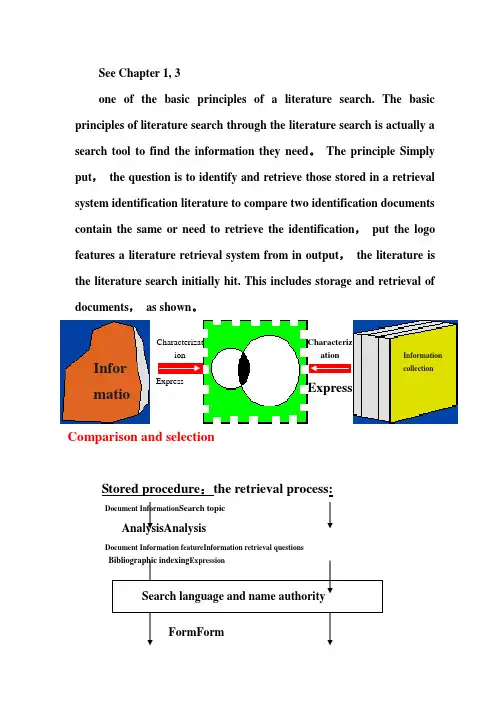
See Chapter 1, 3one of the basic principles of a literature search. The basic principles of literature search through the literature search is actually a search tool to find the information they need 。
The principle Simply put , the question is to identify and retrieve those stored in a retrieval system identification literature to compare two identification documents contain the same or need to retrieve the identification , put the logo features a literature retrieval system from in output , the literature is the literature search initially hit. This includes storage and retrieval of documents , as shown 。
Comparison and selectionStored procedure :the retrieval process:Document Information Search topicAnalysisAnalysisDocument Information featureInformation retrieval questionsBibliographic indexing ExpressionFormFormSearch language and name authorityCharacterizationExpressInfor matioCharacteriz ationExpressInformation collectionIdentification document information (access points)Search Question ID (search terms)EnterSearchRetrieval system (identified more)OutputSearch Results(Perfectly matched, related, unrelated)2.Information storage and retrieval 1)information storageretrieval booksAbstract number: 020001Title: the dye in production of the microcomputer controlAuthor: zhang Ming; Chien—ming wang;LiuJianYeInstitution: Beijing institute of chemical (Beijing 100001)Literature sources (source) :chemical technology, 2002。
《文献检索与利用》总复习题库(Literature search and utilization review the question bank)General review questions bank of "document retrieval and utilization"First, individual choice questions1. or less is not Boolean logicA.NOTB.ORC.ANDD.NEARThe usual order of operations of 2. Boolean logic operators is ():When A. has parentheses, the parentheses are first executed; NOT, > AND > OR without parenthesesWhen B. is bracketed, the parentheses are executed first; when parentheses are not there, NOT > OR >ANDWhen C. has parentheses, the parentheses are first executed; AND >NOT > OR without parenthesesWhen D. has parentheses, the parentheses are first executed;AND, > OR > NOT without parentheses3. words and phrases? "Can be used instead of 0 or more characters?"A. more than oneB.1C.2D.34. which of the following is the abbreviation of the library public directory retrieval system?A. CalisB. NSTLC. OCLCD. OPACWhat is the unique identifier of the 5.ISSN?A. conference documentsB. standard documentsC. thesisD. JournalWhat is the unique identifier of the 6.ISBN?A. booksB. JournalC. Technology ReportD. patent documents7. which of the following databases is a full-text database?A.CPCIB.Elsevier Science DirectC.EID. SCI8. use Adobe Reader to read the files in which formatA.PDFB. VIPC. HTML9.cajviewer is the following database full text reading software:A. Superstar Digital LibraryB. VIP Chinese science and Technology Periodicals DatabaseKI CNKI full text libraryD. Wanfang Data Resources10. browsing superstar digital library, should be installed first:A. Apabi ReaderB. Adobe ReaderC. CAJ ViewerD. SSReader11. the following databases belong to the bibliographic databaseA. SCIB. ISTPD. library OPAC12.PQDT isA. conference document databaseB. dissertation databaseC. standard document databaseD. science and technology reporting database13.AD, PB, NASA, and DOE are the four largest U.S. government reports, in which NASA refers toA. administrative reportB. Energy ReportC. military reportD. Aerospace Report14. () is a large, informative and comprehensive instrument that reflects all the knowledge, categories, or basic knowledge and basic circumstances of a human being. It is called the king of the book of tools".A. dictionaryB. EncyclopediaC. YearbookD. manual15. which of the following databases do not belong to the numeric and factual databases?A. China Information BankB. search network, statistical yearbook, databaseC. country research dataD. NPC press copy information16. in which of the following search tools can you get statistics over the years?A. dictionaryB. EncyclopediaC. YearbookD. manual17. which of the following retrieval systems provides citations for journals and references?A. WEB OF SCIEB. OCLCC. OPACD. EI18. the following Boolean logic operators are.A. andB. orC.D.near19. commonly used retrieval systems areA. directory retrieval systemB. digest retrieval systemC. full text retrieval systemD. or more20. what kind of retrieval system does the online public directory retrieval system (OPAC) belong to?A. directory retrieval systemB. digest retrieval systemC. full text retrieval system21., we can sum up the general steps of information retrieval.A.1. analysis of search topics, a clear demand for information;2. sources of information, knowledge retrieval system;3. access, selected4. retrieval methods; implementation of retrieval strategy, evaluation of retrieval results;5. adjust the search strategy to obtain the required information;6. analysis of management information, rational use of informationB.1. selects information sources, 2. develops strategies and implements retrieval, 3. evaluation information, 4. adjusts retrieval strategies, and 5. analyzes and utilizes informationC. 1. develops strategies, 2. defining questions, 3. selecting information sources, 4. implementing retrieval, 5. evaluating information, and 6. analyzing and utilizing informationD.1. define problems, 2. select information sources, 3.Develop strategies, 4. implement retrieval, and 5. evaluate information22., you need to write a report on the current status of businessintelligence systems, which should focus on the following information sources.A. web pagesB. newspaperC. magazineD. all kinds of literature database23. the standard format of reference is ().A. author Title SourceB. source of famous authorsPlease mark the 24. documents: Ma Pinzhong. Study on large astronomical telescope. China space science and technology, 1993, 13 (5) P6 - 14, ISSN1000 - 758X which belongs to the type of literature ().A. booksB. Technology ReportC. JournalD. newspaper25. in retrieval language, it is natural language.A. Heading WordsB. keywordC. unit wordsD. keywords26., what kind of retrieval methods should be taken after using the references found in the literature to expand the search scope?A. tool methodB. intersection methodC. retrospective method (snowball method)D. method27. which title of the following retrieval expressions is correct in retrieving the title of the poem entitled "poetry of the Tang and Song Dynasties"?.A. (title = Tang or title = song) and title = PoetryB. title = Tang or title = song and title = PoetryC. title = Tang and title = song or title = PoetryD. title = Tang or title = song or title = Poetry28. which of the following documents belong to the special literature?A. booksB. conference documentsC. JournalD. newspaperAre the fields represented by the 29. field codes AU, AB and PY represented?A. titles, annotations, abstract typesB. authors, abstracts, and publication yearsC. descriptors, classifications, languages30. what is the largest digital library in China?A. superstarB. scholar's homeC. founderD. Wanfang31., Xiao Li students need to find some data about the national economic life, which database can be retrieved in the following?A. Chinese VIP journalsB.EIC. National Research NetworkD.EBSCO32. foreign language full-text database, search results are sorted in several ways, if you want to sort in accordance with the relevant, you should choose: ()A.dateB.sourceC.authorD.relevance33.. This is a literature retrieved in web of science. What is the type of literature in this article?:Title:, Using, desktop, computers, to, solve, large-scale, dense,, linear, algebra, problemsAuthor (s): Marques M.; Quintana-Orti G.; Quintana-Orti E. S.; et al.Conference: Symposium on High Performance Computing (HPC) Applied to Computational Problems in Science and Engineering/9th International Conference on Computational and Mathematical Methods in Science and Engineering Location: Gijon, SPAIN Date: JUN, 2009Source:, JOURNAL, OF, SUPERCOMPUTING, Volume:, 58, Issue:, 2, Special, Issue:, SI, Pages:, 145-150, DOI:,10.1007/s11227-010-0394-2,, Published:, NOV,...A. Journal PapersB. booksC. Conference PapersD. Technical Report34.. The classification numbers of commonly used foreign language and economic books in this museum are respectively:A.H, FB.H, CC.I, HE.I, F35. using the library bibliographic retrieval system, Xiao Li's classmate retrieved a book with the classification number "H319CF". What's the significance of the classification number?A. CET Band FourB. CET Band SixC. postgraduate English testD.Tofel test36. Wang students want to find the "The Washington Post" on November 7th, an article entitled "No favorites emerge in race for horse of the year" text and listen to what can be downloaded, the museum has purchased what search resources of foreign language in the database?A.Elsevier SDB. EBSCO之报纸资源c.wsnD.翡翠二、多选题1。
How to Write a Good Literature Review1. IntroductionNot to be confused with a book review, a literature review surveys scholarly articles, books and other sources (e.g. dissertations, conference proceedings) relevant to a particular issue, area of research, or theory, providing a description, summary, and critical evaluation of each work. The purpose is to offer an overview of significant literature published on a topic.2. ComponentsSimilar to primary research, development of the literature review requires four stages:▪Problem formulation—which topic or field is being examined and what are its component issues?▪Literature search—finding materials relevant to the subject being explored▪Data evaluation—determining which literature makes a significant contribution to the understanding of the topic▪Analysis and interpretation—discussing the findings and conclusions of pertinent literatureLiterature reviews should comprise the following elements:▪An overview of the subject, issue or theory under consideration, along with the objectives of the literature review▪Division of works under review into categories (e.g. those in support of a particular position, those against, and those offering alternative theses entirely) ▪Explanation of how each work is similar to and how it varies from the others▪Conclusions as to which pieces are best considered in their argument, are most convincing of their opinions, and make the greatest contribution to the understanding and development of their area of researchIn assessing each piece, consideration should be given to:▪Provenance—What are the author's credentials? Are the author's arguments supported by evidence (e.g. primary historical material, case studies, narratives, statistics, recent scientific findings)?▪Objectivity—Is the author's perspective even-handed or prejudicial? Is contrary data considered or is certain pertinent information ignored to prove the author's point?▪Persuasiveness—Which of the author's theses are most/least convincing?▪Value—Are the author's arguments and conclusions convincing? Does the work ultimately contribute in any significant way to an understanding of the subject?3. Definition and Use/PurposeA literature review may constitute an essential chapter of a thesis or dissertation, or may be a self-contained review of writings on a subject. In either case, its purpose is to:▪Place each work in the context of its contribution to the understanding of the subject under review▪Describe the relationship of each work to the others under consideration▪Identify new ways to interpret, and shed light on any gaps in, previous research▪Resolve conflicts amongst seemingly contradictory previous studies▪Identify areas of prior scholarship to prevent duplication of effort▪Point the way forward for further research▪Place one's original work (in the case of theses or dissertations) in the context of existing literatureHere are some of the questions your literature review should answer:1.What do we already know in the immediate area concerned?2. What are the characteristics of the key concepts or the main factors or variables?2.What are the relationships between these key concepts, factors or variables?3.What are the existing theories?4.Where are the inconsistencies or other shortcomings in our knowledge andunderstanding?5.What views need to be (further) tested?6.What evidence is lacking, inconclusive, contradictory or too limited?7.Why study (further) the research problem?8.What contribution can the present study be expected to make?9. What research designs or methods seem unsatisfactory?HOW CAN I WRITE A GOOD LITERATURE REVIEW?Remember the purpose: it should answer the questions we looked at above. Look at how published writers review the literature. You'll see that you should use the literature to explain your research - after all, you are not writing a literature review just to tell your reader what other researchers have done. You aim should be to show why your research needs to be carried out, how you came to choose certain methodologies or theories to work with, how your work adds to the research already carried out, etc.Read with a purpose:you need to summarize the work you read but you must also decide which ideas or information are important to your research (so you can emphasize them), and which are less important and can be covered briefly or left out of your review. You should also look for the major concepts, conclusions, theories, arguments etc. that underlie the work, and look for similarities and differences with closely related work. This is difficult when you first start reading, but should become easier the more you read in your area.Write with a purpose: your aim should be to evaluate and show relationships between the work already done (Is Researcher Y's theory more convincing than Researcher X's? DidResearcher X build on the work of Researcher Y?) and between this work and your own. In order to do this effectively you should carefully plan how you are going to organize your work.A lot of people like to organize their work chronologically (using time as their organizing system). Unless developments over time are crucial to explain the context of your research problem, using a chronological system will not be an effective way to organize your work. Some people choose to organize their work alphabetically by author name: this system will not allow you to show the relationships between the work of different researchers, and your work, and should be avoided!When you read for your literature review, you are actually doing two things at the same time (which makes things more difficult for you!):1. you are trying to define your research problem: finding a gap, asking a question,continuing previous research, counter-claiming;2. you are trying to read every source relevant to your research problem.Naturally, until you have defined your problem, you will find that there are hundreds of sources that seem relevant. However, you cannot define your problem until you read around your research area. This seems a vicious circle, but what should happen is that as you read you define your problem, and as you define your problem you will more easily be able to decide what to read and what to ignore.TRAPSSome traps to avoid:Trying to read everything! As you might already have discovered, if you try to be comprehensive you will never be able to finish the reading! The idea of the literature review is not to provide a summary of all the published work that relates to your research, but a survey of the most relevant and significant work.Reading but not writing! It's easier to read than to write: given the choice, most of us would rather sit down with a cup of coffee and read yet another article instead of putting ourselves in front of the computer to write about what we have already read! Writing takes much more effort, doesn't it? However, writing can help you to understand and find relationships between the work you've read, so don't put writing off until you've "finished" reading - after all, you will probably still be doing some reading all the way through to the end of your research project. Also, don't think of what you first write as being the final ornear-final version. Writing is a way of thinking, so allow yourself to write as many drafts as you need, changing your ideas and information as you learn more about the context of your research problem.Not keeping bibliographic information!The moment will come when you have to write your references page . . . and then you realize you have forgotten to keep the information you need, and that you never got around to putting references into your work. The only solution is to spend a lot of time in the library tracking down all those sources that you read, and going through your writing to find which information came from which source. If you're lucky, maybe you can actually do this before your defence - more likely, you will unable to find all your sources, a big headache for you and your committee. To avoid this nightmare, always keep this information in your notes. Always put references into your writing. Notice how on this course we have referenced the works that we have referred to - you should do the same.LITERATURE REVIEW: AN EXAMPLEHere is an example of using the literature to explain and define a problem. This example is taken from an introduction because most thesis literature reviews tend to be too long for us to easily look at. Although your literature review will probably be much longer than the one below, it is useful to look at the principles the writers have used.On the optimal container size in automated warehousesY. Roll, M.J. Rosenblatt and D. Kadosh, Proceedings of the NinthICPRAutomated storage and retrieval systems (AS/RS) are being introduced intothe industry and warehousing at an increasing rate. Forecasts indicate thatthis trend will continue for the foreseeable future (see [1]). Research in thearea of AS/RS has followed several avenues. Early work by Hausman,Schwarz and Graves [6, 7] was concerned with storage assignment andinterleaving policies, based on turnover rates of the various items. Elsayed [3]and Elsayed and Stern [4] compared algorithms for handling orders inAR/RS. Additional work by Karasawa et al. [9], Azadivar [2] and Parry et al.[11] deals with the design of an AS/RS and the determination of itsthroughput by simulation and optimization techniques.Several researchers addressed the problem of the optimal handling unit(pallet or container) size, to be used in material handling and warehousingsystems. Steudell [13], Tanchoco and Agee[14], Tanchoco et al. [15] andGrasso and Tanchoco [5] studied various aspects of this subject. The last tworeferences incorporate the size of the pallet, or unit load, in evaluation of theoptimal lot sizes for multi-inventory systems with limited storage space. In areport on a specific case, Normandin [10] has demonstrated that using the'best-size' container can result in considerable savings. A simulation modelcombining container size and warehouse capacity considerations, in anAS/RS environment, was developed by Kadosh [8]. The general results,reflecting the stochastic nature of the flow of goods, are similar to thosereported by Rosenblatt and Roll [12]. Nevertheless, container size was foundto affect strongly overall warehousing costs.In this paper, we present an analytical framework for approximating theoptimal size of a warehouse container. The approximation is based on seriesof generalizations and specific assumptions. However, these are valid for awide range of real life situations. The underlying assumptions of the modelare presented in the following section.Notice how the writers have:grouped similar information: "Steudell [13], Tanchoco and Agee[14], Tanchoco et al. [15] and Grasso and Tanchoco [5] studied various aspects of this subject."shown the relationship between the work of different researchers, showingsimilarities/differences: "The general results, reflecting the stochastic nature of the flow of goods, are similar to those reported by Rosenblatt and Roll [12]."indicated the position of the work in the research area history: "Early work by Hausman, Schwarz and Graves [6, 7] . . . "moved from a general discussion of the research in AS/RS to the more specific area (optimal container size) that they themselves are researching i.e. they relate previous work to their own to define it, justify it and explain it.。