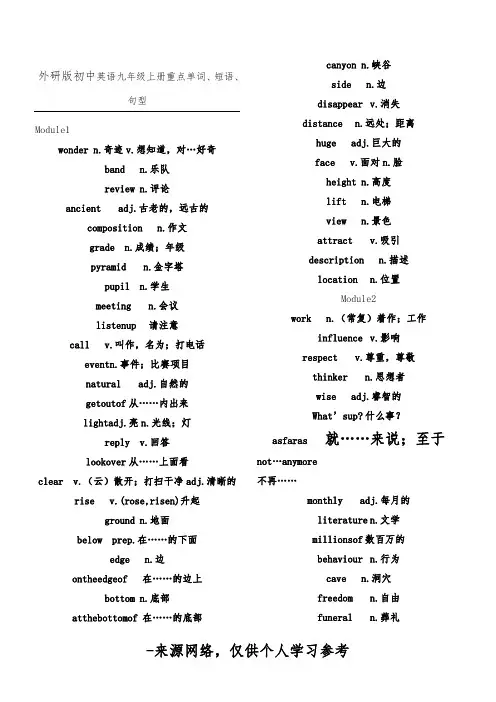
外研版英语九年级上册m1到m4单元重点短语或语法全文共6篇示例,供读者参考篇1Title: Mastering English with Fun and Games!Hey there, kids! Are you ready to embark on an exciting adventure through the world of English? In this article, we'll explore some cool phrases and grammar rules that will help you become a language master. Get ready to have a blast while learning!Unit M1: Let's Start with Greetings!One of the first things you'll learn in English is how to greet people. It's like giving a friendly high-five with words! Here are some common greetings:"Hello!" - This is a classic way to say hi to someone."Good morning/afternoon/evening." - Use these greetings based on the time of day."How are you?" - Ask this to find out how someone is feeling.Now, let's talk about the present continuous tense. It's like describing an action that's happening right now. For example:"I am studying English." (I'm studying English.)"She is playing football." (She's playing football.)Just add "is" or "are" before the verb and add "-ing" at the end. Easy peasy, right?Unit M2: Talking About the PastTime to travel back in history! The past simple tense is your ticket to discussing events that have already happened. Here's how it works:"I went to the park yesterday." (Regular verbs like "go" have an "-ed" ending in the past tense.)"She played basketball last week." (For irregular verbs like "play," you'll need to learn the past form separately.)Remember to use expressions like "yesterday," "last week," or "in 2020" to indicate when the action took place.Unit M3: Future Adventures Await!Now, let's look ahead to the future! The future simple tense is all about discussing plans and predictions. Here's how it goes:"I will go to the beach tomorrow." (Use "will" before the verb to talk about the future.)"She will not (won't) eat vegetables." (Add "not" or use a contraction like "won't" to make a negative statement.)You can also ask questions in the future tense:"Will you come to my birthday party?" (Put "will" before the subject to form a question.)Unit M4: Describing People and ThingsAdjectives are like colorful words that add extra details to nouns (people, places, or things). Check out these examples:"She is a kind girl.""That is a tall building.""I like the red shirt."You can also compare things using comparative and superlative adjectives:"My brother is taller than me." (Comparative adjectives, like "taller," compare two things.)"That is the biggest tree in the park." (Superlative adjectives, like "biggest," compare three or more things.)Phew! That was a lot of information, but don't worry; practice makes perfect. Keep playing with these phrases and grammar rules, and you'll be a language pro in no time!Remember, learning English should be fun, so let's turn it into a game. Why don't you try making up silly sentences using the new phrases and grammar you've learned? Or, you could challenge your friends to a grammar competition and see who can come up with the most creative examples.The world of English is vast and exciting, filled with endless possibilities for communication and self-expression. Embrace the journey, have fun, and never stop exploring!篇2Title: The Grammar Gizmos - A Fun Way to Learn English!Hey there, fellow grammar gizmo lovers! Are you ready to dive into the wild and wacky world of English grammar? Hold on tight because we're about to blast off on a linguistic adventure that will make your brain cells dance with joy!First up, let's tackle those pesky little things called phrases. You know, those groups of words that kind of hang out together and do cool stuff? Yeah, those guys! In Unit M1, we learned allabout noun phrases. These bad boys help us identify people, places, and things in our sentences. For example, "the big red balloon" is a noun phrase that tells us exactly what kind of balloon we're talking about.But wait, there's more! Unit M2 introduced us to verb phrases, which are like the action heroes of our sentences. They tell us what's happening and who's doing it. "Has been studying" is a verb phrase that lets us know someone has been hitting the books hard!Now, let's move on to Unit M3 and the world of prepositions. These little words might seem small, but they pack a mighty punch! They help us understand the relationships between different parts of a sentence. For instance, "under the table" tells us exactly where something is located.Last but not least, we have Unit M4, where we learned about clauses. These bad boys are like mini-sentences that can either stand on their own or team up with other clauses to form more complex sentences. "Because it was raining" is a dependent clause that needs a little help from its independent clause buddy to make a complete sentence.But wait, there's even more grammar goodness to explore! In these units, we also learned about some super cool grammar concepts like:Tenses (past, present, and future) - These help us talk about when things happened, are happening, or will happen.Passive voice - This is when the subject of a sentence is acted upon, rather than doing the action itself.Conditional sentences - These allow us to talk about hypothetical situations and their consequences.Relative clauses - These little guys help us provide extra information about nouns in our sentences.Phew! That was a lot of grammar gizmo action, wasn't it? But don't worry, we're not done yet! There are still plenty of linguistic adventures waiting for us in the upcoming units.So, my fellow grammar gizmo lovers, keep practicing, keep exploring, and never stop learning. Because the more you know about English grammar, the better you'll be able to communicate with people from all around the world. And who knows, maybe one day you'll become a grammar gizmo master!篇3Hey there! It's me again, your friendly neighborhood English learner. I know, I know, you're probably thinking "Ugh, not another lecture on grammar and vocab!" But trust me, this one's gonna be different. I'm gonna make it fun and easy to understand, just like a game!First up, let's talk about Unit M1. Remember all those cool expressions with "make" and "do"? Like "make a phone call" or "do the laundry"? Those are called phrasal verbs, and they're super useful for describing everyday actions. But be careful, because some of them have multiple meanings! For example, "make up" can mean "invent a story" or "apply makeup". Tricky, right?Now, let's move on to Unit M2. This one's all about comparisons and giving opinions. You know how your mom always says "Don't compare yourself to others"? Well, in English, we do it all the time! We use words like "as... as", "not as... as", "more... than", and "less... than" to compare things. And when we want to give our opinion, we use phrases like "I think...", "In my opinion...", or "From my point of view...". Easy peasy, right?Okay, get ready for Unit M3. This one's a bit more challenging, but I know you can handle it. We're talking about the future tense, baby! You know, like "I will study hard" or "Sheis going to become a doctor". But wait, there's more! We also learned about phrases like "be about to" and "be due to" for talking about the near future. And let's not forget those funky future continuous structures like "I will be studying" or "They will be playing football". Phew, that's a lot to remember, but I know you've got this!Last but not least, Unit M4. This one's all about the past tense, and let me tell you, it's a doozy! We've got the simple past tense, like "I went to the park", the past continuous, like "She was watching TV", and the past perfect, like "They had already eaten dinner". And that's not even counting all the irregular verb forms we had to memorize! But hey, at least we learned some cool idioms and slang expressions, like "once upon a time" and "a piece of cake".Phew, that was a lot of information, wasn't it? But you know what they say, practice makes perfect. So keep practicing those phrases and grammar points, and before you know it, you'll be speaking English like a pro!Oh, and one last thing: remember to have fun with it! Learning a new language is all about exploring new cultures and ways of thinking. So don't just memorize the rules, try tounderstand the logic behind them. And most importantly, don't be afraid to make mistakes. That's how we learn and grow.Alright, that's all for now, folks. Keep up the good work, and I'll see you next time for another thrilling installment of "Grammar Adventures with [Your Name]"!篇4Title: Mastering English Expressions and Grammar: A Fun Journey through Units M1-M4Hey there, fellow learners! Are you ready to embark on an exciting adventure through the world of English expressions and grammar? In this article, we'll explore the key phrases and grammar points from Units M1 to M4 in your Grade 9 English textbook. Buckle up and get ready for some language fun!Unit M1: Introducing OurselvesIn this unit, we learned how to introduce ourselves and share information about our hobbies, interests, and aspirations. One of the most important phrases we encountered was "What's your name?" This simple question allows us to start a conversation and get to know someone new. We also learned how to respond with "My name is..." or "I'm..."Additionally, we explored the use of subject pronouns like "I," "you," "he," "she," "it," "we," and "they." These little words help us identify who or what we're talking about in a sentence. For example, "I like playing basketball" or "They are my friends."Unit M2: Talking about AbilitiesUnit M2 taught us how to express our abilities and skills using phrases like "can" and "be able to." We learned to say things like "I can speak English fluently" or "She is able to play the piano beautifully." These expressions allow us to showcase our talents and appreciate the abilities of others.We also delved into the world of adverbs, which are words that describe how something is done. Words like "quickly," "slowly," "carefully," and "loudly" help us paint a vivid picture of actions and events.Unit M3: Describing People and ThingsIn Unit M3, we focused on describing people and objects using adjectives. We learned how to use words like "tall," "short," "big," "small," "beautiful," and "ugly" to provide detailed descriptions. For example, "My friend is a tall, friendly girl with long hair."Additionally, we explored the use of comparatives and superlatives to compare different people or things. Phrases like "taller than," "shorter than," "the tallest," and "the shortest" help us express how things measure up against each other.Unit M4: Expressing Likes and DislikesUnit M4 taught us how to express our likes and dislikes using phrases like "I like..." and "I don't like..." We learned to talk about our preferences for different activities, foods, and hobbies. For instance, "I like playing video games, but I don't like doing homework."We also discovered the importance of using contractions like "don't," "can't," and "won't" to make our speech more natural and conversational. These shortened forms of words add a touch of informality and make our language sound more like how we actually speak.Phew, that was quite a journey! We covered a lot of ground, from introducing ourselves to expressing our abilities, describing people and things, and sharing our likes and dislikes. Along the way, we encountered various grammar concepts and useful phrases that will help us communicate more effectively in English.Remember, practice makes perfect, so keep practicing these expressions and grammar points whenever you can. The more you use them, the more natural and confident you'll become in your English communication skills. Happy learning, and keep exploring the wonderful world of the English language!篇5Hey there, friends! Are you ready to dive into the world of English with me? Today, we're going to explore some really cool phrases and grammar rules from the first few units of our English textbook. Don't worry, I'll make it fun and easy to understand!Let's start with Unit M1, shall we? One of the most important things we learned is how to use the verb "be" correctly. We use "is" for singular subjects like "he," "she," or "it," and "are" for plural subjects like "we," "you," and "they." For example, "She is a student," and "They are my friends."Another handy phrase from this unit is "there is/there are." We use "there is" to introduce a singular noun, like "There is a book on the table." And we use "there are" to introduce plural nouns, like "There are many flowers in the garden."Moving on to Unit M2, we learned how to ask and answer questions using "what," "where," "who," "why," and "how." Forinstance, "What is your name?" or "Where do you live?" These question words are super useful for getting information from others.Oh, and let's not forget about the present continuous tense! We use it to talk about actions happening right now. To form the present continuous, we use the verb "be" plus the present participle (verb + -ing). Like "I am reading a book" or "They are playing soccer."Unit M3 introduced us to the simple past tense. We use it to talk about completed actions in the past. For regular verbs, we add "-ed" to the base form (like "walked" or "played"). For irregular verbs, we have to memorize the past tense forms (like "went" or "saw").Another cool thing we learned in Unit M3 is how to use "could" to express ability or possibility in the past. For example, "When I was young, I could run really fast" or "They could not solve the puzzle."Finally, in Unit M4, we dove into the world of comparatives and superlatives. We use them to compare people, animals, or things. For short adjectives, we add "-er" for comparatives and "-est" for superlatives (like "taller" and "tallest"). For longeradjectives, we use "more" and "most" (like "more beautiful" and "most beautiful").Phew, that was a lot of grammar, huh? But don't worry, practice makes perfect! Keep using these phrases and rules in your conversations and writing, and they'll become second nature. Remember, learning English is a journey, and every step counts.If you ever feel stuck or confused, don't hesitate to ask your teacher or classmates for help. We're all in this together, and teamwork makes the dream work!Keep up the great work, my friends, and let's continue exploring the wonderful world of English together!篇6Hey there, friends! It's me, your friendly neighborhood English learner, ready to share some super important stuff I've picked up from my English textbook. Now, I know what you're thinking - "Ugh, not another lecture on grammar!" But trust me, this is going to be way more fun than a boring old grammar lesson!Let's start with Unit M1, shall we? One of the first things we learned was how to use "used to" to talk about past habits or situations that no longer exist. For example, "I used to love playing with toy cars when I was little, but now I prefer video games." Isn't that cool? It's like a time machine for our language!Speaking of time, we also learned about the present perfect tense, which is super handy for talking about experiences we've had up to now. Like, "I have visited my grandparents in the countryside many times." It's like a secret code for sharing our adventures!Unit M2 was all about comparing things, and let me tell you, it's a game-changer! We learned how to use phrases like "not as... as" and "the same as" to point out similarities and differences. For instance, "My little brother isn't as tall as me, but he's the same age." Mind-blowing, right?But wait, there's more! We also learned about the past perfect tense, which is like a time travel machine for our stories. "When I arrived at the party, everyone had already left." It's like a secret language that lets us jump back and forth in time!Moving on to Unit M3, we dove into the world of hypothetical situations and wishes. We learned how to use "if" clauses and phrases like "I wish" to talk about imaginaryscenarios. Like, "If I could fly, I would visit all the amazing places in the world." Isn't that just the coolest?And let's not forget about the future perfect tense, which allows us to talk about things that will be completed by a certain time in the future. "By the time I graduate from high school, I will have studied English for ten years." It's like a crystal ball for our language skills!Last but not least, Unit M4 introduced us to the wonderful world of reported speech. We learned how to use phrases like "he said that" and "she told me" to share what others have said or thought. Like, "My mom told me that I should always try my best in school." It's like a secret code for passing on messages!And let's not forget about the perfect modals, which help us talk about things we should have or could have done differently. "I could have studied harder for that test." It's like a time machine that lets us go back and fix our mistakes!Phew, that was a lot of grammar goodness, but I promise it was worth it! Now you've got a whole arsenal of language tools at your disposal, ready to take your English skills to new heights. So, what are you waiting for? Let's put these bad boys to use and start speaking like true English masters!。


![【外研版】九年级英语上册[单词短语句型]全汇总](https://imgs-1438308264.cos.ap-hongkong.myqcloud.com/0680ad4dc281e53a5902ff27.webp)