
APL最新投稿要求
- 格式:pdf
- 大小:12.91 MB
- 文档页数:11
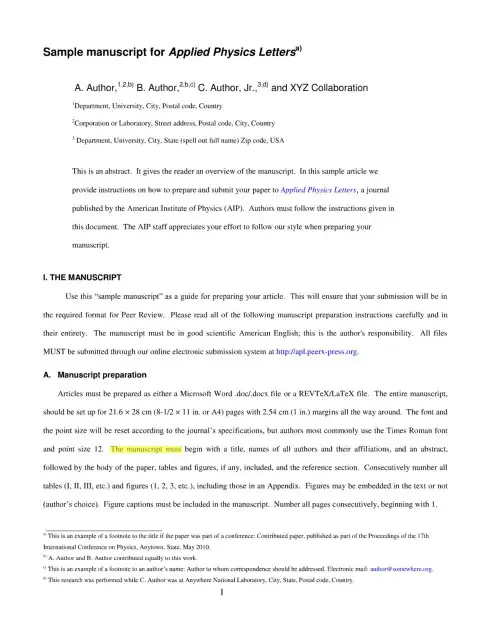

APPLIED PHYSICS LETTERSAPL作为应用物理最高期刊出版周期Weekly期刊主页网址: /在线投稿网址: /cgi-bin/main.plex投过一篇,发现被直接拒稿。
后来才想明白,原来投稿系统中可能有个功能,看看有没有引用APL的文献,如果没有,那就直接被拒了。
编辑发给我的信中,也直接这样写了,说还是投到你引用的期刊上发表吧。
科研不知APL,投遍论文也枉然!实验室的老师和师兄师姐们论文投稿的第一选择都是APL,录了很多篇了,自己做了一个小东西,有点创意,但和拼指标的论文相比,相距甚远!在老师的鼓励下,写了份详细的稿件,老师看后,提出三点,也就是APL的精髓:A代表应用背景扩展,P代表物理模型解析,L代表新颖性和创新性。
论文的重中之重要先L,再P,最后A!自己在这样的思路指导下,坚决执行L-P-A顺序对论文开始重新组织:L是老师给指出来;P的话,花了很长时间,大概一个多月,读了30多篇相关文章,模型根基才算打牢;和老师商量了A,再把图片一个个的清晰化(很关键),前后2个月,完成文章!投出去后,赶上圣诞节,到大年初二,意见回来:Reviewer #1 (Comments to the Author):This is a useful contribution to the field. It should be published "as is".这是个比较快的杂志,收和拒都很快的,如果你做的比较有新意,可以选择投稿,去年投了一篇,修了两次接受大概用了3各月,今年投了两篇,一篇投稿四天后直接接受(这个有一定运气成分,但这篇文章准备了一年半,之前修改的比较多了)一共投稿五次,中了两篇,一篇送审。
文章要有很新的物理思想,倘若结果不好,就要看论文通篇的写法。
最近几年,稿件的标准有所提高,最通常的原因往往是因为稿件缺乏深刻的物理内涵。
所以最适合投稿APL的工作是,有足够的创新性,并且通过深入谈论,得出非常明了、直接的结论。

a 类期刊发表要求A 类期刊发表要求。
在学术界,期刊的等级分为 A、B、C 等不同级别,A 类期刊是最高级别的期刊,发表在 A 类期刊上的论文通常具有较高的学术价值和影响力。
因此,很多学者都希望自己的研究成果能够在 A 类期刊上发表。
但是,A 类期刊的发表要求也相对较高,需要作者在论文内容、研究方法、数据分析、结论推断等方面做到严谨、科学、全面,才有可能通过期刊的审稿和评审。
首先,A 类期刊对论文的学术质量有着严格的要求。
论文应该具有较高的原创性和创新性,能够为学术界提供新的观点、新的研究方法或者新的研究成果。
此外,论文的论证过程应该严密,数据应该充分可靠,结论应该具有较高的说服力。
在撰写论文时,作者需要对相关领域的文献进行充分的调研和分析,确保自己的研究能够站在前人的肩膀上,有所创新和突破。
其次,A 类期刊对论文的语言表达和结构要求也非常高。
论文应该采用准确、简练的语言,避免出现语法错误、表达不清晰的问题。
同时,论文的结构应该合理,层次清晰,逻辑严密,能够使读者能够迅速理解作者的观点和论证过程。
在写作过程中,作者需要对论文的框架和结构进行仔细的规划和设计,确保论文内容的有机衔接,不出现逻辑跳跃或者信息重复的情况。
此外,A 类期刊对论文的图表要求也相对较高。
图表应该清晰、美观、具有较高的信息量,能够有效地辅助论文的论证和说明。
作者在设计图表时,需要注意图表的比例、标注、标题等细节,确保图表的质量能够满足期刊的要求。
最后,A 类期刊对论文的学术伦理要求也非常严格。
作者需要严格遵守学术规范,不得有抄袭、剽窃、造假等行为。
同时,作者需要在论文中明确引用他人的观点和成果,尊重知识产权,不得侵犯他人的学术权益。
综上所述,A 类期刊发表要求非常严格,需要作者在学术研究和论文写作方面具有较高的水平和素养。
只有通过不懈的努力和精益求精的态度,才有可能在 A 类期刊上发表优质的论文。
希望广大学者能够认真对待自己的研究和写作,努力提升学术水平,为学术界的发展贡献自己的力量。
a类期刊发表要求在学术界,期刊发表是评价一个学者研究水平和学术成就的重要标准之一。
而要在A类期刊上发表文章,则需要具备一定的学术水平和严谨的研究态度。
下面将从撰写A类期刊发表要求的角度,谈谈如何提高自己的学术水平和写作能力。
首先,要在A类期刊上发表文章,学者需要具备扎实的学术基础和丰富的研究经验。
这就要求学者在平时要多参加学术讨论、研讨会等活动,不断提升自己的学术造诣和研究能力。
同时,要善于总结自己的研究成果,形成系统的学术观点和理论框架,这样才能在A类期刊上发表有深度和广度的研究成果。
其次,A类期刊对于论文的要求非常严格,不仅要求研究成果具有创新性和前瞻性,还要求文章的撰写要符合学术规范和要求。
因此,学者在写作时要注重论文的结构和逻辑,要求文章的思路清晰,论证严谨,数据可靠,图表清晰,语言精准。
只有这样才能提高文章的质量,增加发表的可能性。
此外,学者还需要不断提高自己的写作能力,善于表达自己的观点和研究成果。
在写作过程中,要注重语言的精炼和准确性,避免出现语法错误和表达不清晰的情况。
同时,要注重文献的引用和参考,避免出现抄袭和剽窃的情况,保持学术诚信。
最后,要在A类期刊上发表文章,学者需要具备良好的学术素养和团队合作精神。
在研究过程中,要善于倾听他人的意见和建议,虚心学习,不断完善自己的研究成果。
同时,要注重团队合作,与同行学者进行交流和合作,共同提高研究水平,促进学术交流和学科发展。
综上所述,要在A类期刊上发表文章,学者需要具备扎实的学术基础和丰富的研究经验,注重论文的结构和逻辑,不断提高写作能力,保持学术诚信,具备良好的学术素养和团队合作精神。
只有不断提升自己的学术水平和写作能力,才能在A 类期刊上发表优质的研究成果,为学术界的发展贡献自己的力量。
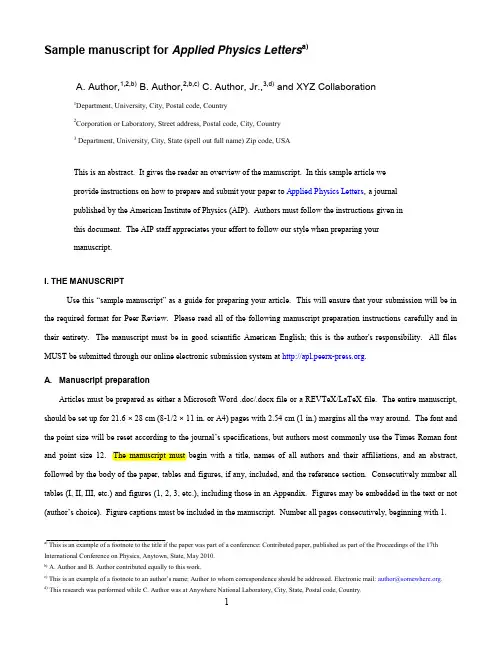
Sample manuscript for Applied Physics Letters a)A. Author,1,2,b)B. Author,2,b,c)C. Author, Jr.,3,d) and XYZ Collaboration1Department, University, City, Postal code, Country2Corporation or Laboratory, Street address, Postal code, City, Country3 Department, University, City, State (spell out full name) Zip code, USAThis is an abstract. It gives the reader an overview of the manuscript. In this sample article weprovide instructions on how to prepare and submit your paper to Applied Physics Letters, a journalpublished by the American Institute of Physics (AIP). Authors must follow the instructions given inthis document. The AIP staff appreciates your effort to follow our style when preparing yourmanuscript.I. THE MANUSCRIPTU se this “sample manuscript” as a guide for preparing your article. This will ensure that your submission will be in the required format for Peer Review. Please read all of the following manuscript preparation instructions carefully and in their entirety. The manuscript must be in good scientific American English; this is the author's responsibility. All files MUST be submitted through our online electronic submission system at .A. Manuscript preparationArticles must be prepared as either a Microsoft Word .doc/.docx file or a REVTeX/LaTeX file. The entire manuscript, should be set up for 21.6 × 28 cm (8-1/2 × 11 in. or A4) pages with 2.54 cm (1 in.) margins all the way around. The font and the point size will be reset according to the journal’s spec ifications, but authors most commonly use the Times Roman font and point size 12. The manuscript must begin with a title, names of all authors and their affiliations, and an abstract, followed by the body of the paper, tables and figures, if any, included, and the reference section. Consecutively number all tables (I, II, III, etc.) and figures (1, 2, 3, etc.), including those in an Appendix. Figures may be embedded in the text or not (author’s choice). Figure captions must be included in the manuscript. Number all pages consecutively, beginning with 1._____________________________a) This is an example of a footnote to the title if the paper was part of a conference: Contributed paper, published as part of the Proceedings of the 17th International Conference on Physics, Anytown, State, May 2010.b) A. Author and B. Author contributed equally to this work.c) This is an example of a footnote to an autho r’s name: Author to whom correspondence should be addressed. Electronic mail: author@.d) This research was performed while C. Author was at Anywhere National Laboratory, City, State, Postal code, Country.B. Manuscript submissionAll files MUST be submitted through the online system . Each version of the manuscript (the original and subsequent revisions) should be submitted with its own complete set of files: a cover letter (indicating the title, authors, and contact information), a complete article file, and separate figure files (see Sec. VIII―FIGURES). When uploading a revised manuscript, also include a response/rebuttal letter (indicating the changes made to address the Ed itor’s and Reviewers’ comments).II. MANUSCRIPT LENGTHManuscripts should not exceed 3500 words (approximately four printed journal pages). Abstract, title, author list, references and acknowledgements are all excluded from the length limit of 3500 words. Figures, tables and equations however are included and must be accounted for. Circumvention of the length limitation by division of a long article into small parts is considered to be contrary to the purpose of this journal. Please use the guidelines for Estimating Length included in the Information for Contributors.III. TITLEMake the title as concise as possible but informative enough to facilitate information retrieval. Only the most common acronyms and abbreviations are allowed in the title. Use acronyms with considerable moderation and always define at first use.IV. ABSTRACTLimit the abstract to less than 100 words. It must be self-contained (contain no footnotes or citations to references), adequate as an index (giving all subjects, major and minor, about which new information is given), and a concise summary (giving the conclusions and all results of general interest in the article). The abstract must be one paragraph and should not contain displayed mathematical equations or tabular material. AIP journals do not require PACs numbers.V. AUTHORS’ NAMES AND ADDRESSESAuthors’ names s hould preferably be written in a standard form for all publications to facilitate indexing and to avoid ambiguities. Include the names and postal addresses of all institutions, followed by city, state, zip code, and USA if in the United States or by postal code, city, and country if not in the U.S. Please provide complete addresses. See the byline for this sample article for examples.Authors with Chinese, Japanese, or Korean names may choose to have their names published in their own language alongside the English versions of their names in the author list of their publications. For Chinese, authors may use eitherSimplified or Traditional characters. Chinese, Japanese, or Korean characters must be included within the author list of the manuscript when submitting or resubmitting. The manuscript must be prepared using Microsoft Word or using the CJK LaTeX package. Specific guidelines for each authoring tool are given at /pubservs/cjk_instructions.html . VI. FOOTNOTESFootnotes are generally unacceptable in AIP journals, with the exception of footnotes to the title or authors. All other information should be included in the reference section. Use a), b), c), etc., for footnotes to the title or authors. The following list shows some examples:a) Contributed paper, published as part of the Proceedings of the 17th International Conference on Physics, Anytown, State, May, 2010. (footnote to title) b) A. Author and B. Author contributed equally to this work. c) Author to whom correspondence should be addressed. Electronic mail: author@.d)This research was performed while C. Author was at Anywhere National Laboratory, City, State, Postal code, Country. VII. EQUATIONSEquations should be punctuated and aligned to bring out their structure, and numbered on the right. Mathematical operation signs indicating continuity of the expression should be placed at the left of the second and succeeding lines. Use (×) rather than a centered dot for multiplication, except for scalar products of vectors. Use a solidus (/) instead of built-up fractions in running text, and in display wherever clarity would not be jeopardized. Use “exp” for complicated exponents. 1212i i i i N B B B B N , (1)21cos 2sin 2.2D n a I nn (2)Please note that you must use MathType or the Microsoft ® Equation Editor 3.0. Use of Microsoft ® Math Editor is not recommended.VIII. ACRONYMS AND NOTATIONAcronyms, except for the most common (such as 2D, rms, or ac) must be spelled out when they first appear both in the abstract and again in the text. Spell out machine names, except for those not considered acronyms (such as ITER or DIII-D). Try to avoid the excessive use of acronyms or specialized jargon.FIG. 1. (Color) This figure will appear in color in print and online. Figures should be created at 300 dpi and submitted at 300 dpi for the best presentation. Choose CMYK (cyan, magenta, yellow, black) for any figure that will appear in color in the print version.FIG. 2. (Color online) This figure will appear in color only in the online version only, not in the printed version. Figures should be created at 300 dpi and submitted at 300 dpi for the best presentation. Choose RGB (red, green, blue) for any figure that will appear in color only online.FIG. 3. This is a good example of information that was presented clearly. When this figure appeared in the printed journal it was in black and white print, but the reader was able to discern the “red” triangles, the closed “green” circles, and the open “black” circles. A description as well as the color is needed. If the caption had simply discussed “the red and green symbols,” the reader of the print version would not understand because he/she would be seeing the figure without the color.FIG. 4. This is an example of line art. Figures should be created at 600 dpi and submitted at 600 dpi for the best presentation. Save line art as black/white bitmap, not grayscale..FIG. 5. This is an example of a halftone. Figures should be created at 300 dpi and submitted at 300 dpi for the best presentation.FIG. 6.This is an example of a combination figure (line art and halftone). Figures should be created at 600 dpi and submitted at 600 dpi for the best presentation.TABLE I.This table provides instructions on how to prepare figures.(a) General guidelines for preparing illustrationsNumber figures in the order in which they appear in the text.Label all figure parts with (a), (b), etc. Each figure file should contain all parts of the figure. For example, if Fig.1 contains three parts [(a), (b), and (c)], then all parts should be combined in a single file for Fig. 1.Avoid any large disparity in size of lettering and labels used within one illustration.Prepare illustrations in the final published size, not oversized. The maximum published width for a one-column illustration is 8.5 cm (3-3/8 in.). The maximum width for a two-column figure is 17 cm (7.0 in.).In cases where reduction is required, avoid small open symbols that tend to fill in and avoid small lettering; ensure that, in the final published illustration, there is a minimum of 8-point type size (2.8 mm high; 1/8 in. high) for lettering and 0.5-point width for lines.Ensure that lettering and lines are dark enough, and thick enough, to reproduce clearly. Remember that fine lines tend to disappear upon reduction.It is preferred that authors embed figures and captions in the manuscript file. Embed the figures in the approximate position and size you think is appropriate. In addition, separate figure files must be provided (see below for accepted file formats) along with the manuscript.(b) Guidelines for preparation of electronic graphics filesAcceptable formats for figures: Portable Document Files (PDF), Encapsulated PostScript Files (EPS), PostScript, or Tagged Image File format (TIF). EPS (using Arial or Times Roman fonts) is preferred graphic format when preparing illustrations. Microsoft Word (.doc or .docx) or JPEG (.jpg) files are NOT acceptable.More detailed information is given about figure preparation on the RSI website in the Information for Contributors tab.Settings: Set the graphic for 600 dpi resolution for line art, 300 dpi for halftones, and 600 dpi for combinations (line art + halftone).Save line art as black/white bitmap, not grayscale.Save halftones and combinations as grayscale, not black/white bitmap.Click here for publication charge information.Submit color files at 300 dpi in one of the accepted file formats: PDF, EPS, PS, or TIF. EPS (using Arial or Times Roman fonts) is preferred graphic format when preparing illustrations. No other type of color illustration is acceptable. When selecting a file mode, for print choose CMYK (cyan, magenta, yellow, black) and for color online choose RGB (red, green, blue).PDF files should be vector files.In the PDF illustration, resolution of any shaded or photographic images must be 600 pixels per inch (PPI).Within the PDF illustration, resolution of line art with no shading should be 1200 pixels per inch (PPI).All fonts must be embedded in the PDF.Select "High Quality Print" when creating a PDF through the application’s print command.If usable color graphics files are received in time for the production process, authors will see color versions of those illustrations when viewing their author proofs. (The Corresponding Author will receive e-mail notification from AIP when the proof, as a PDF file, is available for downloading.)The author is responsible for obtaining permissions to reuse previously published material. Full credit lines are needed for figures that are used with permission. An example of the recommended format for crediting material from a journal article is: “Reprinted with permission from [FULL CITATION]. Copyright [PUBLICATION YEAR], American Institute of Ph ysics.” Full citation format is as follows: Author names, journal title, Vol. #, Issue #, Page # (or CID#), Year of publication. For example, the credit line would appear as: “Reprinted with permission from J. Chem. Phys. 128, 024365 (2008). Copyright 2008American Institute of Physics. If you need help acquiring permissions from another publisher, use this form [CLICK HERE].XI. TABLESSeparate tables (numbered with Roman numerals in the order of their appearance in the text) should be used for all tabular material. Tables must be embedded in the article file, not uploaded like figure files. The structure should be clear. Use simple column headings and include units of measure. Table captions are positioned above the table and should be styled as “TABLE I. This is a table caption.” A caption should make its table intelligible without reference to the text. Capitalize th e first word in the table headings and subheadings. References within tables are designated by lowercase Roman letter superscripts and given at the end of the table. Unaltered computer output and notation should be uploaded as supplemental files. See Table II for an example of correct table styling.TABLE II. Bond distances for alkene molecules (atomic units).No. C a RI,I+1b SRI,I+1c RI−1,I+RI,I+1SRI−1,I+RI,I+12 2.5255 ………4 2.6175 0.123 5.306 …6 2.6314 0.0999 5.3025 0.01128 2.6368 0.0876 5.3009 0.011110 2.6396 0.0795 5.2999 0.010614 2.6424 0.0689 5.2989 0.009618 2.6437 0.0623 5.2982 0.008822 2.6443 0.0573 5.2973 0.00826 2.6448 0.0536 5.2968 0.0074ab RI,I+1 is the distance between two neighboring carbon atoms, while ‹RI,I+1› is the averageof RI,I+1 for a given molecule.c SRI,I+1 is the standard deviation of RI,I+1 within the given molecule.XII. MULTIMEDIA SUBMISSIONSMultimedia files can be included in the online version of published papers. All such files are peer reviewed. When published, these files can be viewed by clicking on a link from the figure caption, provided that the reader has a video player installed, such as Windows Media PlayerTM, Quick Time PlayerTM, or RealOne PlayerTM. Please see Information for Contributors on our website. Click on Multimedia. Please note the following important information when preparing your manuscript:Treat all multimedia files as figures, numbered in sequence as they are referred to in text. (Multimedia files will not have a numbering scheme separate from the figures.) For each multimedia file, provide a figure, which is a staticrepresentation of the multimedia file. Also provide an accompanying caption. At the end of the caption, include the phrase "(enhanced online)."All multimedia files must be cited in the text, referred to by their figure number.XIII. SUPPLEMENTAL MATERIALText material that may not be of interest to all readers, long data tables, multimedia, and computer programs may be deposited as supplementary materials. Information about depositing supplemental material may be found at the journal’s Information for Contributors section on the website.ACKNOWLEDGMENTSTypically, standard acknowledgments include financial support and technical assistance, and may include dedications, memorials, and awards. Check with the Editorial Office for suitability of an acknowledgment if there is any question. To indicate the author, use initials. For example, “B.A. wishes to thank A. Loudon for technical assistance. C.A. wishes to thank Anytown University for use of th eir equipment.” Note: the Acknowledgment section is not a numbered section. APPENDIXAppendices are placed after the acknowledgments section and before the listing of references. Appendices must have a Level One heading as illustrated below. They do not follow the sequential heading numbering given in the rest of the paper. If there is only one appendix, then the heading is set as follows:APPENDIXIf there is more than one appendix, the headings are set as:APPENDIX A: DESCRIPTIONAPPENDIX B: DESCRIPTIONSubheadings in an Appendix are labeled 1, 2, etc.REFERENCESReferences must be numbered consecutively in order of first appearance in the text and should be listed at the end of the text material. Reference citations in text are rendered in several ways. For example:Voitsenya et al.4Kawa and Lin8MOLPRO (Ref. 10)The citation in the reference list must include the full list of authors. Do not list the first author followed by an abbreviation such as et al. See Table III for acceptable reference formats.TABLE III.This table provides instructions on how to prepare references.Articles “submitted to” or “accepted for publication” (but not yet published) in a journal: When possible, these references should be updated in the galley proof.1K. Park, A. Marchenkov, Z. M. M. Zhang, and W. P. King, J. Appl. Phys. 101, 094504 (2007). Books: List authors and editors. Must include publisher, city and year of publication, and the page numbers (unless the entire book is being cited).2R. J. Hunter, Zeta Potential in Colloid Science (Academic, New York, 1981), p.120.AIAA Papers:The usual format is: Authors’ names, Paper Title, AIAA Paper No. (usual formats are 99-1111 or 2004-2222), year (corresponds to numbers on left side of paper number).3M.S. Narayan and A. Banaszuk, “Experimental study of a novel active separation control approach,” AIAA Paper No. 2003-0060, 2003.Conference proceedings: Include the list of authors, the title of the proceedings, the city and year of the conference, the name of the publisher (cannot be a laboratory or institution), city and year of publication (or the words “to be published”), and the page numbers. Inclu de the full list of editors, if they are given.4R. K. Ahrenkiel, in Gallium Arsenide and Related Compounds 1993: Proceedings of the 20th International Symposium on Gallium Arsenide and Related Compounds, Freiburg, Germany, 29 August–2 September 1993, edited by H. S. Rupprecht and G. Weimann (Institute of Physics, London, 1994), pp. 685–690.Government publications:Format as for a book citation. Each must include the author(s), title of the publication, name of the publisher, city and year of publication, and page numbers (unless the entire publication is being cited).5D. Nunes, The Brillouin Effect (U.S. Department of Energy, Washington, DC, 1992).Journal citations: Include authors (see author rule above), volume number, beginning page number, and publication year:6J. D. Kiely and J. E. Houston, Phys. Rev. B 57, 12588 (1998).Laboratory report: May only be used if first deposited with a national depository such as the National Technical Information Service. (Check with the NTIS librarian at 703-605-6000.) Materials or reports in electronic form—codes, data tables,etc.—may be uploaded as supplemental material files (see Sec. XIII). If the paper is on deposit with NTIS, use the following format:7See National Technical Information Service Document No. DE132450 L. (R. Newchuck, SESAME Tables, LANL Rep. 23453, 1983). Copies may be ordered from the National Technical Information Service, Springfield, VA 22161.Multiple citations are acceptable:8D.-Y. Choi, S. Madden, A. Rode, R. Wang, and B. Luther-Davies, J. Non-Cryst. Solids 354, 3179 (2008); J. Appl. Phys. 104, 113305 (2008).(same authors, different journals)or9J.Scaroni and T. Mckee, Solid State Technol. 40, 245 (1997); M. G. Lawrence, Bull. Am.Meteorol. Soc. 86, 225 (2005).(two completely different references)or10Y. de Carlan, A. Alamo, M. H. Mathon, G. Geoffroy, and A. Castaing, J. Nucl. Mater. 283–287, 762 (2000); M. H. Mathon, Y. de Carlan, G. Geoffroy, X. Averty, A. Alamo, and C. H. de Novion, ibid. 312, 236 (2003).(different authors, same journal and volume number)MOLPRO:11H.-J. Werner, P. J. Knowles, R. Lindh, F. R. Manby, M. Schütz, et al., Molpro, version2006.1, a package of ab initio programs, 2006, see .Preprints and electronic postings:Preprints or eprints that have not been submitted to a journal for publication (i.e., are only posted on a preprint server) cannot be used as references.Private communication:May not be one of the authors of the article. Must include the year in which the communication took place.12A. Einstein (private communication, 1954).References as footnotes: Footnotes are not permitted within the main text. Each should be numbered and described in the reference list.Software manuals: If published, use the book format; if not published, give the entire address for the software maker.Thesis/dissertation: Include the author, school and year, but not the title.13S. L. Goldschmidt, Ph.D. thesis, University of California, Los Angeles, 1985.Web sites: Due to their perishable nature, web sites are not generally acceptable as references unless the site is maintained as an archival site. It is permissible to include web sites as adjuncts to acceptable references.11。