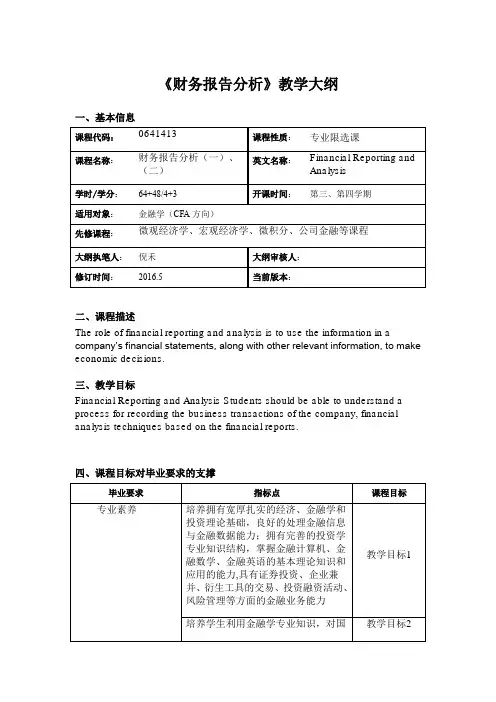
《财务报告分析》教学大纲一、基本信息二、课程描述The role of financial reporting and analysis is to use the information in a company’s financial statements, along with other relevant information, to make economic decisions.三、教学目标Financial Reporting and Analysis Students should be able to understand a process for recording the business transactions of the company, financial analysis techniques based on the financial reports.四、课程目标对毕业要求的支撑五、教学内容第1章Financial Statement Analysis: An Introduction (支撑课程目标1)1.Describe the roles of financial reporting and financial statementanalysis;2.Describe the objective of audits of financial statements, the types ofaudit reports, and the importance of effective internal controls3.Identify and describe information sources that analysts use in financialstatement analysis besides annual financial statements andsupplementary information;4.Describe the steps in the financial statement analysis framework.第2章Financial reporting mechanics (支撑课程目标2,3,5,6)1.Explain the relationship of financial statement elements and accounts,and classify accounts into the financial statement elements;2.Explain the accounting equation in its basic and expanded forms;3.Describe the process of recording business transactions using anaccounting system based on the accounting equation;4.Describe the need for accruals and other adjustments in preparingfinancial statements;5.Describe the relationships among the income statement, balance sheet,statement of cash flows, and statement of owners equity;6.Describe the flow of information in an accounting system;第3章Financial reporting standards (支撑课程目标1,2,3,5,6)1.Describe roles and desirable attributes of financial reporting standardsetting bodies and regulatory authorities in establishing and enforcingreporting standards, and describe the role of the InternationalOrganization of Securities Commissions;2.Describe the International Accounting Standards Boards conceptualframework, including the objective and qualitative characteristics offinancial statements, required reporting elements, and constraints andassumptions in preparing financial statements;3.Describe general requirements for financial statements under IFRS;compare key concepts of financial reporting standards under IFRS andU.S. GAAP reporting systems;4.Identify characteristics of a coherent financial reporting framework andthe barriers to creating such a framework;5.Describe implications for financial analysis of differing financialreporting systems and the importance of monitoring developments infinancial reporting standards;6.Analyze company disclosures of significant accounting policies.第4章Understanding income statements (支撑课程目标1,3,5,6)1.Describe the components of the income statement and alternativepresentation formats of that statement;2.Describe general principles of revenue recognition and accrualaccounting, specific revenue recognition applications (includingaccounting for long-term contracts, installment sales, bartertransactions, gross and net reporting of revenue), and implications ofrevenue recognition principles for financial analysis;3.Describe general principles of expense recognition, specific expenserecognition applications, and implications of expense recognitionchoices for financial analysis;4.Describe how earnings per share is calculated and calculate andinterpret a company’s earnings per share (both basic and dilutedearnings per share) for both simple and complex capital structures;5.Evaluate a company’s financial performance using common-sizeincome statements and financial ratios based on the incomestatement;6.Describe other comprehensive income, and identify major types ofitems included in it.第5章Understanding balance sheets (支撑课程目标1,3,4,6)1.Describe uses and limitations of the balance sheet in financial analysis;2.Describe alternative formats of balance sheet presentation;3.Describe different types of assets and liabilities and the measurementbases of each;4.Convert balance sheets to common-size balance sheets and interpretcommon-size balance sheets;5.Calculate and interpret liquidity and solvency ratios.第6章Understanding cash flow statements (支撑课程目标1,2,3,4)pare cash flows from operating, investing, and financing activitiesand classify cash flow items as relating to one of those threecategories given a description of the items;2.Describe how non-cash investing and financing activities are reported;3.Contrast cash flow statements prepared under International FinancialReporting Standards (IFRS) and U.S. generally accepted accounting principles (U.S. GAAP);4.Describe the steps in the preparation of direct and indirect cash flowstatements, including how cash flows can be computed using income statement and balance sheet data;5.Analyze and interpret both reported and common-size cash flowstatements;6.Calculate and interpret free cash flow to the firm, free cash flow toequity, and performance and coverage cash flow ratios.第7章Inventories (支撑课程目标2,3,4,5)1.Distinguish between costs included in inventories and costs recognizedas expenses in the period in which they are incurred;2.Describe different inventory valuation methods (cost formulas);3.Calculate cost of sales and ending inventory using different inventoryvaluation methods and explain the effect of the inventory valuationmethod choice on gross profit;4.Calculate and compare cost of sales, gross profit, and ending inventoryusing perpetual and periodic inventory systems; compare cost of sales, ending inventory, and gross profit using different inventory valuationmethods;5.Calculate and explain how inflation and deflation of inventory costsaffect the financial statements and ratios of companies that usedifferent inventory valuation methods;6.Convert a company’s reported financial statements from LIFO to FIFOfor purposes of comparison;7.Analyze and compare the financial statements and ratios of companies,including those that use different inventory valuation methods;8.Explain issues that analysts should consider when examining acompany’s inventory disclosures and other sources of information.第8章Long-lived assets (支撑课程目标2,3,5)1.Distinguish between costs that are capitalized and costs that areexpensed in the period in which they are incurred;pare the financial reporting of the following types of intangibleassets: purchased, internally developed, acquired in a businesscombination;3.Describe the different amortization methods for intangible assets withfinite lives, the effect of the choice of amortization method on thefinancial statements, and the effects of assumptions concerning useful life and residual value on amortization expense;4.Calculate amortization expense;5.Describe the revaluation model;6.Explain the impairment of property, plant, and equipment and intangibleassets;7.Explain the derecognition of property, plant, and equipment andintangible assets;8.Describe the financial statement presentation of and disclosuresrelating to property, plant, and equipment and intangible assets.第9章Income taxes (支撑课程目标2,3,6)1.Describe the differences between accounting profit and taxable income,and define key terms, including deferred tax assets, deferred taxliabilities, valuation allowance, taxes payable, and income taxexpense;2.Explain how deferred tax liabilities and assets are created and thefactors that determine how a company’s deferred tax liabilities andassets should be treated for the purposes of financial analysis;3.Calculate the tax base of a company’s assets and liabilities;4.Calculate income tax expense, income taxes payable, deferred taxassets, and deferred tax liabilities, and calculate and interpret theadjustment to the financial statements related to a change in theincome tax rate;5.Evaluate the impact of tax rate changes on a company’s financialstatements and ratios;6.distinguish between temporary and permanent differences in pre- taxaccounting in- come and taxable income;7.Describe the valuation allowance for deferred tax assets, when it isrequired and what impact it has on financial statements;8.Analyze disclosures relating to deferred tax items and the effective taxrate reconciliation, and explain how information included in thesedisclosures affects a company’s financial statements and financialratios;9.Identify the key provisions of and differences between income taxaccounting under IFRS and U.S. GAAP.第10章Non-current (long-term) liabilities (支撑课程目标2,4,5,6)1.Determine the initial recognition, initial measurement and subsequentmeasurement of bonds;2.Describe the effective interest method and calculate interest expense,amortization of bond discounts/premiums, and interest payments;3.Explain the derecognition of debt;4.Describe the role of debt covenants in protecting creditors;5.Describe the financial statement presentation of and disclosuresrelating to debt.第11章Evaluating quality of financial reports (支撑课程目标2,4,5,6)1.Demonstrate the use of a conceptual framework for assessing thequality of a company’s financial reports;2.Explain potential problems that affect the quality of financial reports;3.Describe how to evaluate the quality of a company’s financial reports;4.Evaluate the quality of a company’s financial reports;5.Describe the concept of sustainable (persistent) earnings.六、教学安排该课程累计共64+48=112学时为课堂授课教学时间。