状语从句详解
- 格式:doc
- 大小:79.00 KB
- 文档页数:11
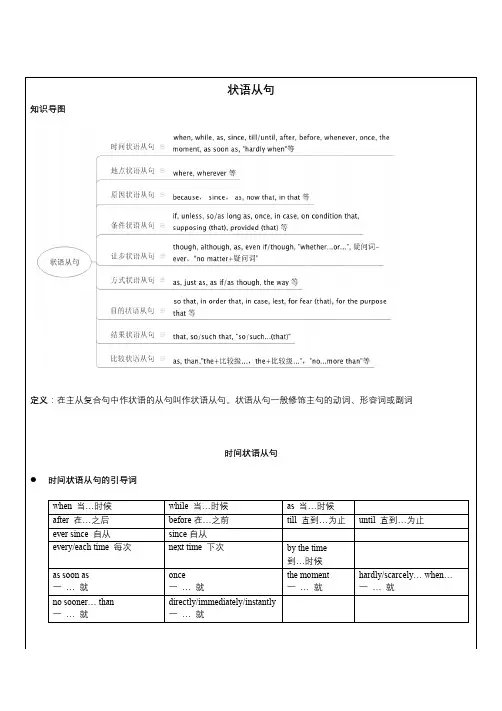
结构图
概述
时间状语从句的用法:1、2、3、4、5、6、7
状语从句 地点状语从句的用法:
原因状语从句的用法:1、2、3、4
条件状语从句的用法:1、2
用法 方式状语从句的用法:
让步状语从句的用法:1、2、3
目的状语从句的用法:
结果状语从句的用法:1、2、3
比较状语从句的用法:1、2、3、4、5、6
一、概述:
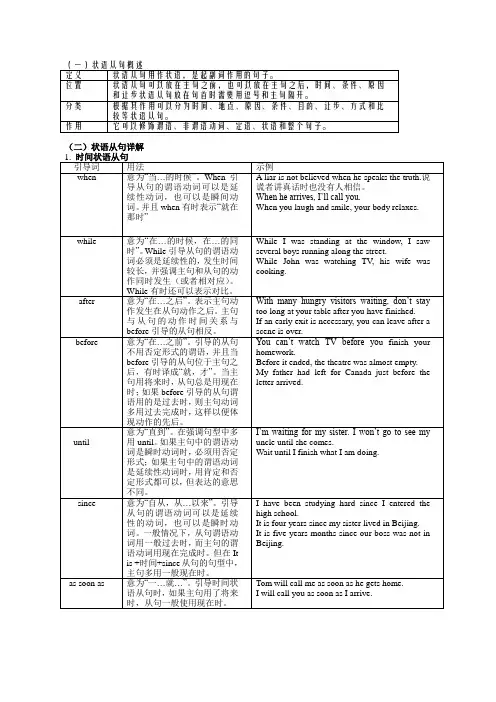
状语从句修饰主句中的动词、形容词、副词等,在复合句中作状语。引导状语从句的关联词是从属连词。状语从句用陈述句语序,一般位于复合句的句首或句末。当从句放在主句前面时,常用逗号与主句隔开。状语从句根据其在句中的不同作用可以分为时间、地点、原因、目的、结果、条件、让步、方式和比较状语从句九种。
状语从句类别 从属连词
时间 when,whenever,while,as,since,ever since,before,after,once,as soon
as,soon after,till/until,hardly(scarcely)…when,no sooner…than, each
time,every time,by the time,the moment/minute/time/day/week…),
地点 where,wherever,anywhere,everywhere
原因 because,as,since,now that,considering that,seeing that
条件 if,unless,as/so long as,as/so far as,on condition that,whether(…or not),once,in case(如果),suppose that
让步 though,although,even if,even though,as,however,whatever,whenever,wherever,whoever,whether...or,no matter who/what/which/where/how
方式 as,as if,as though 目的 so…that,in order that,for fear that,in case(以防,以免)
结果/程度 so/such that,so/such…that,that,with the result that
比较 as…as,not as/so…as,than
二、用法:
(一)时间状语从句的用法:
1、注意点:
⑴在时间、条件状语从句中,谓语动词一般不用将来时态表示将来,而用一般现在时态代替将来时态,用一般过去时态代替过去将来时态,用现在完成时态代替将来完成时态。如:
When he comes here,I will let you know. When I have finished reading the book,I will tell
you.
⑵if可以引导条件状语从句和宾语从句,引导条件状语从句时,意为“如果,假如”,引导宾语从句时,意为“是否”。如:
If he has any questions,he will come to ask me. Tell me if you will go to school tomorrow.
⑶时间、条件、方式、让步等状语从句常常可以转换成省略形式或简单句句子成分。
①when,while,as,if,though,as if等引导时间、条件、方式、让步等状语从句时,若从句和主句的主语一致或主句的主语是it且含有be动词时,可以将从句中的主语连同后面的be动词一起省略。如:
As(he is)a child,he began to learn English. If(he was)alive,he must be at least
ninety years old. Although(she was)told to stop,she kept on working. The boy looked
as if(he were)afraid of nothing. If(it is)possible,I will come to see you.
②since,before,after引导的状语从句有时可以变成介词短语或分词短语。如:
They had not met any more since leaving(=since they left)school. Having finished(After
he had finished)middle school,she entered Beijing University.
③原因状语从句如果主从句主语一致,也可以将从句省略为分词短语,介词短语或独立结构。如:
Being(=As he is)the oldest,Bill looks after his little sisters. Because of smoking(=Because
he smokes)too much,Linda doesn’t look healthy. ④so that,in order that引导的目的状语从句,若主从句主语一致,可以用动词不定式短语so as to或in order to代替。如:
I left early so as to(=so that I could)catch the first bus.
⑤so that,so…that引导的结果或程度状语从句如果主从句主语一致,可以用“enough +
不定式”或“too…to”结构代替。如:
Tom studied hard enough to pass(=Tom studied hard so that he passed)the examination. She
was too tired to(so tired that she couldn't)go any farther.
⑥if引导的条件状语从句,常可省去从句中的主语和系动词,转换为介词短语、不定式短语、分词短语或独立结构。如:
If(it is)possible,I will help you. With her help(=If I had help from her),I could do the
experiment.
⑦as,than引导的比较状语从句中,与主句相同的部分可以省略。如:
He is a head taller than I(am tall).
2、when,while,as(均表示“当……的时候”)引导时间状语从句的异同:
when引导的时间状语从句中的谓语动词既可以是延续性动词,也可以是瞬时性动词,从句的动作可以和主句动作同时发生,也可以先于主句的动作发生;while引导的时间状语从句的谓语动词必须是延续性动词,强调主从句谓语动词所表示的动作或状态是同时发生或存在的;as引导时间状语从句时,主从句的谓语动作同时发生,也可以用来说明两种正在发展和变化的情况,从句的谓语动词一般应具有延续性。如:
When I came here,I found him lying on the ground. While/When I was reading,I saw a
bird. As I was getting on the bus,someone called me.
注意:⑴when引导的从句是系表结构且主从句主语一致时,可以用as引导的省略句来代替。如:
As(=When he was)a young man,he went to France for French.
⑵when/while引导的时间状语从句,如果主从句主语一致时,可以用“when/while + 现在分词”结构表示时间状语。如:While(=While he was)taking a walk in the street,he saw an
accident.
⑶when有时连接两个并列分句,起并列连词的作用,意为and then或at that time,表示某一动作正在进行或即将发生而突然出现的情况。如:Lin Tao and Lily were walking around
the school corner when the traffic accident happened. 3、before,after引导的时间状语从句的用法:
before,after引导时间状语从句,表示“在......以前/以后”。常用before的句型是:It be(not)+ 时间 + before + 从句。如:
It will be years before we meet again. 再过多年我们才会见面。 It will not be long
before we meet again. 过不了多久我们还会再见面的.
4、as soon as,no sooner…than…,hardly/barely/scarcely…when…,immediately,directly,instantly,once(均表示“一……就……”)引导时间状语从句的异同:
⑴as soon as引导时间状语从句,表示主从句动作相继发生。如:As soon as she heard the
news,she came to tell us about it.
⑵no sooner…than…,hardly/barely/scarcely…when…结构中,主句一般要用过去完成时态,从句用一般过去时态;如果no sooner或hardly/barely/scarcely放在句首时,从句要用倒装语序。如:He had no sooner seen the policeman than he ran away.=No sooner had he seen the
policeman than he ran away. She had hardly sat down when the telephone rang.=Hardly had