Against的详细用法总结
- 格式:doc
- 大小:25.08 KB
- 文档页数:24
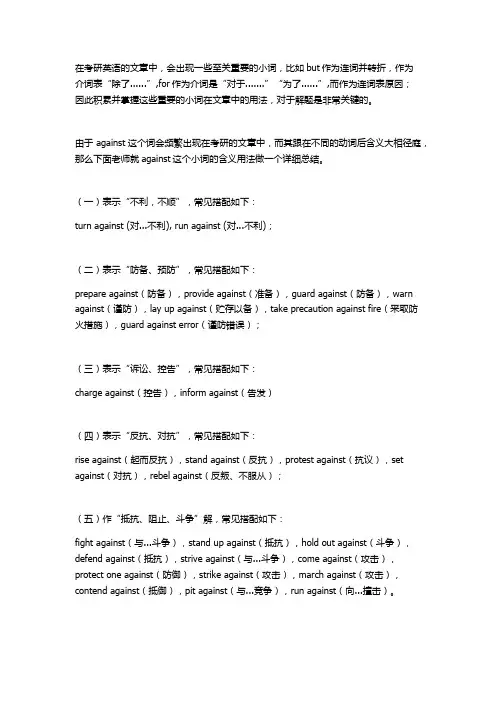
Against的详细用法总结今天给大家带来Against的用法,我们一起来学习吧,下面就和大家分享,来欣赏一下吧。
Against的用法Against:这个词是个介词1. “逆着,对着,顶着”They were rowing against the current.他们逆水划船。
The ship won’t strike against a rock.这首船不会触礁。
Heat is produced when work is done against friction.克服摩擦作攻时,产生热。
2. “反对,违反”This explanation is against the natural laws.这个解释是违反自然规律的。
There is a regulation against smoking in the office. 办公室禁烟。
Americans were against the proposal.美国人反对这项建议。
3. “靠着,相对”The photo hangs against the wall.这张照片挂在墙上。
Against the post office there stands a hospital.邮局对面是一家医院。
The shop is against the school.商店在学校对面。
4. “对照”3 against 23比2The trees were black against the morning sky.在早晨的天空的映照下,那些树是黑的。
The school has 100 students this year,as against the 80 last year.这所学校今年有100个学生,而去年只有80个学生。
5.“以防,以备”We store up vegetables against the winter.我们储备蔬菜以备冬用。
We must guard against disease.我们必须预防疾病。
Save money against a rainy day未雨绸缪熟练掌握against的词性与用法①.表示反对关系:a. I will speak against anything that I know to be wrong.b. Many of the students are against the plan.②.(表位置)靠着,顶着,迎着,衬着a. The piano stood against the wall.b. He could hear the rain pattering against the windows.c. The trees were black against the morning sky.d. He struck her head against the branch of a tree.③.预防,防备,准备…时用a. We are all taking medicine against the disease.b. They bought some warm clothes against the cold winter.c. We have to save some money against old age.④.表示对比关系a. He was elected by a majority of 20 votes against 10.⑤.词组或固定搭配:against one’s will违反自己的意愿; go against违反,不利于英语语法|史上最全的英语介词用法归纳总结!表示方位的介词:in, to, on1. in 表示在某地范围之内。
Shanghai is/lies in the east of China. 上海在中国的东部。
2. to 表示在某地范围之外。
Japan is/lies to the east of China. 日本位于中国的东面。
3. on 表示与某地相邻或接壤。
Mongolia is/lies on the north of China. 蒙古国位于中国北边。
表示计量的介词:at, for, by1. at 表示“以……速度”“以……价格”。
It flies at about 900 kilometers an hour. 它以每小时900公里的速度飞行。
I sold my car at a high price. 我以高价出售了我的汽车。
2. for 表示“用……交换,以……为代价”。
He sold his car for 500 dollars. 他以五百元把车卖了。
注意:at表示单价(price) ,for表示总钱数。
3. by 表示“以……计”,后跟度量单位。
They paid him by the month. 他们按月给他计酬。
Here eggs are sold by weight. 在这里鸡蛋是按重量卖的。
表示材料的介词:of, from, in1. of 成品仍可看出原料。
This box is made of paper. 这个盒子是纸做的。
2. from 成品已看不出原料。
Wine is made from grapes. 葡萄酒是葡萄酿成的。
3. in 表示用某种材料或语言。
Please fill in the form in pencil first. 请先用铅笔填写这个表格。
They talk in English. 他们用英语交谈。
表示工具或手段的介词:by, with, on1. by 用某种方式,多用于交通。
I went there by bus. 我坐公共汽车去那儿。
2. with表示“用某种工具”。
He broke the window with a stone. 他用石头把玻璃砸坏了。
注意:with表示用某种工具时,必须用冠词或物主代词。
3. on 表示“以……方式”,多用于固定词组。
They talked on the telephone. 他们通过电话进行交谈。
She learns English on the radio/on TV. 她通过收音机/电视学英语。
表示关于的介词:of, about, on1. of 仅是提到或谈到过某人或某事。
He spoke of the film the other day. 他前几天提到了这部影片。
2. about 指“关于”某人或某事物的较详细的情况。
Can you tell me something about yourself? 你能告诉我关于你自己的事情吗?3. on 指“关于”学术性的或严肃的事。
It’s a textbook on the history of china. 它是一本有关中国历史的教科书。
表原因或理由的介词:for, at, from, of, with, by, because of1. for 表示原因,与sorry, famous, punish, praise, thank, blame连用。
I am sorry for what I said to you. 我后悔不该对你讲那些话。
2. at 指情感变化的原因,意为“因听到或看到而……”。
He was surprised at the news. 听到这消息他大吃一惊。
3. from 指“外在的原因”,如受伤、车祸等。
He died from the wound. 他因受伤而致死。
4. of 指“内在的原因”,如病、饿等。
The old man died of hunger. 老人死于饥饿。
5. with 指生理上或情感上的由外界到内心的原因。
Hearing the news, he jumped with joy. 他们听到这个消息,欣喜若狂。
He was shaking with anger. 他气得浑身发抖。
6. by 表示外部的,尤其是暴力的或无意中造成某种结果的原因。
Her body was bent by age. 他因年老背弯了。
She took your umbrella by mistake. 我因弄错拿了你的雨伞。
7. because of 表示引起结果的直接原因。
He retired last month because of illness/because he ill.8. owing to 多表示引起某不良后果的原因。
Owing to the rain they could not come. 由于下雨他们没来。
9. thanks to 表示引起某种幸运结果的原因,常译为“幸亏……,多亏……”。
Thanks to John, we won the game. 多亏约翰,我们才赢了这场比赛。
10. out of 表示动机的起因,常译为“出于……”。
He asked the question out of curiosity. 他出于好奇才问了那个问题。
11. through 多表示因局部而影响全局的原因。
The war was lost through bad organization. 战争因组织不周而失败了。
表示好像或当作的介词:like, as1. like表示“像……一样”,其实不是。
Peter the Great, like his country, was strong and proud. 彼得大帝像他的国家一样强健和自豪。
2. as表示“作为,以……身份”,其实也是。
He talked to me as a father. 他以父亲的身份跟我谈话。
注:as作连词时,可表示“好像……”。
The work is not so difficult as you imagine. 这工作不像你想像的那么困难。
表示支持或反对的介词:against, foragainst 反对,for支持,互为反义词。
Are you for my idea or against it? 你赞同还是反对我的想法?表示除某人某物外的介词:besides, except1. besides是包括后面所提人或物在内的“除……外,还”。
Thirty students went to the cinema besides him. 除他以外,还有30个学生去看了电影(共计31人去)。
He is interested in tennis besides(=as well as)football.他对足球和网球都感兴趣。
2. except是指不包括后面所提人或物在内的“除去”。
Everyone is excited except me. 除我以外的每个人都很激动(我并不激动)。