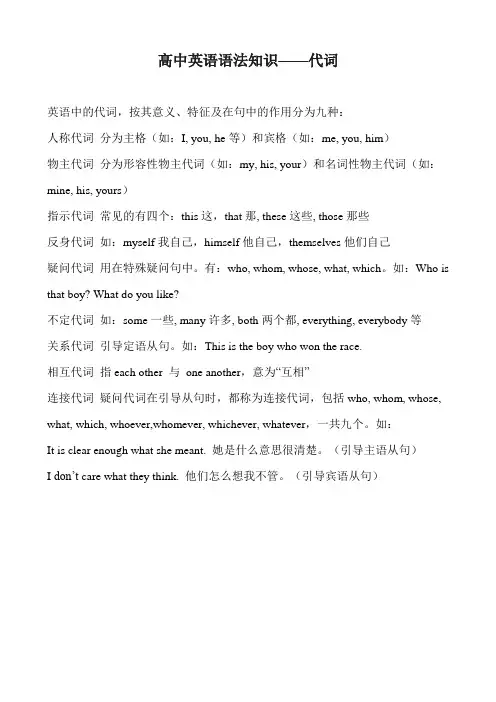
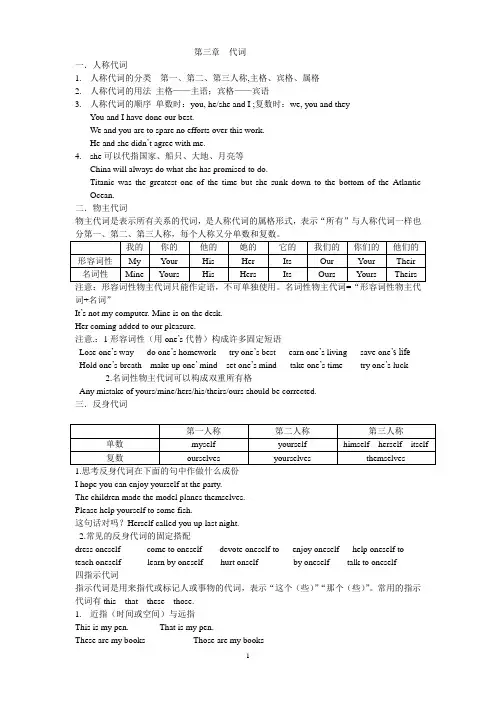
高中英语语法总结大全-代词(参考)
- 格式:docx
- 大小:29.01 KB
- 文档页数:23
第 1 页/共 23 页
高中英语语法总结大全-代词
高中英语语法总结大全之代词
人称代词的用法
1)人称代词的主格在句子中作主语或主语补语,例如:
John waited a while but eventually he went home.
约翰等了一会儿,最终他回家了。
John hoped the passenger would be Mary and indeed it was she.
约翰希翼那位乘客是玛丽,还真是她。
讲明:在复合句中,假如主句和从句主语相同,代词主语要用在从句中,名词主语用在主句中,例如:
When he arrived, John went straight to the bank.
约翰一到就直截了当去银行了。
2)人称代词的宾格在句子中作宾语或介词宾语,但在口语中也能作主语补语,第一人称在省略句中,还能够作主语,例如:
I saw her with them, at least, I thought it was her.
我看到她和他们在一起,至少我以为是她。(her做宾语,them做介词宾语,her作主语补语)
a. -- Who broke the vase?--谁打碎了花瓶?
b. -- Me.--我。(me作主语补语= It's me.)
讲明:在上面两例句中,her和me分不作主语补语。现代英语中多用宾格,在正式文体中这个地方应为she和I。
人称代词之主、宾格的替换 第 2 页/共 23 页
1) 宾格代替主格
a.在简短对话中,当人称代词单独使用或在not 后,多用宾语。
---- I like English.--我喜爱英语。
---- Me too.--我也喜爱。
---- Have more wine?--再来点酒喝吗?
---- Not me.--我可别要了。
b.在表示比较的非正式的文体中,常用宾格代替主格。但假如比较状语的谓语保留,则主语只能用主格。
He is taller than I/me.
He is taller than I am.
2) 主格代替宾格
a. 在介词but,except 后,有时可用主格代替宾格。
b. 在电话用语中常用主格。
---- I wish to speak to Mary. --我想和玛丽通话。
---- This is she. --我算是玛丽。
注意:在动词be 或to be 后的人称代词视其前面的名词或代词而定。
I thought it was she. 我认为是她。(主格----主格)
I thought it to be her.(宾格----宾格)
I was taken to be she.我被当成了她。(主格----主格)
They took me to be her.他们把我当成了她。(宾格----宾格)
代词的指代咨询题 第 3 页/共 23 页
1)别定代词anybody,everybody,nobody,anyone,someone,everyone,no one,及whoever和person在正式场合使用时,可用he, his, him代替。
Nobody came, did he?谁也没来,是吗?
2)动物名词的指代普通用it或they代替,有时也用he, she,带有亲切的感情色彩。
Give the cat some food. She is hungry.给这猫一些吃的。她饿了。
3)指代车或国家,船舶的名词,含感情色彩时常用she。
并列人称代词的罗列顺序
1) 单数人称代词并列作主语时,其顺序为:
第二人称-> 第三人称-> 第一人称
you -> he/she;it -> I
You, he and I should return on time.
2) 复数人称代词作主语时,其顺序为:
第一人称-> 第二人称-> 第三人称
we->you ->They
注意:在下列事情中,第一人称放在前面。
a. 在承认错误,承担责任时,
It was I and John that made her angry.
是我和约翰惹她生气了。
b. 在长辈对晚辈,长官对下属讲话时,如长官为第一人称,如:I and
you try to finish it. 第 4 页/共 23 页
c. 并列主语惟独第一人称和第三人称时,
d. 当其他人称代词或名词被定语从句修饰时。
物主代词
1)物主代词既有表示所属的作用又有指代作用,例如:
John had cut his finger; apparently there was a broken glass
on his desk.
约翰割破了手指,显而易见,他桌子上有个破玻璃杯。
物主代词有形容词性(my, your等)和名词性(mine, yours等)两种,形容词性的物主代词属于限定词。
名词性的物主代词在用法上相当于省略了中心名词的--'s属格结构,例如:
Jack's cap意为The cap is Jack's.
His cap 意为The cap is his.
2) 名词性物主代词的句法功能
a. 作主语,例如:
May I use your pen? Yours works better.
我能够用一用你的钢笔吗?你的比我的好用。
b. 作宾语,例如:
I love my motherland as much as you love yours.
我爱我的祖国就像你爱你的祖国一样深。
c. 作介词宾语,例如:
Your should interpret what I said in my sense of the word, not 第 5 页/共 23 页
in yours.
你应当按我所用的词义去解释我讲的话,而别能按你自个儿的意义去解释。
d. 作主语补语,例如:
The life I have is yours. It's yours. It's yours.我的生命属于你,属于你,属于你。
双重所有格
物主代词别可与a, an, this, that, these, those, some, any,
several, no, each, every, such, another, which等词一起前置,修饰一具名词,而必须用双重所有格。
公式为:
a, an, this, that +名词+of +名词性物主代词。如:
a friend of mine.
each brother of his.
反身代词
1)列表
2)做宾语 第 6 页/共 23 页
a. 有点动词需有反身代词
absent, bathe, amuse, blame, dry, cut, enjoy, hurt, introduce,
behave
We enjoyed ourselves very much last night.我们昨晚玩得非常快乐。
Please help yourself to some fish.请你随便吃点鱼。
b. 用于及物动词+宾语+介词
take pride in, be annoyed with, help oneself to sth.
I could not dress (myself) up at that time.这个时候我别能装扮我自个儿。
注:有点动词后别跟反身代词,get up, sit-down, stand up, wake
up等。
Please sit down.请坐。
3)作表语;同位语
be oneself: I am not myself today.我今天别舒畅。
The thing itself is not important.情况本身并别重要。
4)在别强调的事情下,but, except, for 等介词后宾语用反身代词或人称代词宾格均可。如:
No one but myself (me) is hurt.
注意:
a. 反身代词本身别能单独作主语。
(错) Myself drove the car. 第 7 页/共 23 页
(对) I myself drove the car.我自个儿开车。
b. 但在and, or, nor连接的并列主语中,第二个主语可用反身代词,特殊是myself 作主语。
Charles and myself saw it.
5)第二人称作宾语,要用反身代词。
You should be proud of yourself.你应为自个儿感到骄傲。
相互代词
1)相互代词惟独each other和one another两个词组。他们表示句中动词所叙述的动作或感受在涉及的各个对象之间是相互存在的,例如:
It is easy to see that the people of different cultures have
always copied each other.
显而易见,别同文化的人总是相互借鉴的。
2)相互代词的句法功能:
a. 作动词宾语;
People should love one another. 人们应当彼此恩爱。
b. 可作介词宾语;
Does bark, cocks crow, frogs croak to each other.吠、鸡鸣、蛙儿对唱。
讲明:传统语法以为,相互关系存在于两个人或物之间用each other,存在于两个以上人和物之间用one another。现代英语中,两组词交