
仁爱九年级英语上册Unit_1_Topic_2_Section_B
- 格式:ppt
- 大小:5.85 MB
- 文档页数:21


教师学科教案[ 20 – 20 学年度第__学期]任教学科:_____________任教年级:_____________任教老师:_____________xx市实验学校仁爱英语九年级上册Unit1 Topic2 SectionA---SectionD 教案Section AThe main activities are 1a, 2 and 3a. 本课重点活动是1a, 2和3a。
Ⅰ. Teaching aims and demands 教学目标1. Master some new words and useful expressions:probably, European, population, take place, because of, policy, neither, recent2. Go on studying the present perfect with “just, already, yet, ever, never”:(1) I have just called you.(2) Have you found him yet?(3) Have you ever been to France?(4) I’ve never been there before, …(5) But great changes have already taken place in China recently.3. Talk about the changes of economy and population in China.4. Let the students know that they should cherish the happy life now. Ⅱ. Teaching aids 教具录音机/多媒体课件/两张全家福照片(旧与新)/小黑板/超市购物图Ⅲ. Five-finger Teaching Plan 五指教学方案Step 1 Review 第一步复习(时间:12分钟)(教师出示一张超市购物图,通过询问学生是否曾去购物,引入本课话题。

Unit 1 The Changing WorldTopic 2 The population in developing countries is growing faster.一.重点句型:Section A1. We got lost and couldn’t find each other. 我们走失了,互相找不到对方。
get lost 意为“走失,迷路”,其中lost 为形容词,其近义词有missing 和gone.2.Have you found him yet? 你已经找到他了吗?(1)yet 用于疑问句及否定句,谈论尚未发生但可能发生的事,通常位于句末。
(2)already 常用于肯定句中,指动作已经发生,或比期望发生的要早,一般用于句子中或者句末;Have you had your lunch yet?-----Yes, I’ve already had it. 你吃过午饭了吗?------是的,我已经吃过了。
3.Let’s call him up now. 我们现在给他打电话吧。
(1)call up 意为“给......打电话”,名词作宾语时,可以放在up后面或是两词之间;宾语是代词时,必须放在两词之间。
I’ll called you up as soon as I come back. 我一回来就给你打电话。
(2)call up = ring up = make a telephone call = telephone sb.4.I really hate to going to a place like that. ——So do I.我真的很讨厌去那样的地方。
——我也是。
(1)So do I .为倒装句,表示前面提到的肯定情况也同样适合另外一个主体,表“某某也一样”,结构为“so + be /情态动词/ 助动词+ 主语”。
如:Jim is a student, so is Tom. 吉姆是一名学生,汤姆也是。
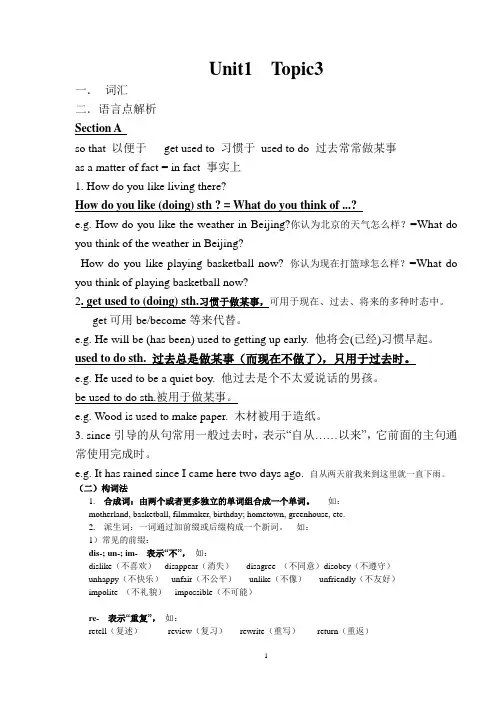
Unit1 Topic3一.词汇二.语言点解析Section Aso that 以便于get used to 习惯于used to do 过去常常做某事as a matter of fact = in fact 事实上1. How do you like living there?How do you like (doing) sth ? = What do you think of ...?e.g. How do you like the weather in Beijing?你认为北京的天气怎么样?=What do you think of the weather in Beijing?How do you like playing basketball now? 你认为现在打篮球怎么样?=What do you think of playing basketball now?2. get used to (doing) sth.习惯于做某事,可用于现在、过去、将来的多种时态中。
get可用be/become等来代替。
e.g. He will be (has been) used to getting up early. 他将会(已经)习惯早起。
used to do sth. 过去总是做某事(而现在不做了),只用于过去时。
e.g. He used to be a quiet boy. 他过去是个不太爱说话的男孩。
be used to do sth.被用于做某事。
e.g. Wood is used to make paper. 木材被用于造纸。
3. since引导的从句常用一般过去时,表示“自从……以来”,它前面的主句通常使用完成时。
e.g. It has rained since I came here two days ago. 自从两天前我来到这里就一直下雨。
(二)构词法1.合成词:由两个或者更多独立的单词组合成一个单词。