八年级英语译林版下册Unit3_Welcome_to_the_unit_优质课教案(江苏省)
- 格式:docx
- 大小:15.88 KB
- 文档页数:3
1 / 3
Unit3 Welcome to the unit 优质课教案(江苏省)
8B Unit 3 Comic strip welcome to the unit (for teachers)
Teaching objects:
1. Knowledge objects:
To learn the new words and phrases in this lesson.
2. Ability objects
(1) To train the students' ability of working in pairs or groups.
(2) To develop the students' abilities of communication by using the new words and
phrases.
3. Moral objects
(1) Through different competitions to make students be interested in study.
(2) Encourage boys and girls to be more creative in the debate.
(3) Don’t spend too much time on computer games. Don’t go through harmful websites.
Don't tell your personal information to strangers online.
Teaching Keys and Difficult Points
1. Key points
(1). Be able to express different parts of a computer and a television in English.
(2). Be able to talk about the advantages and disadvantages of computers (Internet).
2. Difficult points
Improve students' abilities of communication by using the new words and phrases How
to encourage them to be creative and active in the debate.
The Teaching methods
Communicative teaching method, Audio-visual teaching method, Task-based teaching
method, Classified teaching method.
Teaching Aids:
Multi-media PPT, exercise paper
Teaching procedures
Part one: Warm up.
Watch a video about the beautiful view in the USA, and play a guessing game. 2 / 3
T: I like travelling, but I don’t have enough money, what can I do? What should I buy?
The answer is in the riddle.
Part two: Welcome to the unit.
1. Compare a computer with a television talk about the pictures, learn some new words
about computers and televisions.
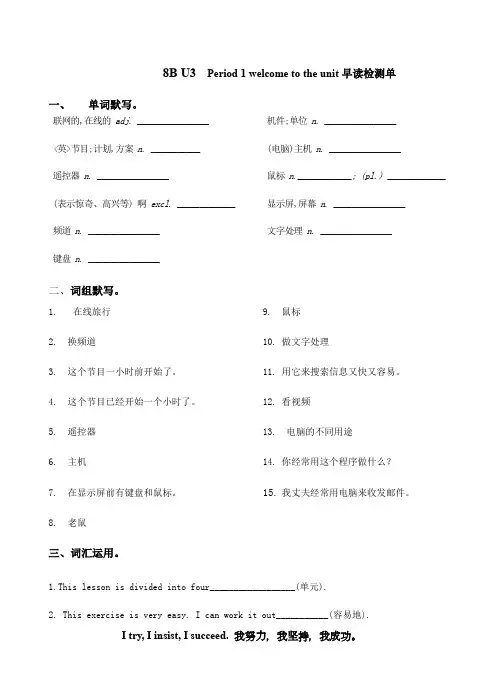
2. Read these new words and have a memory test, finish Part A.
3. Free talk, learn new sentence structures, and go on having the memory test.
A: What do you use your computer for?
B: I use my computer for doing/to do sth.
4. Part B
(1) Listen and answer
What does Simon usually use the computer for?
How often does he use it?
(2) Work in pairs and have an interview with your partner.
A: What do you usually use your computer for?
B: I usually use it to
A: why?
B: Because...
A: How often do you use your computer for this?
B: ...
Part three: Comic strip
1. We have learned many things about computers and televisions. Maybe all of you
know them very well, how about our friends-Eddie and Hobe? Do you know a lot about
computers televisions?
Listen and answer:
(1) Do Eddie and Hobo know much about computers?
(2) What do they think the computer look like?
2. Read and learn useful phrases
3. Practise reading and fill in the blanks. 3 / 3
Eddie and Hobo do not know what the computer is. Hobo thinks it _________a
televison. Eddie thinks the mouse is the_____________. They want to use the mouse
to ___________________, because they think that is boring.
Part four: Have a class activity (a debate between boys and girls)
T: The development of Internet have brought us many changes. But everything has two
sides. Today, let's have a debate. Let's think carefully, "Is the computer useful or
harmful?”
1. Work in groups. Collect useful information first.
2. Show their opinions.
Part five: A summary Teacher's suggestions
1. Don’t spend too much time on computer games.
2. Don't go through harmful websites.
3. Don’t tell your personal information to strangers online.
Part six: Have a class test
1. Fill in the blanks.
2. Translation.
Part seven: Homework
1. Recite the dialogue of part B.
2. Make a similar dialogue as Part B.
3. Make a poster to talk about the advantages and disadvantages of computers.
Part eight: Reflection of teaching after this lesson
......