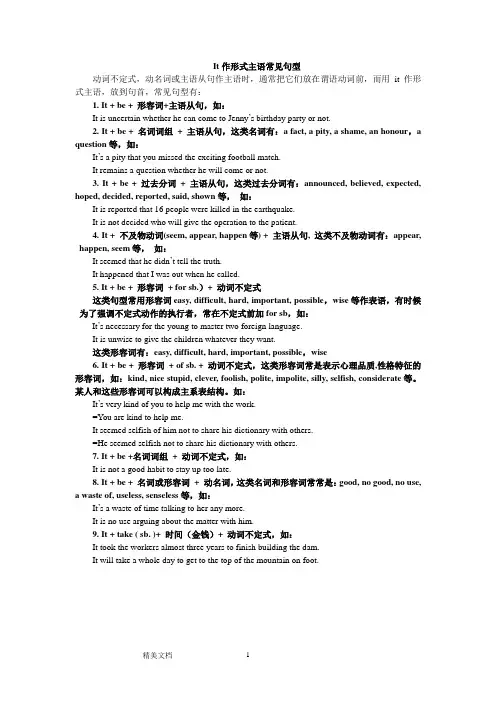
it做形式主语的19个句型
- 格式:doc
- 大小:20.02 KB
- 文档页数:5
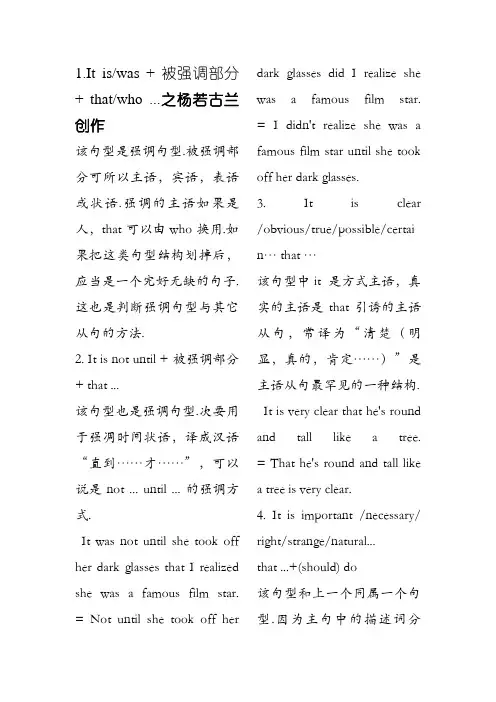
1.It is/was + 被强调部分 +
that/who ...
该句型是强调句型.被强调部分可所以主语,宾语,表语或状语.强调的主语假如是人,that 可以由 who 换用.假如把这种句型构造划失落后,应当是一个完全无缺的句子.这也是断定强调句型与其它从句的办法.
2. It is not until + 被强调部分 + that ...
该句型也是强调句型.重要用于强凋时光状语,译成汉语“直到……才……”,可以说是
not ... until ... 的强调情势.
It was not until she took
off her dark glasses that I
realized she was a famous
film star.= Not until she
took off her dark glasses did I realize she was a
famous film star.= I didn't
realize she was a famous
film star until she took
off her dark glasses.
3. It is clear
/obvious/true/possible/certain… that …
该句型中it 是情势主语,真正的主语是 that 引诱的主语从句,常译为“清晰(显然,真的,确定……)”是主语从句最罕有的一种构造.
It is very clear that
he's round and tall like a
tree. = That he's round
and tall like a tree is
very clear.
4. It is important
/necessary/
right/strange/natural...
that ...+(should) do 该句型和上一个同属一个句型.因为主句中的形容词不合,that
后的从句中要用虚拟语气(should + 动词本相),should 可以省去.
5. It is said (reported,
learned…) that …
该句型中的it 仍是情势主语,真正主语是 that 引诱的主语从句.该构造常译为“ 据说(据报导,据悉……)”.
6. It is suggested
( ordered, required ... )
that ... +(should) do
该句型和上一个同属一个句型.主句中的曩昔分词是暗示要求,建议,敕令等词时,that 后的从句要用虚拟语气(should + 动词本相),should 可以省.常译为“ 据建议;有敕令……)”.
7. It is a pity ( a
shame ... ) that ... 该句型中,that 后的从句一般用虚拟语气(should + 动词本相),should 可省去.暗示出乎料想,常译为“竟然”.没有这种意义时,则不必虚拟语气.
It is a pity that such a
thing ( should ) happen in
your class.这种事竟然产生在你们班上,真是圆满! It
is a pity that he is ill.
他生病了,真圆满!
8. It is time ( about
time , high time ) that ...
该句型中that 后的从句应当用虚拟语气,值得留意的是①
经常应用曩昔时态暗示虚拟.② 有时也用should + 动词本相,should 不克不及省.常译为“是(恰是)……的时侯……”.
9. It is the first
( second … ) time that … 该句型要和上一个句型差别开来.该句型中的 that 从句不必虚拟语气,而用完成时态.至于用什么完成时态,由主句的谓语动词的时态决议.假如是一般如今时,后面从句用如今完成时态;假如是一般曩昔时,后面从句则用曩昔完成时态.该构造中
that 可以省去;it 有时用
this 调换,常译为“是第一(二)……次……”.
It is the first time I
have been here. = This is
the first time I have been
here.
10. It is … since ...
该句型重要用作处理刹时动词的完成时,又要和暗示一段时光的时光状语连用的问题.主句中是时光作表语,当时态是如今时或完成时,since 引诱的从句平日是一般曩昔时态,并且是刹时动词.假如主句是一般曩昔时,从句则用曩昔完成时.
11. It is ... when ...
该句型中的 when 引诱的是一个时光状语从句,主句中的
it 指时光,表语由具体的时光充当.常译为“当……的时刻,是……”.
12. It be ... before ...
该句型主句中的 it 指时光, 主句中的时态常是未来一般时或曩昔时两种时态.主句中的表语多是long, not
long , 3 days , 2 weeks 等暗示时光段的词或短语.常译为“……之后……”.
13. It happens (seems,
looks, appears ) that...
该句型中it是情势主语,that
引诱的是主语从句,主句中的happen, seem 等词是不及物动词. It happened ( so
happened ) that he met his
teacher in the street. 恰巧…… It seems that he
will be back in a few days.
看来……
14. It takes sb. … to do
sth.
该句型中的不定式是真正的主语,it是情势主语,句型中的直接宾语是时光.常译为“做……要消费或人……”.
15. It is no good (use )
doing sth.
该句型中的真正主语是动名词短语,主句中的表语可所以no good , ( not any good ) ,
no use , ( not any use ).
16. It doesn't matter
whether ( if ) ...
该句型中whether (if) 引诱的从句是真正主语,该句型常译为“不管(是否)…… 没紧要…….
17. It is kind ( of sb. )
to do sth.
该句型中的不定式短语是真正主语,假如不定式的逻辑主语是由 of 引起,主句中的形容词必须是能暗示逻辑主语特点的形容词.罕有的有: bad,
brave, careless, clever,
cruel, foolish, good (恶意的), honest, horrible, kind,
lazy, modest, naughty, nice
(有教化的), polite, rude,
silly, stupid, wise, wrong
(错误的)等. 这个句型可以改写为:sb. is kind to do sth.
It is kind of you to say
so. = You are kind to say
so.
18. It is necessary ( for
sb. ) to do sth. 该句型与上一个同属一个句型.假如不定式的逻辑主语是由for 引起,主句中的形容词平日是暗示重要性,紧急性,频仍程度,难易,安然等情形的形容词.罕有的形容词有:
① important, necessary,
natural
② easy, safe, common,
normal, hard, difficult,
dangerous, unusual, rare,
impossible, pleasant 等.
在①中的形容词作表语可以用从句改写,如:
It is important for her
to come to the party.
= It is important that
she (should ) come to the
party
19. It looks ( seems ) as
if ...
该句型中it 无意义. as if 引诱一个状语从句.常译为,“看起来仿佛…… "假如与事实不相相符,则用虚拟语气.