
unit4
- 格式:ppt
- 大小:4.60 MB
- 文档页数:44

Unit 4 教材全解析(1)
When HAMLET meets PEKING OPERA
1I thought I knew a lot about Hamlet. As a high school student with English literature as one
of my main subjects, I have to【1】! Shakespeare's Hamlet is probably the most important play①
by the most important writer in English. Almost everybody knows “To be, or not to be”【2】, right?
Having seen quite a few productions② of Hamlet and read the play many times, I was full of
confidence③-until the Peking Opera came to town 【3】!
【1】本句中with English literature...subjects为with复合结构,作后置定语修饰前面的student, English literature 作宾语,介词短语as...subjects作宾补;后面I have to是I have to
know a lot about Hamlet的省略。
【2】To be, or not to be全句是“To be, or not to be-that is the question.”这是《哈姆雷特》中丹麦王子的经典独白。王子面对父亲的猝然离世、母亲的改嫁及叔父的篡位,内心充满矛盾、犹豫和痛苦,于是说出了这么一句话。该句意为:“生存还是毁灭?那是个问题。”因为其简单易记,读来朗朗上口,有诗的韵律和节奏,所以为普通民众所传诵。
英语读写教程-Unit-4-词汇详解
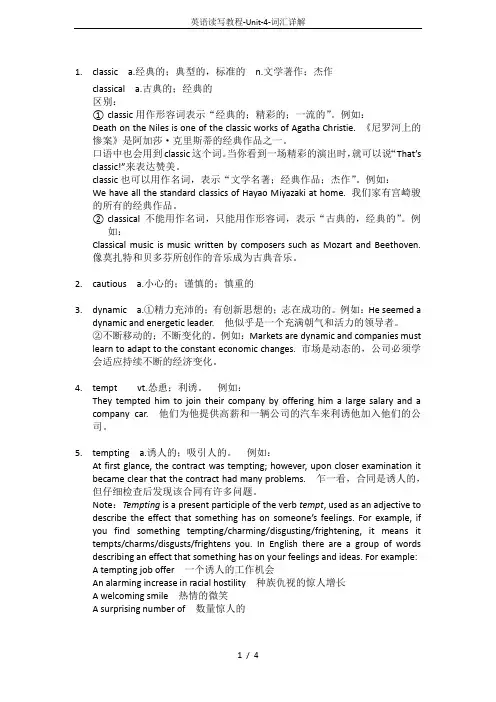
1 / 4 1. classic a.经典的;典型的,标准的 n.文学著作;杰作
classical a.古典的;经典的
区别:
① classic用作形容词表示“经典的;精彩的;一流的”。例如:
Death on the Niles is one of the classic works of Agatha Christie. 《尼罗河上的惨案》是阿加莎·克里斯蒂的经典作品之一。
口语中也会用到classic这个词。当你看到一场精彩的演出时,就可以说“That’s
classic!”来表达赞美。
classic也可以用作名词,表示“文学名著;经典作品;杰作”。例如:
We have all the standard classics of Hayao Miyazaki at home. 我们家有宫崎骏的所有的经典作品。
② classical不能用作名词,只能用作形容词,表示“古典的,经典的”。例如:
Classical music is music written by composers such as Mozart and Beethoven.
像莫扎特和贝多芬所创作的音乐成为古典音乐。
2. cautious a.小心的;谨慎的;慎重的
3. dynamic a.①精力充沛的;有创新思想的;志在成功的。例如:He seemed a
dynamic and energetic leader. 他似乎是一个充满朝气和活力的领导者。
②不断移动的;不断变化的。例如:Markets are dynamic and companies must
learn to adapt to the constant economic changes. 市场是动态的,公司必须学会适应持续不断的经济变化。
4. tempt vt.怂恿;利诱。 例如:
UNIT4
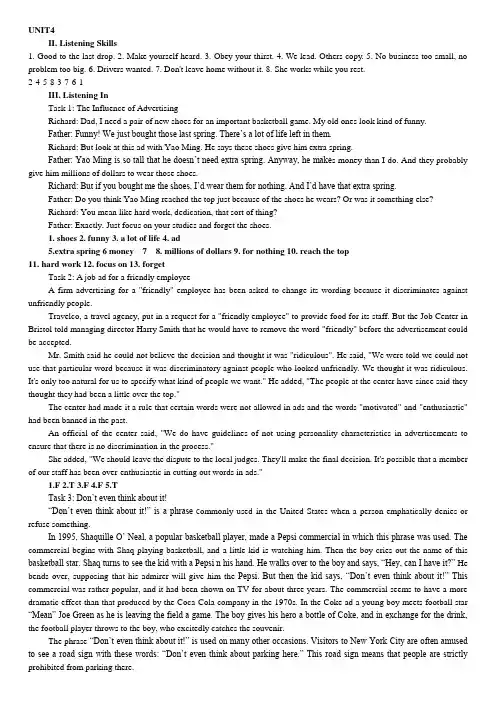
II. Listening Skills
1. Good to the last drop. 2. Make yourself heard. 3. Obey your thirst. 4. We lead. Others copy. 5. No business too small, no
problem too big. 6. Drivers wanted. 7. Don't leave home without it. 8. She works while you rest.
2-4-5-8-3-7-6-1
III. Listening In
Task 1: The Influence of Advertising
Richard: Dad, I need a pair of new shoes for an important basketball game. My old ones look kind of funny.
Father: Funny! We just bought those last spring. There’s a lot of life left in them.
Richard: But look at this ad with Yao Ming. He says these shoes give him extra spring.
Father: Yao Ming is so tall that he doesn’t need extra spring. Anyway, he makes money than I do. And they probably
give him millions of dollars to wear those shoes.
Richard: But if you bought me the shoes, I’d wear them for nothing. And I’d have that extra spring.

高中英语必修4Unit4解析
小编今天整理了关于高中英语必修4Unit4的解析,高中的同学可以看一看,有需要的可以收藏起来参考一下
解答句子
1.There are many different ways to greet someone using
words.(P25)
难句解读
用言语问候某人有许多不同的方法。
句中的不定式表目的,using words作方式状语。greet意为“问候,迎接,向……打招呼”,它的名词形式是greeting,意为“问候,招呼”,其复数形式greetings可表示“贺词,问候语”。
例如:
Bill greeted us with a cheerful grin.
比尔笑盈盈地向我们打招呼。
I said good morning to Ann, but it seemed that she didn’t
hear my greeting.
我向安道早安,但她似乎并没有听到我的问候。
birthday greetings
生日贺词
2.Yesterday, another student and I, representing our
university’s student association, went to the Capital
International Airport to meet this year’s international
students.(P26)
难句解读
昨天,我和另一个同学代表我们大学的学生会去首都国际机场迎接今年的国际学生。
representing…association作定语,修饰主语another student
and I,相当于一个非限制性定语从句,represent在此意为“代表”,它还可意为“象征,描述,作为……的官方或授权代表或代理”。 例如:
The rose represents England.
玫瑰花是英格兰的象征。