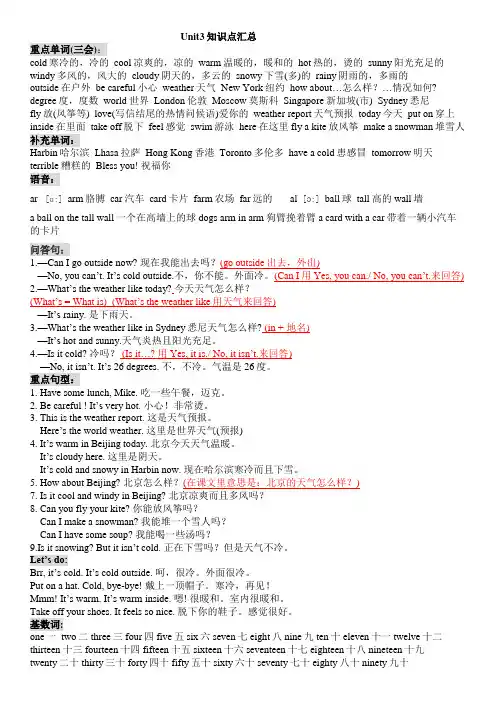
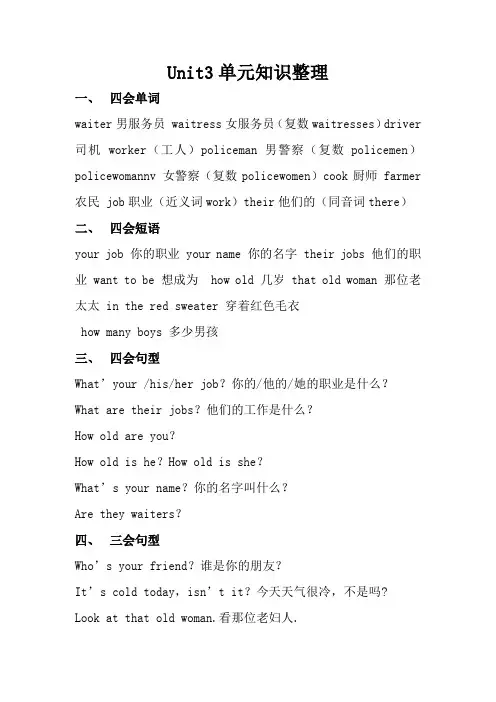
四年级下册英语译林版第三单元单词全文共3篇示例,供读者参考篇1Unit 3 Vocabulary - A Student's PerspectiveWow, Unit 3 was packed with some really cool new words! I enjoyed learning them through the stories, games, and activities in class. Let me take you through some of the highlights.One of the first words we learned was "mitten." I remember our teacher showing us a silly picture of a puppy wearing oversized mittens. We all giggled at how silly it looked! Mittens are those thick woolly handcovers we wear in winter to keep our hands warm. I have a favorite pair of red mittens that my grandma knitted for me.Then there was "sled." We read a story about some kids going sledding on a snowy hill. Sledding is basically sitting on a little vehicle and riding down a slope covered in snow or ice. It's super fun but you have to be careful not to crash! Some of the other winter words were "icy," "freezing," and "frosty." I sure am glad we don't have that freezing weather all year round!We learned some really useful verbs like "deliver," "protect," "connect," and "collect." The mail carrier delivers letters and packages to our house. A firefighter's job is to protect people from fires. The internet connects millions of computers around the world. My little sister likes to collect stickers, rocks, and just about anything!Two of my favorite new words are "massive" and "marathon." Massive means extremely large in size or amount. For example, the dinosaurs were massive creatures. A marathon is a very long foot race - I can't even imagine running that far! The longest I've ever run is maybe a mile.Some other cool adjectives we picked up are "artificial," "previous," "curious," and "internal." Artificial meanshuman-made rather than natural, like artificial flavors or artificial flowers. Previous refers to the one before, like my previous birthday. If you're curious, it means you want to learn more about something. And internal relates to the inside, like your internal organs.I had fun practicing the words "wriggle," "shiver," "nestle," and "lurk." A worm wriggles to move across the ground. When you're really cold, you shiver and shake. A cat might nestle up ina cozy spot to take a nap. And a spider lurks in the corner waiting for its next meal - kind of creepy if you ask me!One sentence I'll never forget is: "The artistic sculptor carved the marble statue with diligence." A sculptor is someone who makes sculptures out of materials like marble or clay. To carve means to cut or shape something. And if you do something with diligence, you do it in a careful, hard-working way.By the end of the unit, I felt like I had collected a whole basket of new vocabulary words to use in my English journey. I'm looking forward to the next set of words in Unit 4! Learning new words is not only fun, but gives me tools to express myself better.I wonder what crazy pictures and stories our teacher has up her sleeve next time? One thing's for sure - it won't be a "frosty" or "icy" situation!篇2Unit 3 Vocabulary WordsHey friends! We just started a new unit in our Yilin English textbook, and boy are there a lot of new vocabulary words to learn. I always get a little overwhelmed at first, but then I remember that repetition is key. If I just keep reviewing and using the words, they'll stick in my brain eventually.The theme for this unit is "Going Green" which is all about protecting the environment. The first word we learned was "environment" itself. It refers to the surroundings or conditions that you live in. Things like the air, water, land, plants, and animals around you make up your environment. Keeping our environment clean and healthy is really important.Next up was "pollute" which means to make air, water or land dirty and unsafe. Factories pollute by releasing harmful gases and chemicals. Cars and buses pollute too when they burn gasoline or diesel fuel. We have to be careful not to pollute or else it could damage our environment."Conserve" is the opposite of pollute – it means to protect natural resources from being wasted. We can conserve water by taking shorter showers and turning off faucets tightly. Conserving electricity by turning off lights helps too. I try to conserve paper by using both sides of the sheet whenever I can."Renewable" is a cool word that describes a natural resource that can be replenished and will never run out, like solar and wind power. Non-renewable resources like coal, oil and natural gas will someday get used up though, so we have to use them wisely."Solar energy" is the energy that comes from the sun's rays. It's a really useful renewable energy source that can generate electricity through solar panels. My dad just installed some on our roof to help reduce our electricity bill and carbon footprint."Carbon footprint" refers to the amount of carbon dioxide and other greenhouse gases that human activities produce. Burning fossil fuels for factories, transportation, and electricity increases our carbon footprint which contributes to climate change and global warming. We all need to find ways to reduce our carbon footprints.Another word we learned is "recycle" which means to put used materials through a process so they can be turned into new products. Things like paper, plastic, glass and metal can often be recycled instead of just throwing them in the trash. Our class has special recycling bins that we use every day."Decompose" is what happens to natural materials like leaves, food scraps, and paper when they slowly break down into basic components. My mom has a composter in our backyard where fruit and vegetable peels can decompose and turn into fertile soil for our garden."Sustainable" describes something that can continue or be maintained at a certain level for a long time without causingdamage. A sustainable lifestyle tries to reduce consumption and waste while protecting the environment. I'm learning about ways I can live more sustainably."Deforestation" is the clearing or removal of forests and trees from an area. It's a huge environmental problem because trees absorb carbon dioxide and produce oxygen. When we cut them down, it harms air quality and increases greenhouse gas levels. I hate seeing forests destroyed for new buildings and developments.The last vocabulary word is "landfill" which is an area of land where trash and garbage gets buried and left to decompose. I can't even imagine how big some of these landfills must be with all the waste our society produces. It really makes me motivated to reduce, reuse, and recycle as much as I possibly can.Well, those are the key words from this unit on taking care of the environment. It's a lot to remember, but I know if I keep studying and practicing them every night, eventually they'll all stick. I may not be able to change the world single-handedly, but at least I can do my small part to "go green" and live a more eco-friendly lifestyle. That's my goal moving forward!篇3Unit 3 Vocabulary - A Student's PerspectiveHey there! I'm here to share my thoughts on the vocabulary we learned in Unit 3 of our 4th-grade English textbook. As a student, mastering these words was both a challenge and an opportunity for growth.Let's start with the topic of "Clothes." We learned words like "shirt," "pants," "dress," and "shoes." At first glance, these may seem like simple words, but understanding their usage and pronunciation was crucial. For instance, the word "pants" was a bit tricky for me initially since in my native language, we use a different term. But through practice and repetition, I eventually got the hang of it.Moving on, we delved into the world of "Colors." Words like "red," "blue," "green," and "yellow" became part of our vocabulary arsenal. Remembering their spellings and associating them with real-life objects helped reinforce our understanding. I still vividly remember the game we played in class where we had to identify objects by their colors – it was both fun and educational!Next up, we tackled the realm of "Food and Drinks." Words like "apple," "banana," "milk," and "water" were introduced. As a food lover, this unit was particularly exciting for me. Learning thenames of different fruits and beverages opened up a whole new world of culinary exploration. I remember practicing these words by creating my own imaginary grocery list – a deliciously memorable experience!Then came the "Family" unit, where we learned terms like "father," "mother," "brother," and "sister." Understanding the relationships within a family unit was essential for effective communication. I found it fascinating to learn how different cultures might have variations in family terminology, yet the underlying concepts remained universal.The "Numbers" unit was a true test of our memory skills. Memorizing the English words for numbers from "one" to "twenty" was no easy feat. However, through engaging activities like counting games and number-based songs, we gradually mastered this crucial aspect of the language.Let's not forget the "Animals" unit, where we encountered words like "dog," "cat," "bird," and "fish." Learning animal names was not only practical but also a lot of fun. I remember drawing pictures of different animals and labeling them with their English names – a creative way to reinforce our learning.Lastly, we explored the "Body Parts" unit, with words such as "head," "hands," "feet," and "eyes." Understanding these wordswas crucial for describing ourselves and others. I recall a hilarious game we played where we had to follow instructions like "touch your nose" or "point to your ears" – a laughter-filled way to cement our knowledge.Throughout this unit, we not only learned new vocabulary but also gained valuable insights into the English language and its cultural nuances. Each word carried a story, a connection to the world around us, and a bridge to better communication.Looking back, I realize that mastering these simple yet essential words was the foundation upon which our English language journey was built. It wasn't always easy, but with determination, practice, and a bit of creativity, we overcame the challenges and emerged victorious.As we move forward, I'm excited to explore more complex vocabulary and delve deeper into the intricacies of the English language. But for now, I'll cherish the memories of learning these basic yet crucial words – the building blocks that have empowered me to communicate in a whole new way.。