
by+doing练习
- 格式:doc
- 大小:20.00 KB
- 文档页数:1

高考英语语法词汇专项突破:01重点语法易错易混点(被动语态、by+Ving和情态动词)被动语态、by+Ving和情态动词的用法,现将它们的易错易混点总结如下:【误用1】Our house is being knocking down to make way for a new road.【指正】knocking改为knocked。
现在进行时的被动语态构成是:is/are being done,表示谓语动词动作正在被进行,句子主语与谓语动词之间是动宾关系。
【运用】A meeting on education is being held in Shanghai.【误用2】When the ship sank we had to save ourselves with swimming.【指正】with改为byby doing是“介词by+动名词”形式,表示方式或者手段,在句子中作方式状语。
【运用】He lightened his bag by taking out some books.【误用3】—Can’t you stay a little longer?—It’s getting late. I really may go now. My daughter is home alone.【指正】may改为must或have to。
情态动词may在确定句中表示“可以”,即说话人同意或者许可。
依据“天晚了”和“女儿一个人在家”看出说话人要走,可以理解为认为必需走了,用must,或者由于前后句子提出的事实状况,认为客观状况使得不得不走,用have to。
【运用】She must think rapidly, make a plan, make some use of her knowledge.【误用4】— I’ve prepared all kinds of food for the picnic.—Do you mean we shan’t bring anything with us?【指正】shan’t改为needn't。

巩固练01动词+by doing一、单选题1.---Dad,must we wait until the light becomes green?---Yes,I’m afraid we.That’s the traffic rule.A.can B.may C.have to D.need【答案】C【解析】句意:---爸爸,我们必须等到绿灯亮了吗?---是的,恐怕我们必须这样做。
这是交通规则。
must的含义是必须一定,其否定形式mustn’t表示禁止的含义。
故must的否定回答一般借助于needn’和don’t have to来构成,故答案为C。
2.Most young people find exciting to watch a football match.A.it B.this C.that D.one【答案】A【解析】句意:大多数年轻人觉得看足球比赛很刺激。
A.it它;B.this这个;C.that那个;D.one一个;“find it+adj.+to do sth.”为固定结构,意为“发现做某事是……的”。
这里的it为形式宾语,真正的宾语是后面的动词不定式短语,其他选项无此用法。
根据题意,故选A。
3.---How are you getting on with your cousin?----Very well.He is really and joins in all kinds of activities in his spare time.A.polite B.strict C.active D.careful【答案】C【解析】句意:——你和你的表弟相处得怎么样?——非常好。
他非常活跃,在业余时间参加各种各样的活动。
考查形容词辨析题。
A.polite有礼貌的;B.strict严格的,与with连用;C.active有活力的;D.careful细心的。
根据下文joins in all kinds of activities in his spare time,可知active符合句意,故选C。
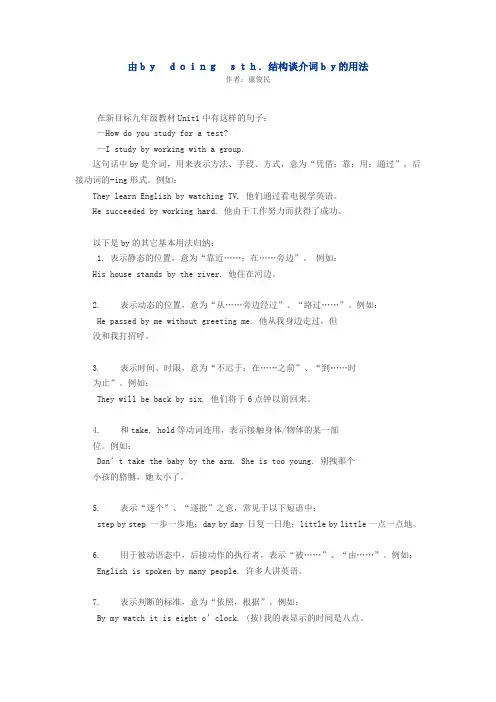
由bydoingsth.结构谈介词by的用法作者:康俊民在新目标九年级教材Unit1中有这样的句子:—How do you study for a test?—I study by working with a group.这句话中by是介词,用来表示方法、手段、方式,意为“凭借;靠;用;通过”,后接动词的-ing形式。
例如:They learn English by watching TV. 他们通过看电视学英语。
He succeeded by working hard. 他由于工作努力而获得了成功。
以下是by的其它基本用法归纳:1. 表示静态的位置,意为“靠近……;在……旁边”。
例如:His house stands by the river. 他住在河边。
2.表示动态的位置,意为“从……旁边经过”、“路过……”。
例如:He passed by me without greeting me. 他从我身边走过,但没和我打招呼。
3.表示时间、时限,意为“不迟于;在……之前”、“到……时为止”。
例如:They will be back by six. 他们将于6点钟以前回来。
4.和take, hold等动词连用,表示接触身体/物体的某一部位。
例如:Don’t take the baby by the arm. She is too young. 别拽那个小孩的胳膊,她太小了。
5.表示“逐个”、“逐批”之意,常见于以下短语中:step by step 一步一步地;day by day 日复一日地;little by little一点一点地。
6.用于被动语态中,后接动作的执行者,表示“被……”、“由……”。
例如:English is spoken by many people. 许多人讲英语。
7.表示判断的标准,意为“依照,根据”。
例如:By my watch it is eight o’clock. (按)我的表显示的时间是八点。

一、选择题1.I improve my writing by ________ an English diary every day.A.write B.wrote C.to write D.writing D解析:D【解析】【详解】句意:我通过每天写英语日记来提高我的写作。
A. write写,动词原形;B. wrote写,一般过去时;C. to write写,不定式;D. writing写,动名词。
本句中为介词by加doing形式,故选D。
2.—What about_______ a rest? —OK!Let’s go for a walk.A.to have B.hadC.have D.having D解析:D【解析】试题分析:句意:休息一会儿怎样?好!我们去散散步吧。
所填动词跟在介词之后该用动名词,所以选D。
考点:考查非谓语动词。
3.---Dad, ________ should I water the flowers in the garden when you are not at home? ---once a day.A.How Many B.how long C.how often D.how soon C解析:C【详解】句意:——爸爸,当你不在家的时候,我应该多久浇一次花园里的花?——一天一次。
A. How Many提问可数名词的复数,表示多少;B. how long多久,提问for+一段时间;C. how often提问频度;D. how soon提问多久,对in+一段时间提问。
根据题意,故选C。
【点睛】how long, how often, how soon三者都可以译成“多久”。
how long用来提问“多长时间”,对“一段时间的长短”提问时用,与延续性动词连用;how often用来提问某动作或状态发生的频率,对“一段时间内发生了几次活动”(always,usually, often, never或twice a day等表示频度的词或短语)提问时用;how soon用来提问某人要“多快”能做好某事,或某事要“多快”能完成,对“过多少时间(就能……)”(in短语)提问时用,常用于将来时。