不定代词用法
- 格式:doc
- 大小:45.51 KB
- 文档页数:10
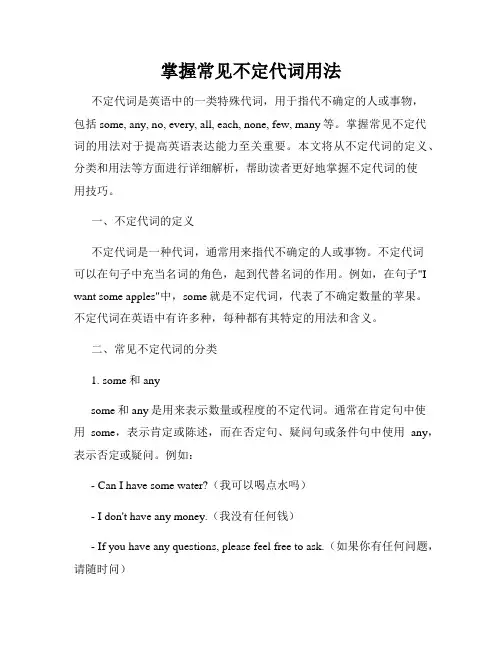
不定代词的定义常用不定代词有:some(something,somebody,someone),any(anything,anybody,anyone), no(nothing,nobody,no one),every(everything,everybody),all,each,both,much,many,(a)little,(a)few,other(s),another,none,one,either, neither等。
一般来讲,修饰不定代词的词要置于其后。
1.作主语Both of them are teachers.他们两人都是教师。
2.作宾语I know nothing about this person.我对这个人一无所知。
3.作表语This book is too difficult for a child.这本书对一个小孩来说太难了。
4.作定语There is a little water in the glass.玻璃杯里有一些水。
5.作状语I can't find my book anywhere.我在任何地方都不能找到我的书。
修饰不定代词的词,一般情况下要后置.一般不定代词用法例子1.some 一些,某些,某个不定代词some可以代替名词和形容词,常用在肯定句中作主语、宾语、定语等。
作定语时,它可以修饰可数名词(单、复数皆可)和不可数名词。
例如:some are doctors,some are nurses.有些人是医生,有些人是护士。
(作主语)2.any一些,任何不定代词any可以代替名词和形容词,常用在否定句或疑问句中作主语、宾语、定语等。
作定语时,它可以修饰可数名词(多为复数)和不可数名词。
例如:there isn’t any ink in my pen.我的钢笔没有墨水。
(作定语)不定代词any有时也可以用在肯定句中,表示"任何的"。
例如:you may come at any time;i’ll be home the whole day.你任何时候来都行,我整天都将呆在家里。
不定代词any也可以用作副词,做状语,表示程度。
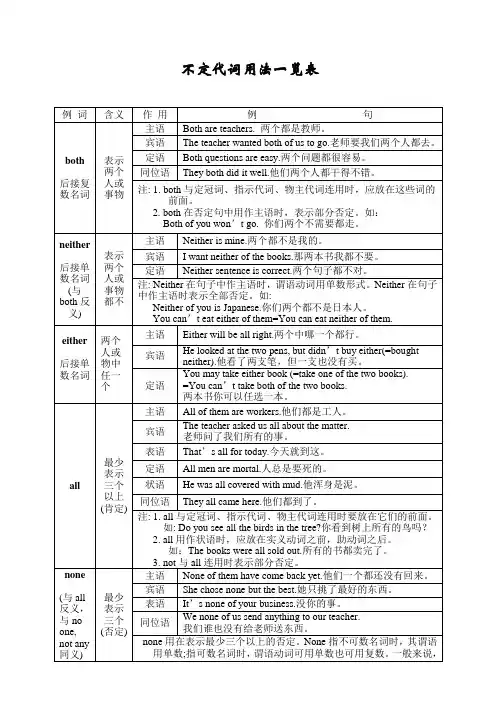
例如:is he any better today?他今天好一点了吗?3.all 全体,所有(指三者以上)不定代词all它可以代表或修饰可数名词和不可数名词。
代表或修饰可数名词时,指两个以上的人或物。
that。
例如:all were present at the meeting.全都到会了。
(作主语,代表可数名词)4.both 全部,都不定代词both指两个人或事物。
和all一样,可以用作主语、宾语、定语或同位语。
例如:we invited both to come to our farm.我们邀请两个人都来我们的农场?(作宾语)5.none 无人或无不定代词none的含义和all物相反,和no one,not any同义,但其用法相当于名词,在用单数形式;代替可数名词作主语时,谓语动词用单、复数皆可。
例如:none of the problems is /are easy to solve.这些问题没有一个是容易解决的。
(作主语,代替可数名词)6.either 两者之中的任何一个,这个或那个。
不定代词 either 可以作主语、宾语和定语。
例如:either of them will agree to this arrangent.他们两人中会有人同意这样的安排的。
(作主语)7.neither 两个之中一个也不是不定代词 neither 是either 的否定形式,可以作主语、宾语和定语。
例如:neither is interesting.两个都没有趣。
(作主语)8.each 每个,各自的不定代词each指每一个人或事物的个别情况,甚至指这些个别情况各不相同。
它在句中可以作主语、宾语、定语和同位语。
例如:she gave the children two apples each.她给了每个小孩两个苹果。
(作the children的同位语。
)9.every 每个,每一的,一切的不定代词every有"全体"的意思,和all的意义相近,但只能作定语。
复合不定代词使用例子1. some, any, every, no都能和one, body, thing一起构成代词,这些代词叫复合不定代词。
它们基本含义为:指人somebody someone 某人anybody anyone 任何人 everybody everyone每人 nobody no one 没人指物 Something某物某事 anything任何事物everything一切 nothing没东西 2. 一般情况下,some构成的复合不定代词,其作用和some相同,用于肯定句;any构成的复合不定代词用于否定句或疑问句;no构成的复合不定代词表示否定含义,用于否定句。
如:① I have something to tell you. 我有事要告诉你。
② He didn’t say anything at the meeting yesterday. 昨天在会上他没发言。
③ Everybody likes swimming. 每个人都喜欢游泳。
④ There is nothing wrong with your ears. 你耳朵没毛病。
3. something 可用于提建议或请求的问句中,以及希望说话对方作出肯定回答的问句中。
如:Would you like something to eat? 你要吃点东西吗? 4.复合不定代词在句子中作主语时,谓语动词一般用单数形式。
如:Nobody knows his name. 没有人知道他的名字。
5. 不定代词的定语要后置。
如:Is there anything important in today’s newspaper? 今天的报纸上有什么重要新闻吗?一般的,不定代词(包括复合不定代词)在句子中,通常用单三形式 1.不定式是英语动词的一种形式。
它在许多情况下可省略"to",它不同于汉语动词,汉语动词只有一种形式。
如:我看书。
她看书。
但英语要说“看”必须根据主语的人称,动作发生的时间等确定其形式。
如:1)I read a book. 2)She reads a book.1)句中的“read”是一般现在时第一人称的动词定式。
2)句中的“reads”是一般现在时第三人称单数的动词定式。
I want to read a book./She wants to read a book. 我想要看书。
她想要看书。
其中的“看”不易确定其形式。
因为动作还未发生,因此称不定式。
通俗的说,就是“不一定是什么形式” 2.不定代词是不指明代替任何特定名词或形容词的代词,英语中不定代词有:some(something,somebody,someone),any(anything,anybody,anyone), no(nothing,nobody,no one), every(everything,everybody,everyone),all,each,both,much,many,(a)little,(a)few,other(s),another,none,one,either, neither等。
1) 陈述部分的主语是I,疑问部分要用 aren't I.I'm as tall as your sister,aren't I? 2) 陈述部分的谓语是wish,疑问部分要用may +主语。
I wish to have a word with you, may I? 3) 陈述部分用 no, nothing, nobody, never, few, seldom, hardly, rarely, little等否定含义的词时,疑问部分用肯定含义。
The Swede made no answer, did he / she? Some plants never blown (开花), do they ? 4) 含有ought to 的反意疑问句,陈述部分是肯定的,疑问部分用shouldn't / oughtn't +主语。
He ought to know what to do, oughtn't he? / shouldn't he? 5) 陈述部分有have to +v. (had to + v.),疑问部分常用don't +主语(didn't +主语)。
We have to get there at eight tomorrow, don't we? 6) 陈述部分的谓语是used to 时,疑问部分用didn't +主语或usedn't +主语。
He used to take pictures there, didn't he? / usedn't he? 7) 陈述部分有had better + v. 疑问句部分用hadn't you?You'd better read it by yourself, hadn't you? 8) 陈述部分有would rather +v.,疑问部分多用 wouldn't +主语。
He would rather read it ten times than recite it, wouldn't he?9) 陈述部分有You'd like to +v. 疑问部分用wouldn't +主语。
You'd like to go with me, wouldn't you? 10) 陈述部分有must 的疑问句,疑问部分根据实际情况而定。
He must be a doctor, isn't he? You must have studied English for three years, haven't you? / didn't you? He must have finished it yesterday, didn't he? 11) 感叹句中,疑问部分用be +主语。
What colours, aren't they? What a smell, isn't it? 12) 陈述部分由neither…nor, either… or 连接的并列主语时,疑问部分根据其实际逻辑意义而定。