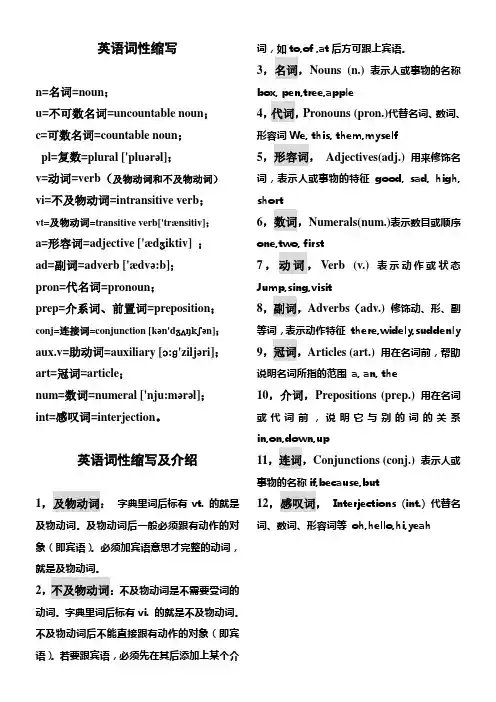
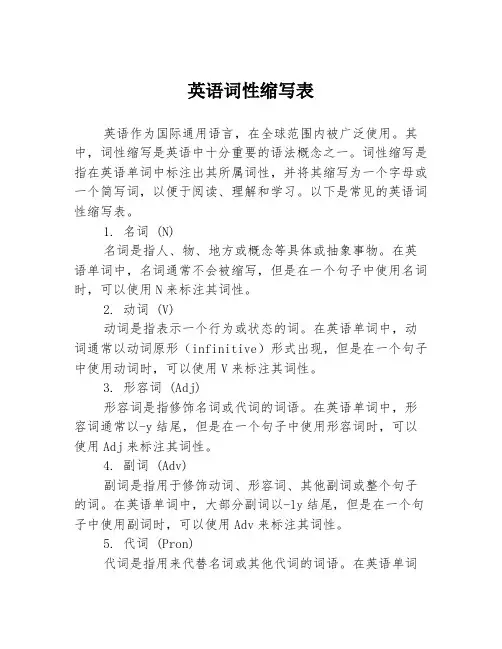
英语词性缩写n=名词=noun;u=不可数名词=uncountable noun;c=可数名词=countable noun;pl=复数=plural ['pluərəl];v=动词=verb(及物动词和不及物动词)vi=不及物动词=intransitive verb;vt=及物动词=transitive verb['trænsitiv];a=形容词=adjective ['ædʒiktiv] ;ad=副词=adverb ['ædvə:b];pron=代名词=pronoun;prep=介系词、前置词=preposition;conj=连接词=conjunction [kən'dʒʌŋkʃən];aux.v=助动词=auxiliary [ɔ:ɡ'ziljəri];art=冠词=article;num=数词=numeral ['nju:mərəl];int=感叹词=interjection。
英语词性缩写及介绍1,及物动词:字典里词后标有vt. 的就是及物动词。
及物动词后一般必须跟有动作的对象(即宾语)。
必须加宾语意思才完整的动词,就是及物动词。
2,不及物动词:不及物动词是不需要受词的动词。
字典里词后标有vi. 的就是不及物动词。
不及物动词后不能直接跟有动作的对象(即宾语)。
若要跟宾语,必须先在其后添加上某个介词,如to,of ,at后方可跟上宾语。
3,名词,Nouns (n.) 表示人或事物的名称box, pen,tree,apple4,代词,Pronouns (pron.)代替名词、数词、形容词We, this, them,myself5,形容词,Adjectives(adj.) 用来修饰名词,表示人或事物的特征 good, sad, high, short6,数词,Numerals(num.)表示数目或顺序one,two, first7,动词,V erb (v.) 表示动作或状态Jump,sing,visit8,副词,Adverbs(adv.) 修饰动、形、副等词,表示动作特征 there,widely,suddenly 9,冠词,Articles (art.) 用在名词前,帮助说明名词所指的范围 a, an, the10,介词,Prepositions (prep.) 用在名词或代词前,说明它与别的词的关系in,on,down,up11,连词,Conjunctions (conj.) 表示人或事物的名称if,because,but12,感叹词,Interjections (int.) 代替名词、数词、形容词等 oh,hello,hi,yeahBasic English Sentence Structures五种基本句型1. 主+谓(不及物动词)Man can think .The fire is burning.不可忽视:常用不及物动词有break, breathe, burn, smoke, swim, skate, appear, disappear, work, think, etc.2. 主+谓+表语(系动词)He became a scientist.She is getting more and more beautiful.不可忽视:常用系动词:be, get, turn, feel, seem, appear, look, taste, sound, smell, become, go, prove, etc.3. 主+谓+宾(及物动词)We love peace.They will paint the door.常用动词有:see, watch, need, love, like, study, answer, carry, etc.4. 主+谓+宾+宾补We elected him president.They painted the door white.I advised the students to recite the texts.王牌重点:常用作宾补的形式:(请将每个例句大声朗读一遍)(1) 名词:The couple named their baby Johnson.(2) 形容词: I keep the door open.(3) 副词: The naughty boy knocked the bottle over.(4) 不定式: He ordered his men to fire.(5) 分词: He heard me singing.I saw the vase broken.(6) 介词短语: They look on him as a teacher.(7) 名词性从句: I asked him what he was doing.5-1. 主+谓+间接宾语+直接宾语My friend bought me a gift.I passed him the book.5-2. 主+谓+直宾+介词+间宾My friend bough a gift for me.I passed the book to him.常与介词for搭配的动词有:buy, make, do, get, play, call, choose, cook, fetch, find, keep, order, save, etc.常与介词搭配的动词有:bring, give, grant, hand, pass, lend, offer, pay, promise, sell, send, show, teach, tell, throw, write, etc.美国老师讲解句型I. 简单句 (Simple sentence) 主语+谓语+宾语I love my Mom.I go to school everyday.II. 复合句 ( Compound Sentence)Beijing is in the North and Nanjing is in the South.(特点: When two independent clauses, or complete sentences are joined together, they form one compoundsentence. 复合句是由两个独立的句子组合在一起构成的.例句中,有下面两个完整并且独立的句子组成: Beijing is in the North.Nanjing is in the South.III. 复杂句 (Complex Sentence)My uncle, who is seventy years old, works on a farm.(特点: When an independent clause and a dependent lause are joined together, they form one complex sentence. 复合句是由一个独立的句子加一个从句构成的.)China is a country that its history is very long.IV. 复杂句+复合句(Compound sentence+ Complex sentence)Studying English is important because a lot of jobs needpeople know English; moreover, learning English helpspeople understand other country’s culture.整体看,这是一个由 moreover 连接的复合句,前后两句都在谈论学英语的重要性, 两个独立完整的句子. 但第一句话中又包含了一个由because 引导的从句. 你知道英语中最常用的句型是什麽句子吗? 复杂句(complex).My American teacher said, “The most common sentence pattern is complex sentence, because language reflects life.’’为什麽不是复合句呢?She said, “How many things are equal in our life?”看来因为生活中复杂的事情要多于并列的同等的事情,所以英语中复杂句多于简单句.。